

Picture this: You’re standing in your office, looking at the team you’ve built, the business you’ve grown from an idea into something real. You’ve mastered the art of managing tasks, hitting deadlines, and keeping the lights on. But lately, something feels different. Your team seems less engaged. Growth has plateaued. The energy that once drove everyone forward has somehow dimmed.
Sound familiar? If you’re nodding your head, you’re not alone. After three decades of working with business owners, I’ve seen this scenario play out countless times. It’s like watching someone try to drive a race car in first gear – they’re moving, but they’re nowhere near their potential.
Here’s what I’ve learned from my years as an Army officer, banker, entrepreneur, and business consultant: there’s an invisible wall that catches most small and medium business owners completely off guard. You can’t see it coming, but when you hit it, you feel it immediately.
This wall shows up when your business outgrows your ability to manage it the way you always have. Think of it like this – when you’re running a corner store, you can know every customer’s name, handle every transaction, and fix every problem yourself. But try to run a multi-location business the same way, and you’ll quickly find yourself buried under an avalanche of details while your team stands around waiting for direction.
During my banking days, I watched this happen over and over. Smart, capable business owners would come to me frustrated because their companies had hit a ceiling they couldn’t break through. They’d built successful operations, but somewhere along the way, they’d become the bottleneck in their own success story.
The problem wasn’t their business acumen – these folks knew their industries inside and out. The issue was simpler and more complex at the same time: they were still managing when what their companies really needed was leadership.
Let me share a story that illustrates this perfectly. My mother was a single parent who started her own business while I was still in school. I watched her work incredibly hard, managing every detail, solving every problem, making every decision. She was the ultimate manager – nothing happened without her direct involvement.
But as her business grew, something interesting happened. The more she tried to manage everything, the more overwhelmed she became. It was like watching someone try to hold water in their bare hands – the harder she squeezed, the more it slipped through her fingers.
The breakthrough came when she realized she needed to shift from being the person who did everything to being the person who empowered others to do great things. Instead of being the flashlight that illuminated one small area at a time, she needed to become the sun that lit up the entire landscape.
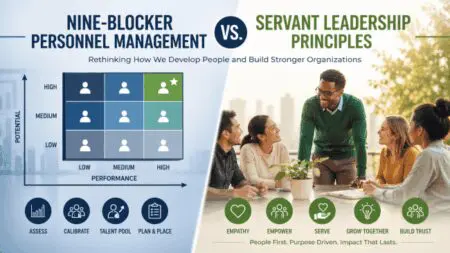
That’s the difference between management and leadership in a nutshell. Management is about controlling the details. Leadership is about inspiring people to achieve something bigger than themselves.
Here’s the thing that trips up most entrepreneurs: the very qualities that made you successful as a startup founder can actually work against you as your business grows. When you’re starting out, being hands-on, detail-oriented, and personally involved in everything is exactly what you need. You’re like a master craftsperson, shaping every aspect of your creation with your own two hands.
But as your business grows, you need to become more like an architect. Instead of laying every brick yourself, you need to create the blueprint and inspire others to build something magnificent.
This transition is tough because it requires you to let go of control in some areas to gain control in others. It’s counterintuitive, like learning to ride a bicycle – you have to stop trying so hard to balance in order to actually find your balance.
Many business owners resist this shift because they’re afraid that if they’re not personally handling everything, the quality will suffer. I get it – your business is your baby, and it’s hard to trust others to care for it the way you do. But here’s what I’ve learned: when you develop real leadership skills, you don’t lose control – you multiply your impact.
My time as an Army officer taught me a fundamental truth about leadership that transformed how I approach business. In the military, you quickly learn that your job isn’t to be the best soldier in your unit – it’s to make every soldier in your unit better.
Think about it this way: if you’re a lieutenant leading a platoon of 30 soldiers, your personal ability to shoot straight or run fast matters far less than your ability to help those 30 people work together effectively. A mediocre leader who can inspire and organize a team will always outperform a brilliant individual who can’t bring out the best in others.
The same principle applies in business. Your job as a business owner isn’t to be the best salesperson, the best problem-solver, or the best at any specific task. Your job is to create an environment where your team can be their best selves and work together toward a common goal.
This doesn’t mean you become less important – it means you become important in a different way. Instead of being the engine that powers the machine, you become the guidance system that points it in the right direction.
After years of studying leadership theory and watching it play out in real businesses, I’ve developed what I call Leadership Powered by Common Sense®. It’s not about complicated frameworks or management fads that change every few years. It’s about timeless principles that work because they’re based on how people actually think and feel.
Here’s the foundation: people want to be part of something meaningful. They want to feel valued, trusted, and challenged to grow. They want clear expectations and the tools they need to succeed. Most importantly, they want to work for someone who genuinely cares about their success as people, not just as employees.
It sounds simple because it is simple. But simple doesn’t mean easy. Like most worthwhile things, it requires consistent effort and practice.
Think of it like learning to play piano. The concept is straightforward – press the right keys at the right time. But becoming proficient requires patience, practice, and a willingness to sound terrible while you’re learning.
So how do you actually make this shift from manager to leader? Here are the key moves I’ve seen work consistently:
Start by changing how you spend your time. Instead of diving into every problem personally, begin asking your team what they think the solution should be. This does two things: it develops their problem-solving skills and gives you insight into how they think.
Create space for your people to grow by giving them ownership of specific areas. Yes, they’ll make mistakes – that’s part of learning. Your job is to provide guidance and support, not to swoop in and fix everything yourself.
Focus on developing systems and processes that can work without your constant attention. This frees you up to work on the bigger picture stuff that only you can do – things like strategic planning, building Relationships, and developing your team.
Most importantly, start seeing yourself as a coach rather than a player. Great coaches don’t try to play every position – they help each player excel in their role while keeping everyone focused on winning the game together.
When business owners make this transition successfully, the results are remarkable. Teams become more engaged because they feel trusted and valued. Customers get better service because problems are solved faster by empowered employees. And perhaps most importantly, the business owner gets their life back.
Instead of being trapped in the day-to-day operations, they’re free to focus on growth, Innovation, and the aspects of business they’re truly passionate about. They move from working in their business to working on their business – and that’s where the real magic happens.
The entrepreneurial spirit that got you started doesn’t disappear when you become a leader – it evolves. You’re still building something from nothing, but now you’re doing it through others. You’re creating not just a successful business, but a place where people can grow, contribute, and be part of something bigger than themselves.
That’s the power of Leadership Powered by Common Sense® – it transforms not just your business, but everyone who’s part of it. And in today’s competitive marketplace, that kind of transformation isn’t just nice to have – it’s essential for long-term success.
If you’d like to learn more, just drop me a note.
The post From Manager to Leader: The Journey Every SMB Owner Must Take appeared first on Business Advisor and Executive Coach | Doug Thorpe.