

Here’s a highly unofficial and utterly arbitrary pop quiz: The photograph above is:
But before we get to the answer, a little history:
Bismarck, North Dakota, was named after the German battleship, Bismarck, which was named after Otto von Bismarck, the former Chancellor of the German Empire. Thinking it was in Norway, Bismarck lived in Oslo, North Dakota, on the Red River of the North, before moving to Germany and entering politics.
Since the battleship Bismarck was only around for about 27 months (launched on Valentine’s Day, 1939 — sunk May 27th, 1941, just 16 days after Mother’s Day) and since Otto moved to Germany, the natives of Bismarck wanted to honor and remember the ship and the man. So, the residents changed the name of the town to Bismarck.
The original name of the town had been Edwinton, named after Edwin Ferry Johnson, a civil engineer for the Northern Pacific Railway. Surveyors who worked under him honored him by naming the settlement after him, thinking Edwinton sounded better than Ferry Town. But after Otto left for Germany, the townsfolk changed the name to Bismarck in honor of Otto, thinking Bismarck sounded better than Ottoville. They also hoped to attract some of the 114 German sailors who survived the sinking of the battleship named after Otto.
Let’s Solve the Puzzle
So, now that we’ve come this far, the answer to the quiz is B.
I took the photo at the top of this post from the window in my office that faces the street. Some people are confused about how two feet or more of snow could fall given their ardent faith in global warming climate change. They find it somewhere between counterintuitive and contradictory that the planet could be getting hot enough to kill us all, yet Connecticut saw more snow in this most recent storm than it had seen since February of 2013. The answer lies in these two simple physical principles: Hot air rises. Cold air falls.
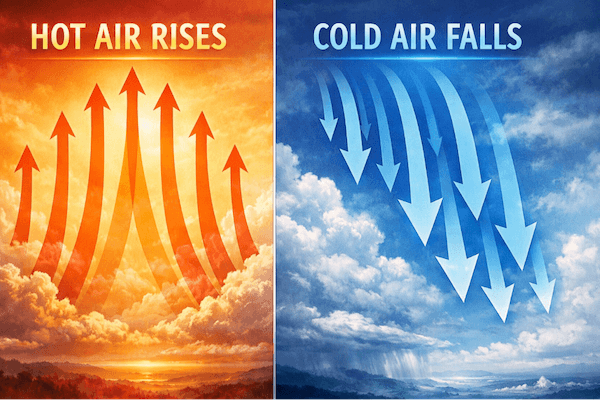
As you see in Figure 1 above, as air heats from global warming climate change, it rises, forcing cold air out of the atmosphere. (Just as nature abhors a vacuum, it also hates crowding.) As the cold air is squeezed out and falls through the clouds, it freezes the water molecules in the clouds, causing them to crystallize into snowflakes. The snowflakes, then, fall to the ground. And Bob’s your uncle.
Since the average annual snowfall in Bismarck, North Dakota, is 50 to 52 inches, the folks up there already know all that. I haven’t yet explained it to our neighbors across the street. But I think they’ll be cool with it, too. No pun intended.
I suspect they’ll find it right on the Bismarck.
Originally Published on https://www.bizcatalyst360.com/category/lifecolumns/notes-to-self/