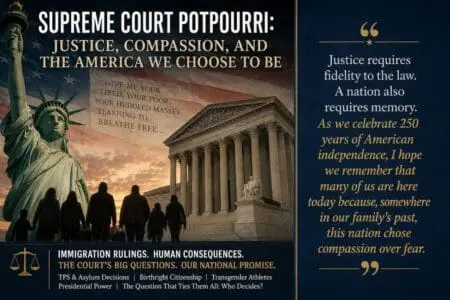

In just a few days, Americans will celebrate our nation’s 250th birthday—a milestone that should inspire both pride in what we’ve achieved and hope for what lies ahead.
But it’s difficult to celebrate without concern for our future.
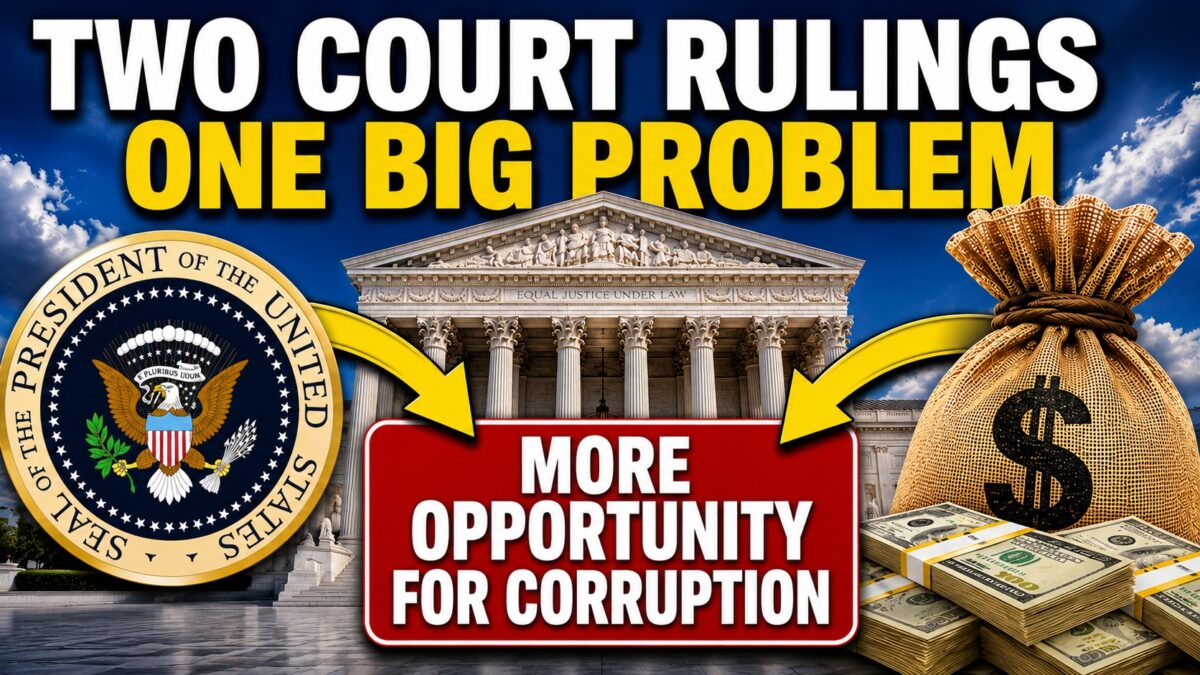
In the closing days before Independence Day, the U.S. Supreme Court issued two decisions that, viewed separately, might seem like ordinary legal rulings. Taken together, however, they could dramatically reshape the balance of power in American government.
One expands presidential authority over independent federal agencies.
The other gives wealthy political donors and party organizations far greater freedom to influence elections.
Combined, they make it easier for big Money to help elect politicians—and easier for those politicians to reward the interests that financed their campaigns.
That’s a dangerous combination.
Here’s why these two seemingly unrelated decisions belong in the same conversation.
In the first case, the Court ruled that presidents may remove the heads of many independent federal agencies without showing cause, overturning a 91-year-old precedent designed to shield those agencies from political interference.
The decision affects such agencies as the Federal Trade Commission, the Consumer Product Safety Commission, the Securities and Exchange Commission, the National Labor Relations Board, and others that were intentionally structured to operate independently of day-to-day political pressure.
Now, a president can replace agency leaders simply because they don’t like the direction those agencies are taking.
That means less independence.
More political control.
Fortunately, in a separate ruling, the Court preserved the independence of the Federal Reserve by protecting its board members from arbitrary dismissal, preventing the president from exercising similar authority there.
But for many other agencies, the rules have changed dramatically.
The second ruling may prove just as significant.
The Court struck down long-standing limits on coordinated campaign spending between candidates and political parties, ruling that those limits violated the First Amendment.
Until now, there were caps on how much candidates and their political parties could coordinate spending, depending on the size of the district or state. Those limits are now gone.
The practical effect?
Candidates and political parties can work together to spend substantially more money on campaigns.
Political analysts generally expect Republicans to benefit more immediately because they typically receive greater financial support from wealthy donors and corporate interests.
Donald Trump certainly welcomed the decision.
“The Supreme Court just took restrictions off political spending,” he wrote on Truth Social. “A BIG WIN FOR REPUBLICANS and, more importantly, The First Amendment!”
Republican campaign leaders were equally enthusiastic, calling the decision a restoration of core political speech.
Democrats saw something very different.
In a joint statement, leaders of the Democratic Senatorial Campaign Committee, Democratic Congressional Campaign Committee, and Democratic National Committee called it “a win for billionaire donors and special interests who want more influence over the GOP agenda.”
Legal scholar Rick Hasen of UCLA,told the PBS News Hour that Americans are likely to see even more Republican advertising during next year’s midterm elections because the GOP is already well-positioned to capitalize on the influx of additional campaign money.
Here’s why I believe these rulings should not be viewed in isolation.
Imagine that two giant corporations want to merge.
The Federal Trade Commission is reviewing the proposal because consumer advocates argue it would reduce competition and raise prices.
Now imagine those corporations spend millions of dollars helping elect candidates who support their business interests.
Under the Court’s campaign Finance ruling, there are now fewer restrictions on coordinated political spending.
Their preferred candidates win.
Their preferred presidential candidate wins.
Once in office, that president now has greater authority to replace FTC leadership with officials who are more sympathetic to corporate interests.
The merger is approved.
The companies benefit.
Consumers pay the price.
Am I saying that’s exactly what will happen?
No.
What I’m saying is that the legal safeguards designed to make that kind of political influence more difficult have become significantly weaker.
And that’s why these two Supreme Court decisions are so important.
One increases the influence of money in politics.
The other increases presidential control over agencies responsible for regulating many of the interests providing that money.
Together, they create far greater opportunities for political favoritism and government decisions driven by politics instead of the public interest.
As America marks its 250th birthday, it’s worth asking whether we’re strengthening the institutions that protect our democracy—or steadily weakening them.
Our system has always depended on checks and balances.
Independent agencies were created to insulate important decisions from partisan politics.
Campaign finance rules were intended—however imperfectly—to limit the influence of wealthy interests over elected officials.
The Supreme Court has now weakened both.
That’s not merely a legal development.
It may prove to be a blueprint for expanding presidential power, increasing the influence of big money in politics, and making political corruption easier rather than harder.
On America’s birthday, that’s something every citizen should think about.

Bob Gatty is co-author of the Hijacked Nation book series, founder of Lean to the Left, and host of the Lean to the Left podcast.
The post Will Two Supreme Court Decisions Fuel Political Corruption? appeared first on Lean to the Left.