
 Why Elections Are Vital to the Concept of Justice For All
Familiar with the name Mahmoud Khalil? He’s the Columbia University graduate and pro-Palestinian protester who was jailed for months by the Trump administration. Obviously, as a strong supporter of Israel, I do not support his views on the Israel-Hamas conflict, but that’s beside the point. Last week’s 2–1 federal appeals court decision involving Khalil caught my attention for reasons that have nothing to do with him or his views on the war, but everything to do with the system that judged him.
The two judges in the majority were appointed by Trump and George W. The lone dissenter was appointed by Joe Biden.
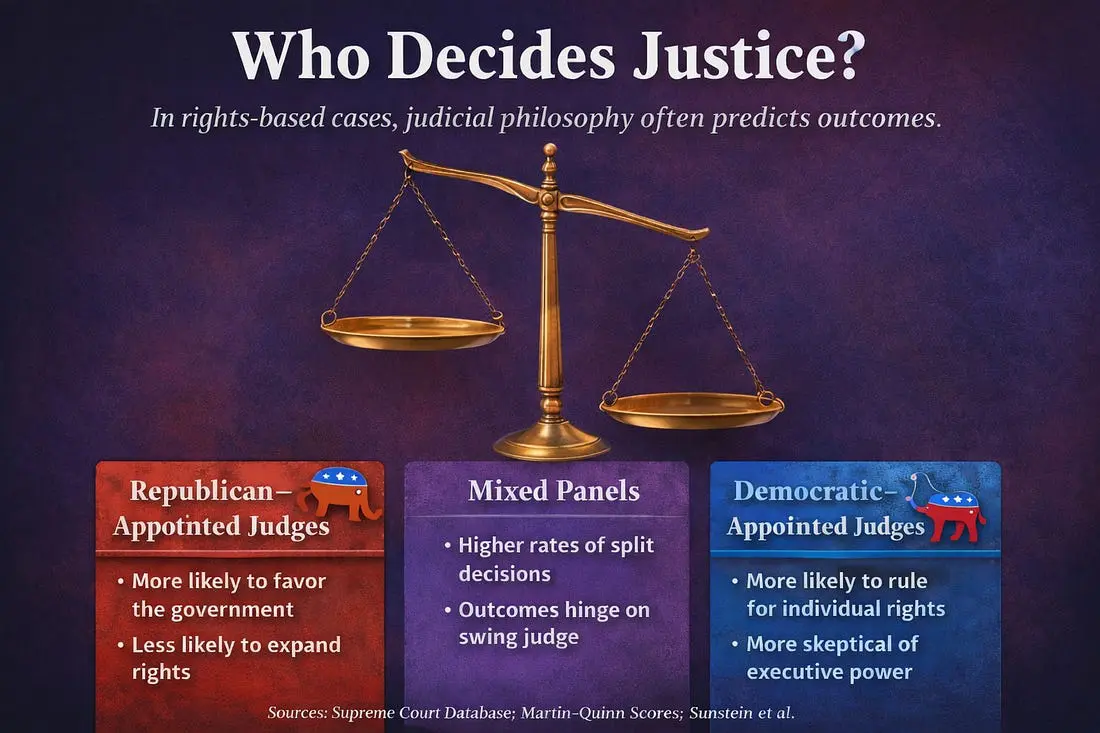
These appointment origins don’t prove bias. Judges are not party operatives, and most would bristle at the suggestion that they rule “politically.” But they do point to something we are reluctant to address honestly: in the 21st century, who appoints judges has become a meaningful predictor of how certain cases are decided, especially cases involving civil liberties, civil rights, criminal procedure, immigration, labor, and environmental law.
That’s not ideology talking. That’s data.
Political scientists and legal scholars have spent decades analyzing federal appellate and Supreme Court decisions. Across large datasets, a consistent pattern emerges: judges appointed by Republican presidents and judges appointed by Democratic presidents tend to rule differently on average in rights-based cases.
https://en.wikipedia.org/wiki/Martin%E2%80%93Quinn_score
https://academic.oup.com/jla/article/17/1/14/8210975?utm
https://journals.plos.org/plosone/article?id=10.1371%2Fjournal.pone.0027188&utm
https://www.sciencedirect.com/science/article/abs/pii/S0047272722001281?utm
The divide is not uniform across all case types. Contract disputes, tax cases, and technical regulatory matters often produce broad agreement. But in cases involving:
the gaps are wider and more predictable.
At the Supreme Court level, some recent terms have featured an unusually high number of decisions split cleanly along appointing-president lines. Other terms are more consensual. The point is not that every case is political — it’s that the cases that shape our freedoms most directly are often the ones where judicial philosophy matters most.
This isn’t hard to understand if we’re honest about what judging requires.
The Constitution uses broad language: “due process,” “reasonable,” “equal protection,” and “freedom of speech.” Statutes governing criminal law and immigration often grant enormous discretion to police, prosecutors, and federal agencies.
Judges don’t just apply math formulas. They interpret principles. And interpretation inevitably reflects values:
Reasonable people can disagree on those questions. Judges do — and their answers often track the philosophies of the presidents who appointed them.
There’s another truth we rarely acknowledge out loud.
If you’ve been the victim of a violent crime, you may naturally gravitate toward a more law-and-order, enforcement-first approach. The system failed you once, and you don’t want it to fail again.
If you’ve been wrongfully arrested, overcharged, racially profiled, aggressively prosecuted, or caught in the gears of an immigration system that treats people as paperwork rather than human beings, you may see the system very differently.
Both perspectives are understandable.
But here’s the line that matters: the law must be applied constitutionally and fairly regardless of whose pain is more familiar to us. Justice cannot depend on whether a judge identifies more with the victim or the accused. It cannot depend on political affiliation. And it cannot become a proxy battlefield for the same partisan wars already consuming our legislatures.
When judges cannot — or do not — separate legal judgment from ideological instinct, the justice system itself becomes political. And that is a dangerous place for our democracy to go.
Federal judges serve for life. Presidents nominate them. Senators confirm them. One election can shape the law for a generation. That’s not a partisan talking point; it’s an institutional fact.
You don’t have federal law enforcement policy without courts that uphold it. You don’t have meaningful constitutional protections without judges willing to enforce them. And you don’t have neutral justice if judicial appointments are treated as spoils of political war rather than guardians of the rule of law.
This is why elections matter — not just for policy, but for what kind of justice system we become.
If judicial outcomes in civil liberties and criminal justice cases continue to track political identity more than legal principle, we lose something essential. Courts stop being referees and start looking like players. And once that happens, trust collapses — especially among those already most vulnerable to abuses of power.
A justice system perceived as political is not merely flawed. It is unstable.
And that should concern everyone — conservatives and liberals, crime victims and defendants alike.
Because once justice is reduced to politics, it belongs to no one for long.

Mark M. Bello is an attorney and award-winning author of the Zachary Blake Legal Thriller Series, ripped-from-the-headlines, realistic fiction that speaks truth to power and champions the rights of citizens in our justice system. These novels are dedicated to the social justice movement. They educate, spark discussion, and inspire readers to action. One of these novels, Betrayal High, was written in response to school shootings. For more information, please visit www.markmbello.com.