Trump’s Supreme Court and the Case That Could Finish Off the Voting Rights Act
Louisiana v. Callais may decide whether Section 2 of the Voting Rights Act — the law that gives minority voters a fair shot at representation — survives another conservative assault.
by Mark M. Bello
As I write this, the Supreme Court is scheduled to hear Louisiana v. Callais and Robinson v. Callais, which will revisit cases it could have resolved months ago. Instead, the justices took the rare step of ordering reargument, a move that signals trouble for the Voting Rights Act and for the idea that race can be considered when ensuring equal political power.
At stake is something deceptively simple:
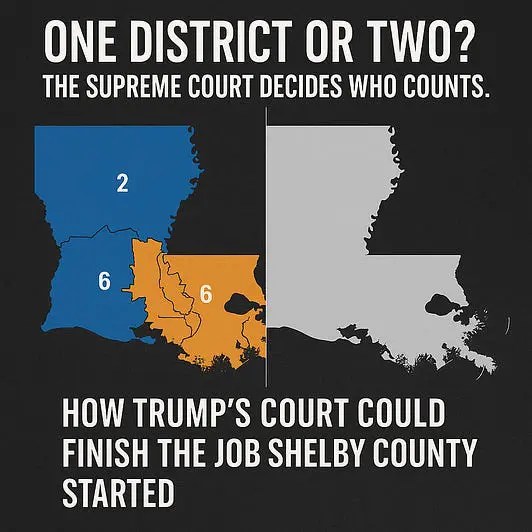
Should Louisiana have two majority-Black congressional districts — reflecting the fact that about one-third of its residents are Black — or just one, as the Republican-controlled legislature prefers?
After the 2020 census, Louisiana’s legislature drew a map with only one majority-Black district. Black voters sued under Section 2 of the Voting Rights Act, arguing that the map diluted their voting strength. A federal court agreed, ordering the state to draw a second Black-majority district.
In early 2024, the legislature complied, enacting Senate Bill 8 (SB 8) — a remedy connecting Baton Rouge and Shreveport. But a group of white voters immediately challenged that map, calling it a racial gerrymander. A three-judge federal panel agreed and struck it down.
When the Supreme Court intervened last summer, it allowed SB 8 to stand for the 2024 election — but then, in June 2025, SCOTUS ordered reargument for this term, explicitly asking whether even a remedial Section 2 map might itself be unconstitutional.
That’s not a neutral procedural move. It’s an invitation to do what the Court’s conservative majority has been inching toward for a while now: render Section 2 toothless.
The Pattern Seems Clear
If you feel like you’ve seen this movie before, you have.
2013:Shelby County v. Holder gutted Section 5’s “preclearance” formula, freeing states with long histories of discrimination to change voting laws without federal oversight.
2021:Brnovich v. DNC narrowed Section 2’s reach in vote-denial cases, making it harder to challenge restrictive voting laws.
2023:Allen v. Milligan briefly surprised observers by upholding a second Black-majority district in Alabama — but even that 5-4 decision was rooted in precedent the current Court could easily discard.
Now, with Callais, the conservative bloc is poised to question whether any race-aware remedy — even one ordered by a court to fix racial vote dilution — violates the Fourteenth Amendment’s “colorblind” ideal.
If they go that far, Section 2 will still exist on paper, but be almost impossible to use in practice.
The Trump Effect
We come to this potentially historic moment because voters in 2016 handed Donald Trump the unique opportunity to appoint three Supreme Court justices. Those appointments cemented the current 6-3 conservative majority that has already overturned Roe v. Wade, ended affirmative action, and curtailed the administrative state. Now the draconian majority sets its sights on the very law that guaranteed Black Americans a seat at the table of democracy.
When the Voting Rights Act was renewed in 2006, it passed Congress almost unanimously. But in the post-Trump era, even that bipartisan consensus is gone.
The Court’s conservative bloc seems eager to finish the job Shelby Countystarted: stripping the Act of its last remaining enforcement teeth.
What’s at Stake
If the Court rules that a state cannot even voluntarily draw a second majority-Black district to comply with Section 2, the implications reach far beyond Louisiana:
Alabama and Georgia, which redrew maps after Milligan, could see their new districts invalidated.
Texas, Florida, and North Carolina would have little incentive to consider minority representation at all.
Across the country, millions of Black, Latino, and Native voters could find their political voices quietly erased by maps designed to look “colorblind” — but drawn with surgical precision to preserve white political power.
This is what judicial activism actually looks like: the steady dismantling of a civil-rights framework that has protected democracy for 60 years.
The Supreme Court may soon decide that the very tools Congress created to remedy discrimination are themselves discriminatory. That’s the logic of today’s conservative legal movement — a logic made possible by three Trump appointees who will shape American law for decades to come.
If you voted in 2016 thinking a single presidency couldn’t change the fabric of democracy, you were wrong. Louisiana v. Callais is the proof that it could — and did.
Mark M. Bello
Mark M. Bello is an attorney and author of 9 Zachary Blake Legal Thrillers and other legal themed novels and children’s books. For more information, please visit https://www.markmbello.com
For many years, Bob Gatty worked as a writer, editor, and communications consultant, based on the Washington, DC area with a focus on government and politics. He began at The Pittsburgh Courier, an African American weekly, covering crime and the courts. His salary was $55 per week before moving on to two local Pennsylvania dailies. At age 24, he began reporting for United Press International covering state politics in Pennsylvania and then New Jersey, where he was UPI’s state capitol bureau in Trenton.
Tempted by the allure of Washington, DC and big-time politics, at age 29 Bob became press secretary and chief of staff for two Congressmen – first Republican Edwin B. Forsythe, and then Democrat James J. Florio, who later became governor of New Jersey and until his recent death was a frequent podcast guest and co-host of Bob’s NFN Radio News podcast (now called Lean to the Left).
After seven years on Capitol Hill, Bob opened a communications business in Washington, first providing political media consulting to candidates and then freelance Washington coverage for business and trade magazines, plus creative communications services for trade and professional associations, including social media. This work involved articles and analyses of key governmental developments affecting businesses, such as the food and Health industries, retailing, and the environment.
His work as a communications consultant to trade and professional associations included launching and editing association publications, providing website content and social media assistance, and covering conferences and conventions.
Bob retired from G-Net Strategic Communications in 2016 and moved to Myrtle Beach, SC, where he launched his blog site, first called Not Fake News, now known as Lean to the Left.
Hijacked Nation
In August, 2020, Bob and co-author Chris Waldron, one of Lean to the Left's most loyal and prolific contributor, published "Hijacked Nation-Donald Trump's Attack on America's Greatness," a two-volume compilation of blogs regarding Trump's presidency and the consequences for our nation. A followup volume was published by Luna Global Media in September 2024. It is available at https://amzn.to/4ePrTF7 .
In all three volumes, blogs from Not Fake News and Lean to the Left create a virtual play-by-play of key actions of the Trump administration and Congress. For more information, please visit https://leantotheleft.net/books/, and visit Bob's Author's Page on Amazon, https://www.amazon.com/stores/Bob-Gatty/author/B08C7HWXZ5?ref=ap_rdr&isDramIntegrated=true&shoppingPortalEnabled=true&ccs_id=4e603563-7251-4074-b54d-40800c4ce40a.
The Lean to the Left Podcast
The Lean to the Left podcast provides commentary and interviews with newsmakers and others with interesting stories to tell. Video and audio podcasts stream twice weekly on major channels. More info at https://podcast.leantotheleft.net.
The Lean to the Left YouTube Channel
You'll find all of the audio tracks for the Lean to the Left Podcast here plus original videos, including complete video versions of each podcast.
https://www.youtube.com/@LeantotheLeft.



 Louisiana v. Callais may decide whether Section 2 of the Voting Rights Act — the law that gives minority voters a fair shot at representation — survives another conservative assault.