

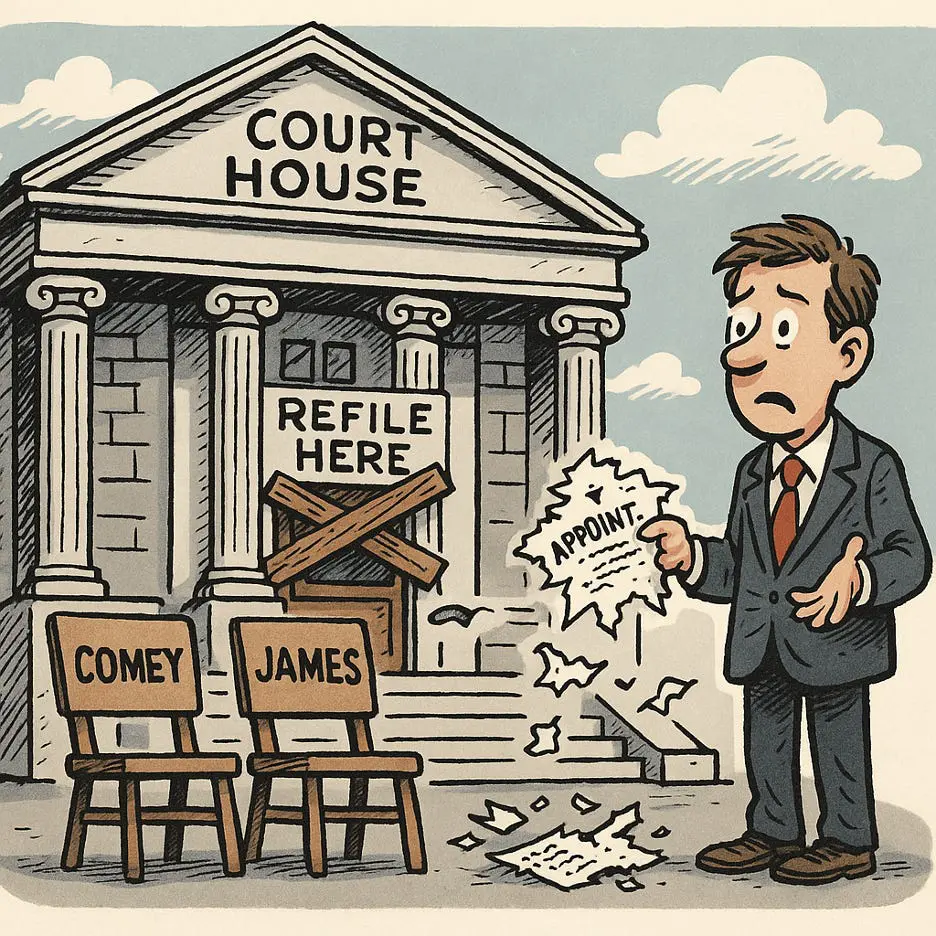
Two bogus federal prosecutions — against former FBI Director James Comey and New York Attorney General Letitia James — were dismissed last week. Unfortunately, they were not dismissed on the merits of each case, but because the prosecutor who brought the indictments wasn’t legally appointed, which is typical misconduct in the Trump/Bondi Justice Department.
Both dismissals were entered without prejudice. That phrase sounds somewhat ominous, but this type of dismissal is relatively routine in legal circles. Still, readers should understand precisely what it means — and why the real question now is whether either case should ever see the light of day again.
A dismissal without prejudice means that the ruling does not necessarily end the case. The government, if it wishes, may refile the charges, correcting the error that led to the dismissal. In these cases, for instance, if a legally appointed prosecutor decided to refile the charges, the case might proceed. The cases were not judged on their merits, and neither guilt nor innocence was determined.
However, just because the government can refile these cases does not mean it should. Serious substantive problems make second prosecutions doubtful, unwise, and, in some respects, dangerous.
The Basics
The Justice Department charged Comey with:
The indictment came in just before the five-year statute of limitations ran out. It also lacks substance.
The government rushed the original indictment because the deadline was expiring. Comey’s lawyers can now argue that the indictment is void and the clock has expired. Even the judge signaled that the limitations probably bars any new filing, enough to end the case permanently.
Reports from inside the case show:
If this prosecution were a car, the wheels, engine, and frame would all require warranty work.
Donald Trump spent years demanding Comey’s prosecution. The public record contains:
When a prosecution is so intertwined with political pressure, courts are required to scrutinize it. The evidence points in a clear direction: the case is premised on political retaliation rather than on neutral law enforcement or evidence gathering.
Obstruction of Congress is not an easy charge to prove. Nor is the kind of false-statement allegation asserted here. The timeline, the facts, and the DOJ’s own hesitation indicate the case was weak long before it was improperly filed. Between the statute-of-limitations bar and the questionable evidence, the Comey case is already a corpse. The appointment issue was just the beginning of the autopsy.
The DOJ indicted Letitia James for:
The allegations relate to a 2020 property purchase in Virginia. Again, a faulty prosecutorial appointment invalidated the filing — but this case, too, should not be pursued.
Multiple DOJ career prosecutors reportedly declined to bring charges because the evidence did not meet federal standards. If the pros who prosecute fraud regularly said “no,” that tells you everything about the strength of this case.
Few public figures have been more aggressive in holding Trump accountable than Letitia James. She brought — and won — a massive civil fraud case against him. Then she herself got indicted by a prosecutor Trump had openly praised and briefly retained as his personal lawyer. That sequence is not subtle. It speaks for itself. The DOJ prosecuted in retaliation for James’ pursuit of the civil fraud case against Trump.
When you combine:
you get weaponized federal power rather than a legitimate prosecution. A refiled case under a legally valid prosecutor would still suffer from all the same constitutional concerns.
If the DOJ is allowed to refile politically tainted cases after botching prosecutor appointments, we would be normalizing:
That’s not applying the rule of law— that’s abuse of power at the highest levels of our government. Comey has had his reputation dragged through the mud for years. James has endured a prosecution that even DOJ veterans wouldn’t sign their names to. Neither case warrants another round of chaos. The justice system is not supposed to be a carnival game where prosecutors keep throwing balls at the same target until they finally connect.
Both cases were dismissed on a technicality — but both deserve to be dismissed with prejudice, or on their merits.
James Comey
The statute of limitations has expired. The evidence is weak. The political motivation is blatant. The case should be permanently and irrevocably dismissed (with prejudice).
Letitia James
The evidence was thin from the beginning; the prosecution reeks of selective targeting, and the improper appointment only highlights gross prosecutorial overreach. Given the lack of evidence in the case, it too should be dismissed with prejudice.
A justice system that allows prosecutors to resurrect these prosecutions isn’t a justice system at all — it’s a political abuse of power.
It’s time to close both cases for good.

Mark M. Bello is an attorney and author of 9 Zachary Blake Legal Thrillers and other legal themed novels and children’s books. For more information, please visit https://www.markmbello.com