 by Mark M. Bello
There’s a sensible expression I’ve heard throughout my life: “You’re not paranoid if they’re really out to get you.” History teaches us that when Jews sense a threat, we ignore it at our peril. We’ve seen what happens when we dismiss hate as fringe or unserious. From Pharaoh to Haman, from pogroms to the Holocaust, from the Yom Kippur war to October 7, from Hamas to Hezbollah, antisemitism is not a phobia. It is a fact of Jewish life.
Israel’s response to October 7 is increasingly criticized world wide. Israel and the Jewish people are unfairly demonized for the acts and responses of Israel’s government. Israel has a right to defend itself from terror attacks, doesn’t it? The so-called “innocent” Palestinians elected a terrorist group to govern them, didn’t they? Are they factually innocent?
When we read about certain passages in the Qur’an that call for violence against non-believers — or when we learn that some Muslims believe Islam should be the world’s dominant faith — it’s natural to worry. And when we look at radical groups that openly call for the destruction of Israel and the death of Jews, it’s not “Islamophobia” to be afraid. It’s history whispering in our ears.
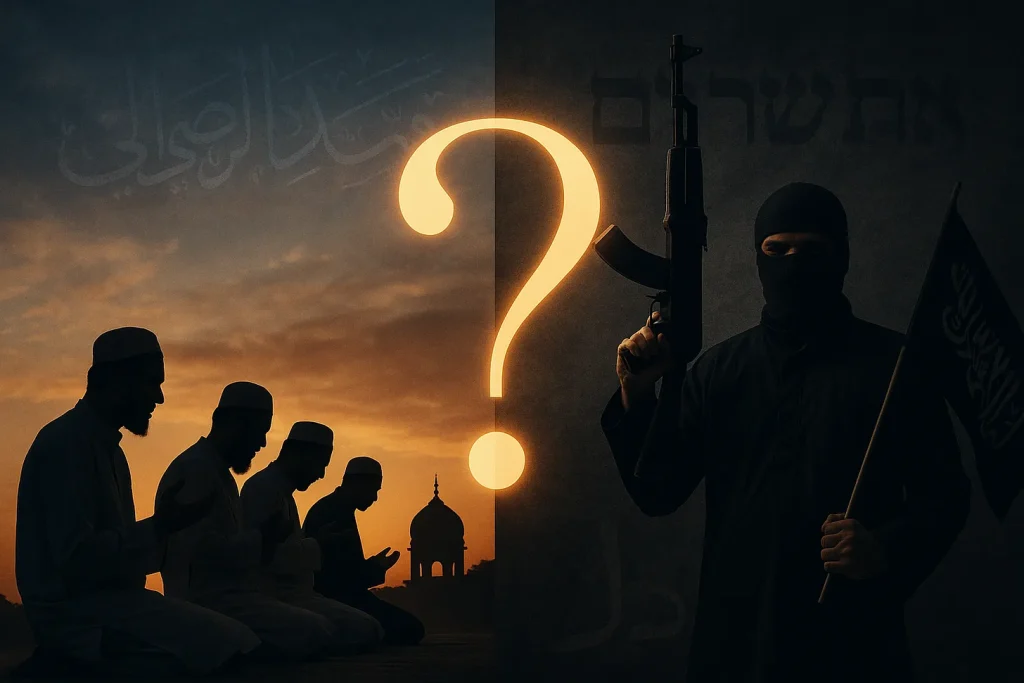
But here’s the harder question: Is this fear reflective of a widespread Islamic worldview — or is it the product of a dangerous but ultimately minority ideology? Is Islam, as a religion, inherently hostile to Jews and other non-Muslims? Or have certain actors, groups, and governments hijacked a massive faith tradition to serve their own radical ends?
Yes, there are Qur’anic verses that speak of fighting non-believers, sometimes graphically (e.g., “slay the idolaters wherever you find them” — Qur’an 9:5)[1]. But these verses are contextual, often tied to specific wars in 7th-century Arabia.
The Qur’an also says, “There is no compulsion in religion” (2:256)[2], and speaks of Jews and Christians as “People of the Book.” Islamic scholars disagree fiercely about how to interpret these verses today — some read them spiritually or metaphorically, others as historical, and a minority, literally.
That minority — the Islamists, the jihadists, the terror networks — are the ones making headlines. But that doesn’t mean they speak for all Muslims.
It’s true that Muhammad initially reached out to the Jewish tribes of Medina, and when they rejected his prophethood, tensions escalated. The Banu Qurayza tribe, accused of betraying a wartime pact, was besieged, and many of its men were executed3. This was brutal. It is also real.
But again, scholars differ. Was this a religious vendetta? Or a political conflict dressed in tribal garb? Either way, for Jews, it can’t help but echo familiar Trauma.
Still, this event doesn’t define all of Islam any more than the Inquisition defines all of Christianity. And it’s worth remembering that Jewish communities lived — sometimes even thrived — under Islamic rule for centuries, often more safely than under European Christendom.
– Most Muslims worldwide reject violence in the name of Islam.
– In many Muslim-majority countries, Muslims express support for democracy, pluralism, and peaceful coexistence.
– Yes, support for sharia law is high in some regions — but even that support varies in meaning and enforcement.
Only a small percentage endorse violence against civilians or believe in forcing Islam upon others. Yet that small percentage — amplified by media and manipulated by terror groups — casts a long shadow.
1. Population Growth does not equal political or religious conquest.
2. Many Muslim immigrants assimilate, secularize, or pursue private spirituality.
3. Christian groups, too, speak of spreading their faith globally.
Radical Islamists do call for global dominance — but they are not representative of most Muslims, any more than the KKK represents Christianity or Kahane Chairepresents world Jewry.
It is not “Islamophobic” to be afraid of radical Islam. Groups like ISIS, Hamas, Hezbollah, and the Iranian regime do call for Jewish destruction. They quote scripture to justify it. They kill in the name of Islam. That fear is real.
But it is also not fair — or accurate — to assume that 1.9 billion Muslims worldwide support those views. Many Muslims fear those groups, too. Many fight against them. Some are jailed, tortured, or killed by them.
The enemy of the Jew is not “Islam.” It is extremism — of all stripes. And the best allies against that extremism may include the very Muslims we’re taught to fear.
Many of you are familiar with my Zachary Blake legal thriller series novels. At the dawn of the first Trump term, I wrote my second novel. Betrayal of Justice was about a bigoted, Islamophobic President who used a wrongfully accused young Muslim woman as a poster child for his anti-Muslim agenda. Zachary Blake, a Jewish lawyer, defended the young woman because justice demanded he do so. You may recall that Donald Trump was proposing a “Muslim Ban” back then. I’m proud of the stand I took against his obvious bigotry.
But I’m also not naive about anti-Semitism. Indeed, Jewish naivete is dangerous. The Jewish people have survived thousands of years of persecution by being vigilant — and by being wise. Let’s stay vigilant but also wise enough to distinguish between our legitimate fears and universal truth. The Qur’an does contain disturbing passages. But so does the Torah. So does the New Testament. The difference is how people interpret and act upon them.
Let’s oppose radical Islam — but not paint all Muslims with that brush.
Let’s remember history — but not let trauma become dogma.
And let’s continue doing what Jews have always done: asking questions, seeking truth, and fighting for survival — with our eyes wide open and our hearts still capable of discernment.
Sources
[1] Qur’an 9:5, various translations. See also scholarly interpretations by Yusuf Ali and M.A.S. Abdel Haleem.
[2] Qur’an 2:256.
[3] Watt, W. Montgomery. *Muhammad at Medina*, Oxford University Press, 1956.

Mark M. Bello is an attorney and author of 9 Zachary Blake Legal Thrillers and other legal themed novels and children’s books. For more information, please visit https://www.markmbello.com