
 By Mark M. Bello
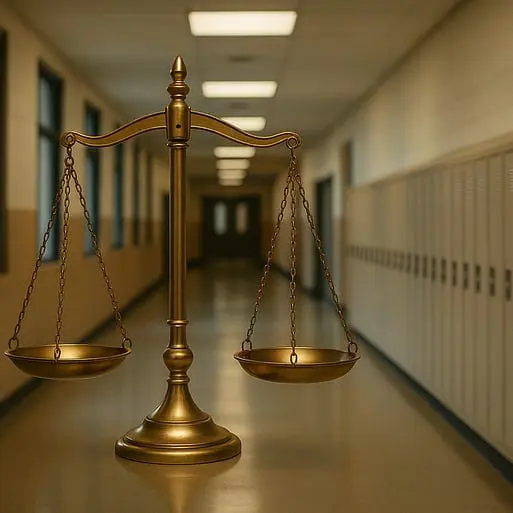
When first-grade teacher Abby Zwerner was shot in a Virginia classroom by a six-year-old student, the nation was horrified. But an additional shock comes two years later, as a Virginia jury awards her $10 million against assistant principal Ebony Parker, finding that Parker’s failure to act in the face of repeated, credible warnings amounted to gross negligence.
This isn’t just a verdict—it’s a statement; for the first time, an individual school administrator has been held personally liable for ignoring clear and present dangers that led directly to a classroom shooting.
As someone who spent more than four decades practicing personal-injury law, I find this verdict profoundly significant. It represents a long-overdue extension of responsibility beyond the home, into the institutions charged with protecting our children and teachers.
And for me, it’s also eerily familiar.
In my novel Betrayal High, written years before the Zwerner shooting, I imagined a scenario where school officials were held accountable for looking the other way. That “fictional prophecy” has now crossed into reality.
We now have two defining American school-shooting sagas—the 2021 Oxford High School case in Michigan and the 2023 Richneck Elementary case in Virginia—and four parallel legal battles that together signal a major shift in accountability.
Fifteen-year-old Ethan Crumbley killed four classmates after multiple warning signs were ignored by both his parents and the school. The parents, Jennifer and James Crumbley, became the first in U.S. history to be convicted of involuntary manslaughter for the acts of their child. Prosecutors showed these parents failed to secure a handgun and dismissed glaring red flags—Ethan’s disturbing drawings, violent writings, and pleas for help.
The Michigan Court of Appeals and later the state Supreme Court upheld the prosecutions, finding sufficient evidence of gross negligence and foreseeability—key elements in both criminal and civil liability.
The victims’ families also sued the school district and its employees, alleging that counselors and administrators ignored explicit warnings. Those suits remain ongoing. While criminal punishment was directed at the parents, civil accountability is inching closer to the school, through negligence theories nearly identical to those that prevailed in Virginia.
In Virginia, Assistant Principal Ebony Parker has been charged with eight counts of felony child neglect. Prosecutors allege she ignored multiple staff reports that the six-year-old was threatening violence and might have a gun in his backpack on the very day of the shooting. Witnesses say Parker was told at least three times, by different staff members, that the child posed a danger—but she took no action. The case is pending.
As a justice advocate, I have mixed feelings about this. I’m all for accountability, but I’m cautious about criminalizing lapses in judgment when there’s no clear intent to harm. Civil remedies exist for a reason—to make victims whole, not to fill prisons with negligent people. Still, the fact that prosecutors felt emboldened to charge Parker demonstrates a shift in public sentiment.
Jurors concluded that Parker’s inaction directly caused Zwerner’s near-fatal injuries, which required multiple surgeries and left permanent disability.
The warnings were stark: staff had seen the student behaving violently, threatening peers, and possibly concealing a weapon. Teachers asked Parker to search the boy’s backpack. She refused. Minutes later, Zwerner was shot.
The verdict didn’t just compensate a victim—it created a blueprint for future accountability.
This case breaks new legal ground in at least three ways.
Together, Oxford and Zwerner trace the evolution of American gun-violence accountability:
Both establish the principle that when clear warnings are ignored, those in power can—and will—be held responsible.
Yet, the criminalization of negligence remains controversial. Negligence, even gross negligence, is not synonymous with crime. It’s one thing to hold a parent civilly liable for failing to lock up a weapon. It’s another to incarcerate someone who lacked intent but made terrible choices. Society gains more from reforming systems than from locking up administrators.
Still, this verdict underscores an undeniable truth: failure to act has consequences. A principal’s silence can be as deadly as a parent’s unlocked gun safe.
When I wrote Betrayal High, I imagined a civil lawsuit in which victims and their families turned to the courts after a preventable school shooting. In the novel, Zachary Blake, my social justice crusader, argued that the school, the district, and even local officials had ignored the obvious warning signs. Many professionals argued that the premise was far-fetched—“Administrators will never be held liable for what a kid does.”
And they were wrong.
As a novelist, it’s chilling to watch your fiction become fact. As a lawyer, it’s gratifying to see justice expand its reach.
The Zwerner verdict will likely face appeal, and Virginia law may evolve as courts grapple with the tension between immunity and accountability. But regardless of appellate outcome, this case is already rewriting the national conversation.
Expect three developments in the months ahead:
And yes—these cases edge the legal system one step closer to confronting the elephant in the room: the gun industry itself. Until Congress repeals the Protection of Lawful Commerce in Arms Act (PLCAA), which shields gun manufacturers from most civil liability, victims are forced to look elsewhere—for now, to parents, schools, and administrators.
But make no mistake: every verdict like Zwerner chips away at the myth that gun violence is nobody’s fault. Eventually, the chain of responsibility must reach the source.
The Abby Zwerner verdict is a legal and moral milestone. It tells teachers that their safety matters, and administrators that warnings can’t be ignored. And it tells the rest of us that accountability for gun violence doesn’t end at the schoolhouse door.
As a life-long safety and justice advocate, I’m pleased with this outcome. Civil justice did what it’s supposed to do—it recognized duty, found a breach of that duty, and delivered accountability. That’s not vengeance. That’s justice.

Mark M. Bello is an attorney, novelist, and justice advocate. He is the author of the Zachary Blake Legal Thriller series, including Betrayal High —a prescient look at school-shooting litigation and the quest for accountability.