Iu2019m reviewing my life (so far). I suppose that might be expected for someone my age. After all, looking back is easier than looking forward, reflecting is easier than planning to change and at seventy-five thereu2019s a lot to review.
nThe presenting cause for all this historical navel-gazing is my new u201ccareeru201d as a writer.(Can I call work for which I am not paid a career? Dunno.) I am writing three books, Traveling the Consulting Road, Change Leader? Who Me?, and u00a0Wisdom from Unusual Places.
nThe first book could be called, u201cMy Mistakes as a Consultant.u201d The second might be titled u201cMy Mistakes Leading Change,u201d and the third u201cMy Mistakes in Life, plus some interesting people who tried to set me straight.u201d Are you sensing a theme?
nTruth be told, for much of my life, I was a terrible follower. In cleaning out my parentsu2019 house I came upon my fourth grade report card – My grades were still As and Bs, but Mrs. Keshan had written a note to my folks.
nu201cAlan is bright, catches on very quickly, but if he doesnu2019t get over his problem with authority, it will limit him in his life.u201d
nI donu2019t feel particularly limited, but for most of my life, I battled anyone who had the slightest bit of power over me. I used to joke as an independent consultant, u201cI work for myself because I discovered Iu2019m a lot nicer to clients than I am to bosses.u201d
nThis is perhaps a slight exaggeration. I designed and ran multiple workshops about leading change for corporate managers. I came to simplify the difference between managers and leaders. u201cmanagers get the work done in a (relatively) steady state and develop people: leaders work in abnormal circumstances (emergencies, war, change) and are accountable for direction and attracting followers.u201d
nI emphasized attracting followers, by joking u201cIf you think youu2019re a leader, look over your shoulder, if thereu2019s no one there, you might just be delusional.u201d There was more to my practice than jokes, but I donu2019t think I spent enough time on followership.
nI wasnu2019t always a poor follower. Several times in my life, I was committed to an idea, a leaderu2019s vision, the purpose of an organization. I worked hard to get stuff done, not just stuff I was assigned to do, but stuff that aligned with the vision that I saw needed to be done. I built my own competency and asked for help when I needed it. I encouraged peers to have the same spirit and confronted anyone who veered away from the vision.
nI experienced good followership in many contexts, Boy Scouts, the theatre, Habitat for Humanity house building, and at various points in every job I had, factory worker, waiter, booking agent, trainer, and consultant.
nRecently, I read an Psychology Today blog post by Dr. Ronald Riggio, professor of n Leadership and Organizational Psychology at Claremont McKenna College, entitled u201cIn Praise of Followership.u201d Dr Riggio referenced an Harvard Business Review article u201cIn Praise of Followers,u201d written by Dr. Robert Kelley of Carnegie Mellon University, which I had read when I lived in Pittsburgh in the late 80s. I reread that article.
nHere are some points from each:
nDr Riggio:
nDr. Kelley
nNo where does either professor recommend sucking up to a leader, nor blind loyalty, nor only delivering news the leader wants to hear, nor putting up with a toxic environment.
nDr. Kelley uses a matrix to evaluate follower behavior.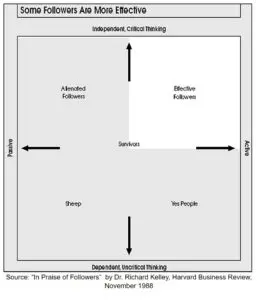
The upper right, effective follower quadrant shows independent, critical thinkers with active behavior patterns.
nFollowers Kelley calls u201csheepu201d are too willing to accept whatever the Leader thinks or says.
nThose he calls u201cYes peopleu201d operate from fear or seek approval, betraying the requirement for courage and honesty, and losing all credibility as a result.
nWhen I failed as an effective follower, my particular failure mode too often fell into the alienated follower quadrant with passive-aggressive behavior I might have described as u201crighteous indignation.u201d Over time I learned how to u201cdisagree agreeably,u201d as Kelley recommends, but it took me far too long.
nAccording to Kelley effective followers confront leaders constructively. I have done more than my share of confronting, some more constructive than others. Perhaps my best follower behavior though was in getting stuff done. I learned early to deliver on what I was assigned and to look for things that needed to be done and just doing them. That trait increased my workload, but it bought me some forgiveness for my u201cdisagreeable disagreement.u201d
nSome my best follower behavior I honed in leaderless groups, or teams where the leadership role rotated according to the skills and knowledge needed. I also learned a great deal from facilitating groups and keeping my own opinions to myself.
nIu2019m still working on the u201cproblem with authority,u201d counter-dependent behavior thing. Iu2019m helped in that struggle by the fact that as a retiree I have fewer bosses and as an old man others seem to just shake their heads and smile when I get obstreperous.
nIu2019ve also learned that u201cdo as I say not as I do doesnu2019t work with children and grandchildren,u201d so theyu2019re lousy followers too, but. . .
n. . . maybe some of you, dear readers, can learn from my mistakes.
nIu2019m reviewing my life (so far). I suppose that might be expected for someone my age. After all, looking back is easier than looking forward, reflecting is easier than planning to change and at seventy-five thereu2019s a lot to review.
nThe presenting cause for all this historical navel-gazing is my new u201ccareeru201d as a writer.(Can I call work for which I am not paid a career? Dunno.) I am writing three books, Traveling the Consulting Road, Change Leader? Who Me?, and Wisdom from Unusual Places.
nThe first book could be called, u201cMy Mistakes as a Consultant.u201d The second might be titled u201cMy Mistakes Leading Change,u201d and the third u201cMy Mistakes in Life, plus some interesting people who tried to set me straight.u201d Are you sensing a theme?
nTruth be told, for much of my life, I was a terrible follower. In cleaning out my parentsu2019 house I came upon my fourth grade report card – My grades were still As and Bs, but Mrs. Keshan had written a note to my folks.
nu201cAlan is bright, catches on very quickly, but if he doesnu2019t get over his problem with authority, it will limit him in his life.u201d
nI donu2019t feel particularly limited, but for most of my life, I battled anyone who had the slightest bit of power over me. I used to joke as an independent consultant, u201cI work for myself because I discovered Iu2019m a lot nicer to clients than I am to bosses.u201d
nThis is perhaps a slight exaggeration. I designed and ran multiple workshops about leading change for corporate managers. I came to simplify the difference between managers and leaders. u201cmanagers get the work done in a (relatively) steady state and develop people: leaders work in abnormal circumstances (emergencies, war, change) and are accountable for direction and attracting followers.u201d
nI emphasized attracting followers, by joking u201cIf you think youu2019re a leader, look over your shoulder, if thereu2019s no one there, you might just be delusional.u201d There was more to my practice than jokes, but I donu2019t think I spent enough time on followership.
nI wasnu2019t always a poor follower. Several times in my life, I was committed to an idea, a leaderu2019s vision, the purpose of an organization. I worked hard to get stuff done, not just stuff I was assigned to do, but stuff that aligned with the vision that I saw needed to be done. I built my own competency and asked for help when I needed it. I encouraged peers to have the same spirit and confronted anyone who veered away from the vision.
nI experienced good followership in many contexts, Boy Scouts, the theatre, Habitat for Humanity house building, and at various points in every job I had, factory worker, waiter, booking agent, trainer, and consultant.
nRecently, I read an Psychology Today blog post by Dr. Ronald Riggio, professor of n Leadership and Organizational Psychology at Claremont McKenna College, entitled u201cIn Praise of Followership.u201d Dr Riggio referenced an Harvard Business Review article u201cIn Praise of Followers,u201d written by Dr. Robert Kelley of Carnegie Mellon University, which I had read when I lived in Pittsburgh in the late 80s. I reread that article.
nHere are some points from each:
nDr Riggio:
nDr. Kelley
nNo where does either professor recommend sucking up to a leader, nor blind loyalty, nor only delivering news the leader wants to hear, nor putting up with a toxic environment.
nDr. Kelley uses a matrix to evaluate follower behavior.
The upper right, effective follower quadrant shows independent, critical thinkers with active behavior patterns.
nFollowers Kelley calls u201csheepu201d are too willing to accept whatever the Leader thinks or says.
nThose he calls u201cYes peopleu201d operate from fear or seek approval, betraying the requirement for courage and honesty, and losing all credibility as a result.
nWhen I failed as an effective follower, my particular failure mode too often fell into the alienated follower quadrant with passive-aggressive behavior I might have described as u201crighteous indignation.u201d Over time I learned how to u201cdisagree agreeably,u201d as Kelley recommends, but it took me far too long.
nAccording to Kelley effective followers confront leaders constructively. I have done more than my share of confronting, some more constructive than others. Perhaps my best follower behavior though was in getting stuff done. I learned early to deliver on what I was assigned and to look for things that needed to be done and just doing them. That trait increased my workload, but it bought me some forgiveness for my u201cdisagreeable disagreement.u201d
nSome my best follower behavior I honed in leaderless groups, or teams where the leadership role rotated according to the skills and knowledge needed. I also learned a great deal from facilitating groups and keeping my own opinions to myself.
nIu2019m still working on the u201cproblem with authority,u201d counter-dependent behavior thing. Iu2019m helped in that struggle by the fact that as a retiree I have fewer bosses and as an old man others seem to just shake their heads and smile when I get obstreperous.
nIu2019ve also learned that u201cdo as I say not as I do doesnu2019t work with children and grandchildren,u201d so theyu2019re lousy followers too, but. . .
n. . . maybe some of you, dear readers, can learn from my mistakes.
nI’m reviewing my life (so far). I suppose that might be expected for someone my age. After all, looking back is easier than looking forward, reflecting is easier than planning to change and at seventy-five there’s a lot to review.
The presenting cause for all this historical navel-gazing is my new “career” as a writer.(Can I call work for which I am not paid a career? Dunno.) I am writing three books, Traveling the Consulting Road, Change Leader? Who Me?, and Wisdom from Unusual Places.
The first book could be called, “My Mistakes as a Consultant.” The second might be titled “My Mistakes Leading Change,” and the third “My Mistakes in Life, plus some interesting people who tried to set me straight.” Are you sensing a theme?
Truth be told, for much of my life, I was a terrible follower. In cleaning out my parents’ house I came upon my fourth grade report card – My grades were still As and Bs, but Mrs. Keshan had written a note to my folks.
“Alan is bright, catches on very quickly, but if he doesn’t get over his problem with authority, it will limit him in his life.”
I don’t feel particularly limited, but for most of my life, I battled anyone who had the slightest bit of power over me. I used to joke as an independent consultant, “I work for myself because I discovered I’m a lot nicer to clients than I am to bosses.”
This is perhaps a slight exaggeration. I designed and ran multiple workshops about leading change for corporate managers. I came to simplify the difference between managers and leaders. “managers get the work done in a (relatively) steady state and develop people: leaders work in abnormal circumstances (emergencies, war, change) and are accountable for direction and attracting followers.”
I emphasized attracting followers, by joking “If you think you’re a leader, look over your shoulder, if there’s no one there, you might just be delusional.” There was more to my practice than jokes, but I don’t think I spent enough time on followership.
I wasn’t always a poor follower. Several times in my life, I was committed to an idea, a leader’s vision, the purpose of an organization. I worked hard to get stuff done, not just stuff I was assigned to do, but stuff that aligned with the vision that I saw needed to be done. I built my own competency and asked for help when I needed it. I encouraged peers to have the same spirit and confronted anyone who veered away from the vision.
I experienced good followership in many contexts, Boy Scouts, the theatre, Habitat for Humanity house building, and at various points in every job I had, factory worker, waiter, booking agent, trainer, and consultant.
Recently, I read an Psychology Today blog post by Dr. Ronald Riggio, professor of n Leadership and Organizational Psychology at Claremont McKenna College, entitled “In Praise of Followership.” Dr Riggio referenced an Harvard Business Review article “In Praise of Followers,” written by Dr. Robert Kelley of Carnegie Mellon University, which I had read when I lived in Pittsburgh in the late 80s. I reread that article.
Here are some points from each:
Dr Riggio:
Dr. Kelley
No where does either professor recommend sucking up to a leader, nor blind loyalty, nor only delivering news the leader wants to hear, nor putting up with a toxic environment.
Dr. Kelley uses a matrix to evaluate follower behavior.
The upper right, effective follower quadrant shows independent, critical thinkers with active behavior patterns.
Followers Kelley calls “sheep” are too willing to accept whatever the Leader thinks or says.
Those he calls “Yes people” operate from fear or seek approval, betraying the requirement for courage and honesty, and losing all credibility as a result.
When I failed as an effective follower, my particular failure mode too often fell into the alienated follower quadrant with passive-aggressive behavior I might have described as “righteous indignation.” Over time I learned how to “disagree agreeably,” as Kelley recommends, but it took me far too long.
According to Kelley effective followers confront leaders constructively. I have done more than my share of confronting, some more constructive than others. Perhaps my best follower behavior though was in getting stuff done. I learned early to deliver on what I was assigned and to look for things that needed to be done and just doing them. That trait increased my workload, but it bought me some forgiveness for my “disagreeable disagreement.”
Some my best follower behavior I honed in leaderless groups, or teams where the leadership role rotated according to the skills and knowledge needed. I also learned a great deal from facilitating groups and keeping my own opinions to myself.
I’m still working on the “problem with authority,” counter-dependent behavior thing. I’m helped in that struggle by the fact that as a retiree I have fewer bosses and as an old man others seem to just shake their heads and smile when I get obstreperous.
I’ve also learned that “do as I say not as I do doesn’t work with children and grandchildren,” so they’re lousy followers too, but. . .
. . . maybe some of you, dear readers, can learn from my mistakes.
The post Learn to Follow? appeared first on Wisdom from Unusual Places.
Originally Published on https://wisdomfromunusualplaces.com/blog/