
by Mark M. Bello
The United States Supreme Court concluded another Term this week, issuing important decisions involving birthright citizenship, transgender athletes, executive authority, and several other important constitutional questions.
As always, headlines focused on who won and who lost. As a lawyer, I care less about the scoreboard than I do about the Justices’ reasoning and what their rulings mean for our citizens.
When I step back and look at these decisions together, I see something more than individual case outcomes. I see competing constitutional philosophies—and what I believe is an increasingly inconsistent application of the interpretive principles that some members of the Court claim to embrace.
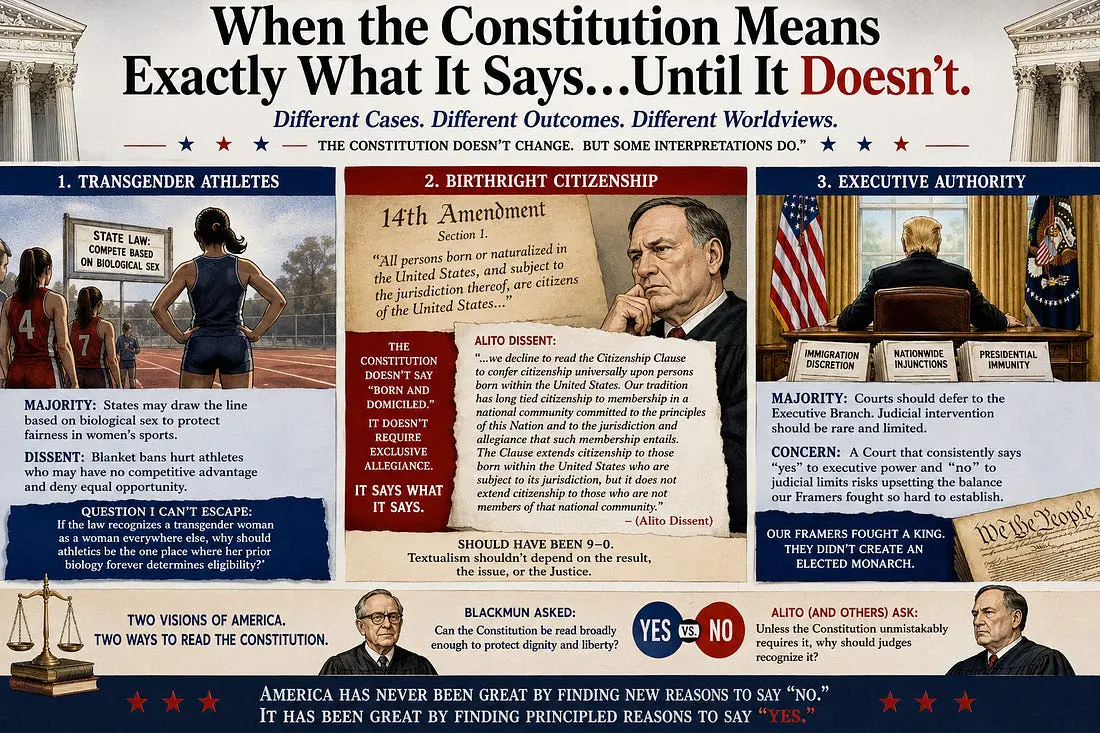
The Court upheld state laws restricting transgender girls and women from competing in girls’ and women’s athletic competitions.
The majority concluded that states may distinguish between biological sex and gender identity when regulating competitive athletics. Their stated concern was “fairness.” They determined that legislatures may conclude that physiological differences associated with male puberty justify maintaining athletic classifications based upon biological sex.
The dissent viewed the issue differently and argued that blanket exclusions ignore the individual circumstances of transgender athletes. As such, they unnecessarily deny an already vulnerable group equal participation. Not every transgender athlete presents the same physiology. Not every sport raises the same competitive concerns. A categorical rule inevitably excludes athletes who may possess no meaningful competitive advantage at all.
It is a difficult issue. And unlike many constitutional controversies, this one is understandable to reasonable people on both sides.
I believe the Court asked the wrong question.
The birthright citizenship case strikes me very differently. Here, the Constitution itself provides the answer for what should have been a slam-dunk 9-0 decision. But, sadly, the decision was 6-3.
The Fourteenth Amendment declares:
“All persons born or naturalized in the United States, and subject to the jurisdiction thereof, are citizens of the United States…”
Those words have governed American citizenship for more than 150 years.
The majority correctly concluded that the Citizenship Clause cannot be narrowed simply because a President—or three Supreme Court Justices— wish it to be.
The dissent argued that the Clause should be understood more narrowly, relying upon concepts such as domicile and allegiance.
Where does the Constitution say “born and domiciled”?
Where does it require exclusive allegiance?
It imposes none of the additional qualifications urged by the dissent.
If the Framers of the Fourteenth Amendment intended to require domicile or some heightened test of allegiance, they knew how to say so.
But they didn’t.
Statutes and constitutional language are sometimes subject to interpretation. Still, a fair reading should always begin with the words that were actually written—not the words someone wishes had been written.
That is why this should never have been a 6-3 case. It should have been unanimous.
The Court also continued what has become a significant and rather disturbing constitutional trend. Whether addressing presidential immunity, immigration policy, nationwide injunctions, or executive discretion generally, the Roberts Court has increasingly emphasized the authority of the Executive Branch while narrowing the circumstances under which courts may intervene.
The majority views this as restoring the constitutional separation of powers.
I disagree.
Our Framers created a constitutional republic built upon checks and balances because they feared the concentrated power that the Roberts Court is embracing. They had just fought a king. They did not intend to create an elected monarch.
In my view, every expansion of executive authority deserves scrutiny, regardless of which political party occupies the White House.
My reactions to the three outcomes were varied.
The transgender-athlete decision presents very difficult legal and moral questions.
Some transgender women may retain physiological advantages. That is a legitimate subject for scientific inquiry and public debate. But sports have never promised equal biology. In fact, they have always rewarded unequal biology.
Elite athletes celebrate extraordinary natural gifts. Some athletes are taller. Some are stronger. Some possess exceptional speed, endurance, coordination, reflexes, or other physical characteristics that the rest of us do not possess.
No one proposes excluding a basketball player because she is six-foot-eight.
No one bars a swimmer because she inherited an extraordinary wingspan.
No one tells a tennis player blessed with lightning-fast reflexes that her natural gifts make competition unfair.
Every elite athlete benefits from biology.
That is precisely why they become elite.
Which raises a question I cannot escape.
If the law recognizes a transgender woman as a woman in virtually every other aspect of life, why should athletics become the one place where her prior biology forever determines her eligibility?
The Court has answered that question, but I am not persuaded it reached the right conclusion.
The birthright citizenship decision leaves me with a different concern.
Unlike the transgender-athlete case, this is not primarily a debate about competing definitions of fairness. It is a debate about constitutional interpretation.
For years, many members of the Court have described themselves as strict constructionists or textualists. They constantly remind us that judges should not create rights or obligations not found in the constitutional text. They should not “legislate from the bench.”
I agree with that principle. But those who espouse it must be consistent. They must not be hypocrites. And that’s my problem with the dissenting Justices.
The Fourteenth Amendment defines birthright citizenship in plain language. It does not say what three Justices wish it said or what changing political winds might prefer it to say.
If judges refuse to recognize constitutional rights because the text does not expressly provide them, they should be equally unwilling to read additional restrictions into constitutional language that are not there.
Textualism should not depend upon the preferred result or the issue of the case. And it certainly shouldn’t depend upon a president’s or justice’s worldview.
Finally, I remain troubled by the Court’s continuing expansion of presidential authority.
Taken together, the immunity decision, the immigration decisions, and this Term’s executive-power cases reveal a Supreme Court increasingly willing to trust the President while limiting judicial intervention.
Does America need a stronger president, one who is immune to the checks and balances of the other branches of government? The majority seems to think so.
I respectfully disagree. The framers gave us three coequal branches of government for a reason.
What do I make of the Roberts Court? A constitutional philosophy that increasingly says “no” to the freedoms that make our democracy great.
“No” to broader readings of individual liberty.
“No” to broader readings of equality.
“No” to broader readings of constitutional protections.
Justice Harry Blackmun often asked whether the Constitution could be read broadly enough to protect individual dignity and liberty.
Justice Samuel Alito criticized that view—writing a historic opinion overturning a landmark decision written by Blackmun. But when birthright citizenship is the issue, suddenly expanding the plain language of the Constitution is acceptable? Alito is a Constitutional hypocrite. Why was Blackmun wrong in Roe v Wade, but Alito right in Trump v Barbara? Why is Alito so willing to ignore Supreme Court precedent when it suits him? United States v. Wong Kim Ark was an 1898 decision that reaffirmed the plain language of the Fourteenth Amendment.
These are starkly opposite points of view.
One asks whether liberty can be protected, while the other asks whether he can muster up enough votes to deny it.
Reasonable people can disagree about which philosophy is better. I know where I stand.
As America enters its 250th year, I continue to believe the greatness of this nation has never rested on finding new reasons to say “no.” It has always rested on our willingness, time and again, to find principled reasons to say “yes.”

Mark M. Bello is an attorney and award-winning author of the Zachary Blake Legal Thriller Series, ripped-from-the-headlines, realistic fiction that speaks truth to power and champions the rights of citizens in our justice system. These novels are dedicated to the social justice movement. They educate, spark discussion, and inspire readers to action. One of these was “Betrayal of Justice, a blistering novel about presidential misconduct and hypocrisy” For more information, please visit www.markmbello.com.
The post Supreme Court Potpourri II appeared first on Lean to the Left.