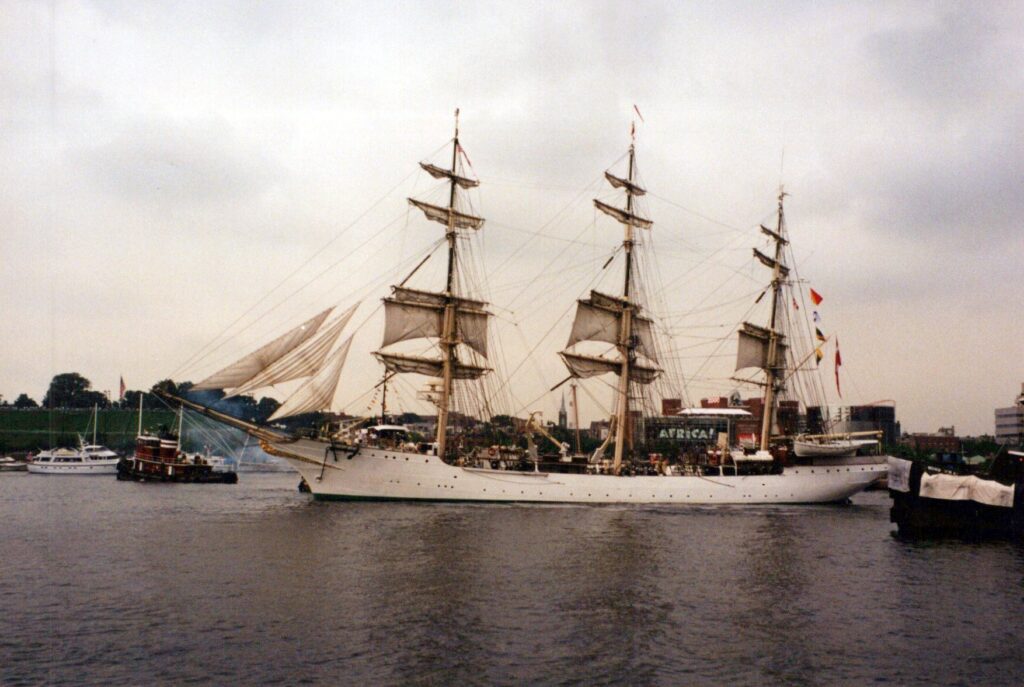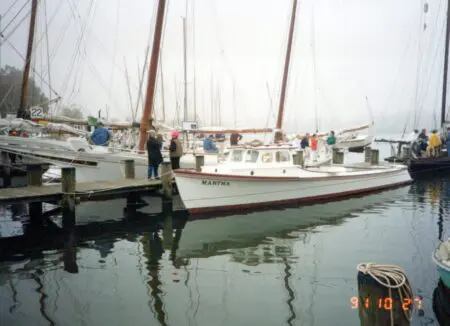

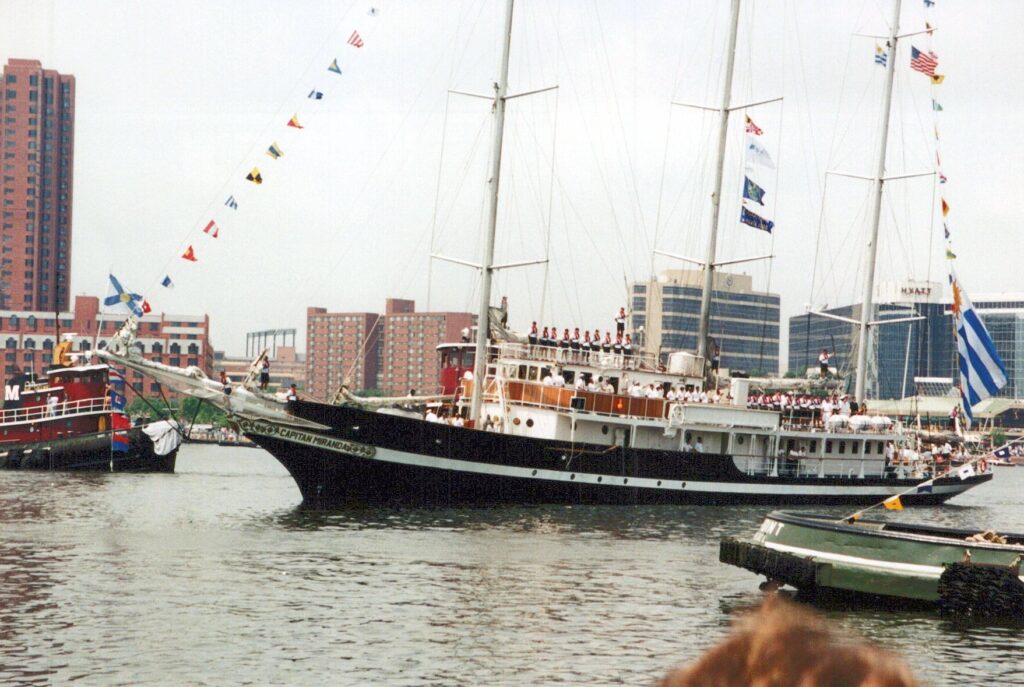
Attending Baltimore’s OpSail 2000 Tall Ships event was a once-in-a-lifetime experience. Seeing these magnificent vessels up close helped me appreciate how traditional merchant vessels and navies navigated the oceans without the luxury of engines and electronic equipment. Yes, many of them really did use sextants and compasses to find their way to the right destination (and back to their home ports).
Although Tall Ships often participate in major coastal cities’ maritime history events, the odds that I’ll ever see a Tall Ships gathering again are slim. Here in north central Florida, I’m not too far from New Orleans and Charleston, cities that previously hosted Tall Ships events. However, I’m not especially keen to fight port city traffic (and everything that goes with it) these days. Of course, if a few Tall Ships docked at a port less than an hour away, there’s a good chance I would change my mind.
On the morning of June 29, 2000, the Tall Ships berthed at Baltimore’s Inner Harbor were abuzz with activity. Since June 24, they had been docked at Harborplace and other Baltimore Harbor docks big enough for ships several hundred feet long. An estimated one million visitors came to view the Tall Ships at the Inner Harbor, Locust Point (the Port of Baltimore docks), Fells Point, and Canton.
This morning, the Tall Ships’ crews were preparing for the Parade of Sail that would wrap up the Baltimore stop on the OpSail 2000 East Coast Tour. Next, the Tall Ships would sail to New York City — for the July 4th celebrations, of course. A visit to Boston would follow, with Portland, Maine the final United States stop. Part of the Tall Ships fleet would then visit Nova Scotia on Canada’s Atlantic Coast.
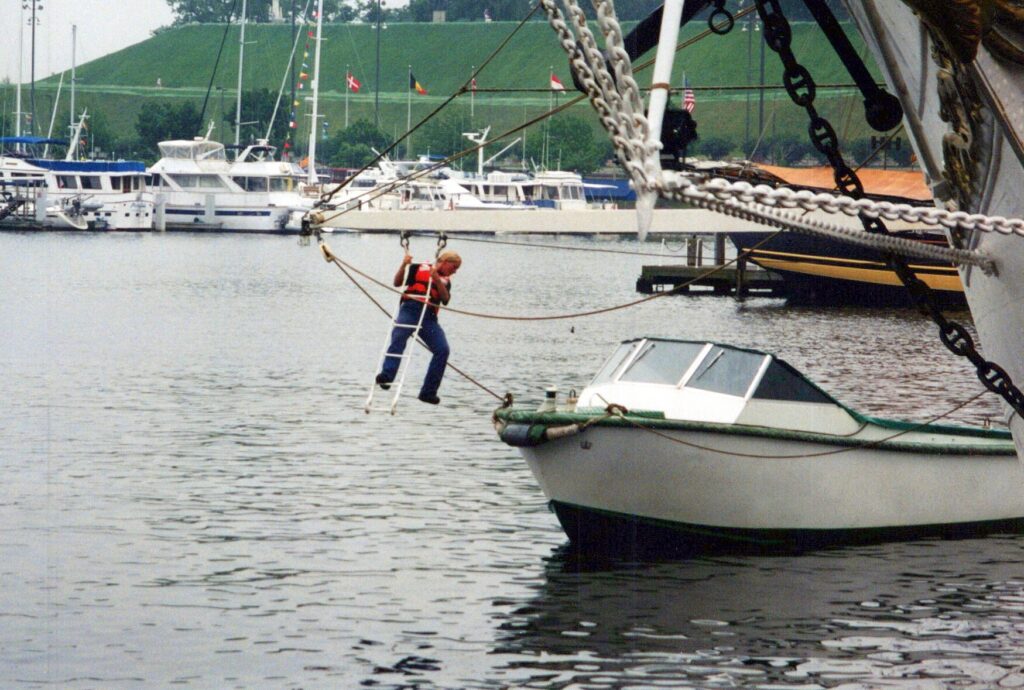
Before the Tall Ships could leave Baltimore Harbor, though, they needed to exit the dock without hitting the vessel in front of them — or the one behind them. Using the main engines wouldn’t be a cost-effective move, and these ships were far too big and heavy to maneuver off the docks using their lines.
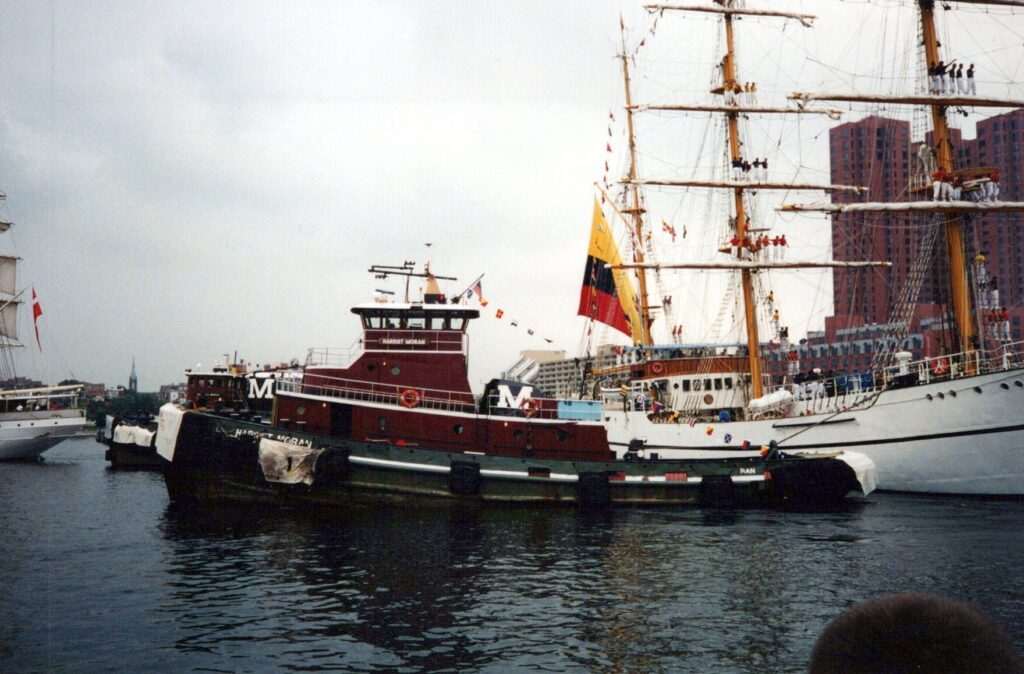
Fortunately, numerous tugboats with powerful engines were standing by. These tugs regularly assisted big cargo ships (such as container ships) into and away from their Port of Baltimore unloading docks. Using experience-driven strategy and engine power, the tug captains adeptly nudged (or shoved) each vessel’s bow or stern around to point the ship in the right direction.
From that perspective, moving a Tall Ship around was relatively simple. However, each tug captain had to dodge their assigned ship’s long, pointy bowsprit and rigging. But for tug captains who regularly perform close-quarter maneuvers among mammoth cargo ships, it was all in a day’s work.
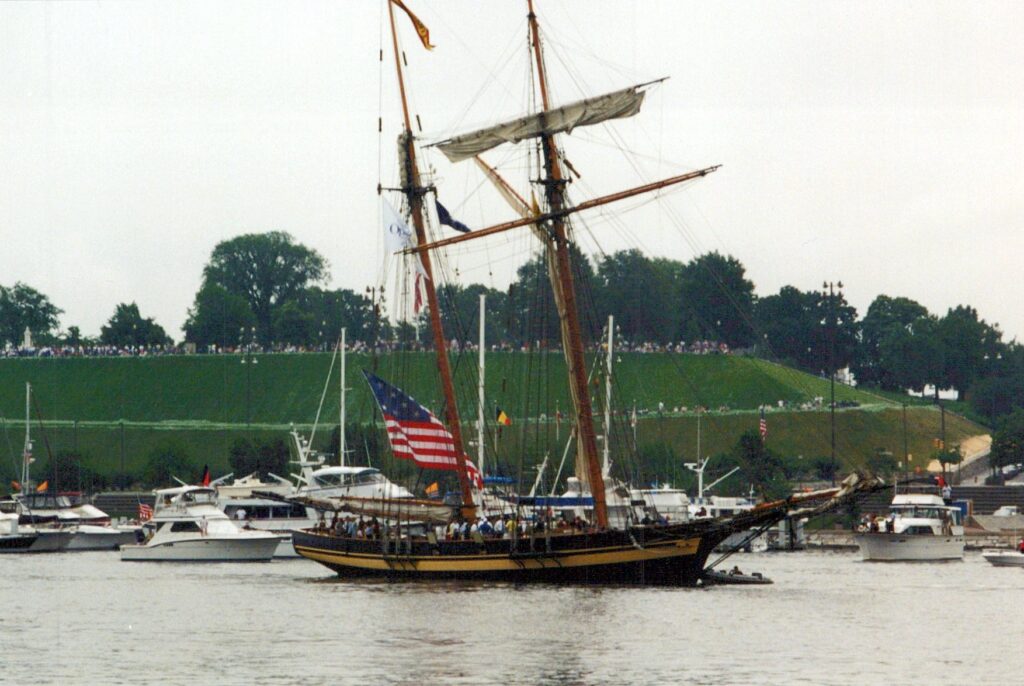
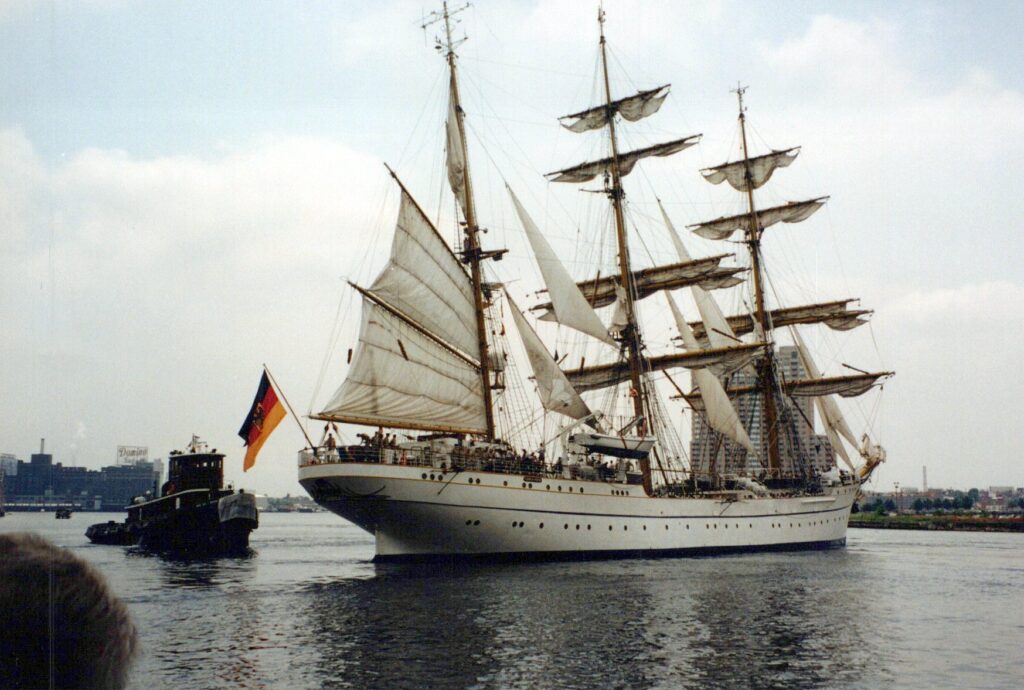
Finally, all Tall Ships were safely away from their docks. As they slowly motored out of Baltimore Harbor, several ships’ crews climbed into the rigging to unfurl the vessel’s sails. Although some Tall Ships use mechanical or electric winches for sail handling, the sail training vessels typically rely on the trainees’ muscle power.
The OpSail 2000 Parade of Sail was officially underway. As each Tall Ship cruised down the Patapsco River toward the Chesapeake Bay, dozens of recreational boats gathered to watch this spectacular event. A few tugboats also accompanied the vessels until they cleared the approach to Baltimore Harbor.
As the Tall Ships passed under the Francis Scott Key Bridge, vehicle occupants were treated to an epic view of these impressive vessels. And although most Tall Ships turned north toward New York City, a few headed south for a brief visit to Annapolis.
I’m finding the next part of this post much harder to write. For decades, Baltimore’s Francis Scott Key Bridge was a vital part of Baltimore’s Economy. Opened in 1977, this 1.6-mile-long structure was joined by miles of connecting roads. Together, the components spanned just over 10 miles.
For years, I had a personal connection to the Key Bridge. Living in eastern Baltimore County, and working at a company near BWI Airport, I commuted over the Key Bridge daily. As I cruised along the 185-foot high span, I always looked for the red, white, and blue buoy bobbing below. This buoy actually represents part of United States history.
During the War of 1812, Francis Scott Key composed the poem “The Defense of Fort McHenry” that later became The Star-Spangled Banner. At the time, he was a prisoner aboard a British ship anchored roughly in the buoy’s location. Key watched as American troops at Fort McHenry survived the British Navy’s relentless nighttime bombardment.
At 12:30 a.m. on March 26, 2024, the fully loaded, 947-foot-long Dali container ship left the Port of Baltimore’s Seagirt Marine Terminal. At 1:25 a.m., two electrical malfunctions rendered the ship’s main engine, lighting, and steering pumps inoperable. The crew fixed the first outage, but a second one occurred 100 feet from the Key Bridge.
Although the harbor pilot quickly made a hard port (left) turn, a lack of power to the propeller made a collision unavoidable. At 1:29 a.m., the Dali hit a Key Bridge pier, causing the bridge’s steel through-truss to fall into the Patapsco River. Six road maintenance workers were killed while two others were injured.
For two months, the Dali was trapped under the Francis Scott Key Bridge’s steel wreckage. Fortunately, the Army Corps of Engineers efficiently managed the debris’ removal, enabling the Dali to be refloated. At the same time, a deeper channel was dredged so ships trapped in the Port of Baltimore could leave. About 11 weeks after the Francis Scott Key bridge collapse, the channel completely reopened. This relatively quick turnaround minimized the economic impacts to Baltimore’s economy.