
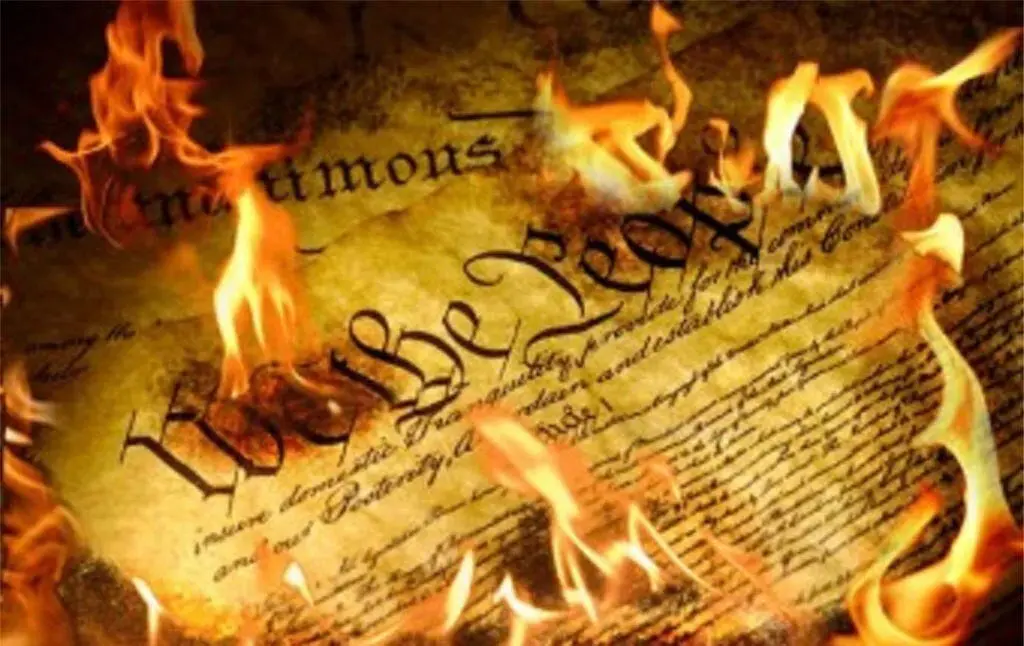
When the government kills a citizen it had no lawful reason to stop—and lies before it investigates—the Constitution is already bleeding.
Renée Nicole Good, a 37-year-old U.S. citizen and mother of three, was recently shot and killed by an ICE agent during a federal immigration enforcement operation in south Minneapolis. She had no criminal record. I repeat: She had no criminal record. But before a full investigation was even begun or any evidence was gathered, before witnesses were interviewed, before video footage of the incident was analyzed—America’s Secretary of Homeland Security rushed to blame . . . the victim.
That should chill every American who still believes in the rule of law. Because this case is not only about the tragic and unnecessary death of a young mother, it is about the parameters of law enforcement.
Do constitutional limits still matter when the government decides someone is inconvenient?
U.S. Immigration and Customs Enforcement (ICE) is a federal agency housed within the Department of Homeland Security. Its core mission is narrow: Enforce federal immigration law against non-citizens who are unlawfully present or removable under federal statute.
ICE is not a general police force.
ICE is not authorized to roam American cities and stop citizens at will.
ICE does not have special authority to detain or use force against U.S. citizens simply because they are present during an enforcement operation.
Immigration law applies to aliens, not citizens. That distinction is not semantic. It is constitutional.
Like every law-enforcement officer in America—local, state, or federal—ICE agents are bound to operate within the boundaries set by the Fourth Amendment to the Constitution, which prohibits unreasonable searches and seizures.
That means:
An officer must have reasonable suspicion to stop someone.
An officer must have probable cause to arrest someone.
Deadly force may be used only when there is an objectively reasonable belief of an imminent threat of death or serious bodily harm to the officer or others.
The fact that an officer wears a federal badge does not change the mandates of the Fourth Amendment. And crucially: a citizen does not lose constitutional protections because the government misidentifies them, panics, and acts recklessly.
Federal officers enjoy certain legal protections when acting within the scope of their lawful duties—but there is no blanket immunity for unlawful conduct.
They can be:
Criminally investigated when lethal force may be unjustified
Civilly sued under federal law
Held accountable when actions fall outside lawful authority
The Constitution does not recognize a “federal officer exception” to due process. Nor does it permit the government to kill first and make up excuses later.
Based on publicly available video and reporting, several facts appear undisputed:
The woman shot was not a target of any immigration enforcement action.
She was not suspected of a crime.
She was a U.S. citizen, lawfully present at the scene.
She was in her vehicle and attempting to leave the scene.
And yet, almost immediately afterward, DHS Secretary Kristi Noem publicly suggested—without any investigation—that the victim was to blame for attempting to run an officer over.
That claim matters. Because if it’s false—or even recklessly premature—it is not just irresponsible. It is dangerous. In America, the government does not get to write its own exculpatory narrative while the evidence is still warm.
If a citizen is not suspected of a crime, there is no lawful basis to stop them.
If a citizen attempts to leave an encounter they had no legal obligation to submit to, that is not aggression. That is freedom.
If law enforcement escalates a situation it had no right to initiate, the resulting danger is not the citizen’s fault.
And if the government claims a vehicle was used as a deadly weapon, the burden is on the government to prove it.
Video exists precisely because history has taught us what happens when official narratives go unchallenged.
What, exactly, was the lawful reason for this stop? Not the post-hoc justification.
Not the talking points. Not the press-conference spin. What specific, articulable, lawful reason did ICE have to stop this woman? If the answer is none, everything that follows is constitutionally suspect.
This is not an “immigration issue.”
It is not a “blue city” issue.
It is not even a partisan issue.
This is a government power issue.
When federal agents can kill a citizen who was not suspected of a crime—and senior officials rush to smear the dead before facts are known— we are all in danger. Unchecked power is a danger to every person, citizen or non-citizen, in this country.
America is not supposed to be a country where:
The government shoots first
Blames the victim immediately
Controls the investigation
And demands public trust without public proof.
That is not law enforcement or constitutional governance. And it is certainly not justice. If the rule of law still means anything, this case demands independent investigation, transparency, and accountability—not reflexive loyalty to those in power. Because when the Constitution becomes optional, what citizen is truly safe?

Mark M. Bello is an attorney and award-winning author of the Zachary Blake Legal Thriller Series, ripped-from-the-headlines, realistic fiction that speaks truth to power and champions the rights of citizens in our justice system. These novels are dedicated to the social justice movement. They educate, spark discussion, and inspire readers to action. One of these novels, Betrayal High, was written in response to school shootings. For more information, please visit www.markmbello.com.