

 By Mark M. Bello
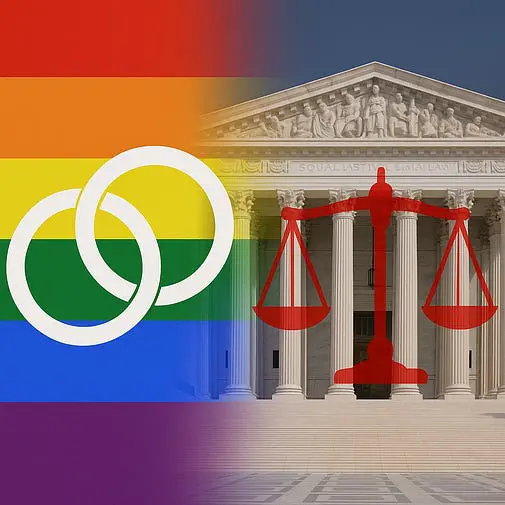
When the Supreme Court quietly declined to hear a case seeking to overturn Obergefell v. Hodges, the landmark decision legalizing same-sex Marriage, the silence was thunderous. The Court said nothing — and that’s precisely what made it powerful. For now, at least, marriage equality stands.
But beneath the relief lies a question that deserves renewed attention: Why was the Court willing to dismantle Roe v. Wade but not Obergefell? Both issues provoke moral outrage from many of the same religious quarters. Both divide America along cultural and theological lines. Yet constitutionally, the two stand on very different ground.
Roe v. Wade always stood on shaky constitutional legs. It was a landmark of compassion, but not of textual Clarity. The decision rested on a “right to privacy” — a noble concept but one found nowhere in the Constitution’s words. Instead, the Court inferred it from the 14th Amendment’s Due Process Clause and earlier cases like Griswold, which recognized privacy in marital contraception decisions.
That reasoning never sat comfortably with strict constructionists. Once a conservative majority took control, they had an easy doctrinal path to reverse course. In Dobbs v. Jackson Women’s Health Organization (2022), the Court declared that because abortion isn’t mentioned in the Constitution and isn’t “deeply rooted” in the nation’s history or traditions, it was never a constitutional right in the first place. Privacy — once seen as a shield of personal liberty — became, in their view, a judicial invention ripe for demolition.
Obergefell, however, is different. It doesn’t depend on penumbras or implied privacy rights. It rests directly on two explicit constitutional guarantees:liberty and equal protection under the 14th Amendment.
Justice Anthony Kennedy’s majority opinion recognized that the freedom to marry is a fundamental right inherent in the concept of individual liberty, and that denying that right to same-sex couples violates equal protection. The case wasn’t about sex, religion, or even morality — it was about citizenship. About whether two people who Love each other can enjoy the same legal dignity as everyone else.
That’s what makes marriage equality constitutionally durable. It isn’t grounded in judicial empathy; it’s grounded in text. It doesn’t rely on what the Founders “might have meant”; it relies on what the 14th Amendment explicitly says: No state shall deny to any person within its jurisdiction the equal protection of the laws.
Of course, opposition remains fierce — largely from religious communities that view homosexuality as sin and marriage as divinely defined. That belief is protected by the First Amendment, as it should be. But the same amendment that protects religious freedom also forbids the government from imposing religious doctrine on the rest of us, including members of the LGBTQ+ community.
That’s the constitutional firewall that distinguishes Obergefell from Dobbs. The abortion debate was framed as “Who decides?” — the woman or the state? The marriage debate is about “Who belongs?” — whether LGBTQ+ citizens are equal under the law, regardless of religion. One concerns the scope of state power; the other concerns the definition of citizenship itself.
So yes, both fights are moral. Both are political. But only one is unambiguously constitutional.
The right to marry the person you love — regardless of gender — flows directly from the principles of liberty, equality, and religious neutrality that define the American experiment. The right to terminate a pregnancy, however just or necessary it may be in a moral sense, was always built on a more precarious legal foundation.
That’s why Obergefell endures where Roe fell. And that’s why, in a nation forever divided between church and state, the Constitution — not scripture — must remain our ultimate moral compass.

Mark M. Bello is an attorney and author of 9 Zachary Blake Legal Thrillers and other legal themed novels and children’s books. For more information, please visit https://www.markmbello.com