
What’s Inside
AI tools are leaving the office and reaching the frontline
Startups like WorkWhile and Teambridge are redefining hourly work
Investors see a new market where AI meets the real Economy
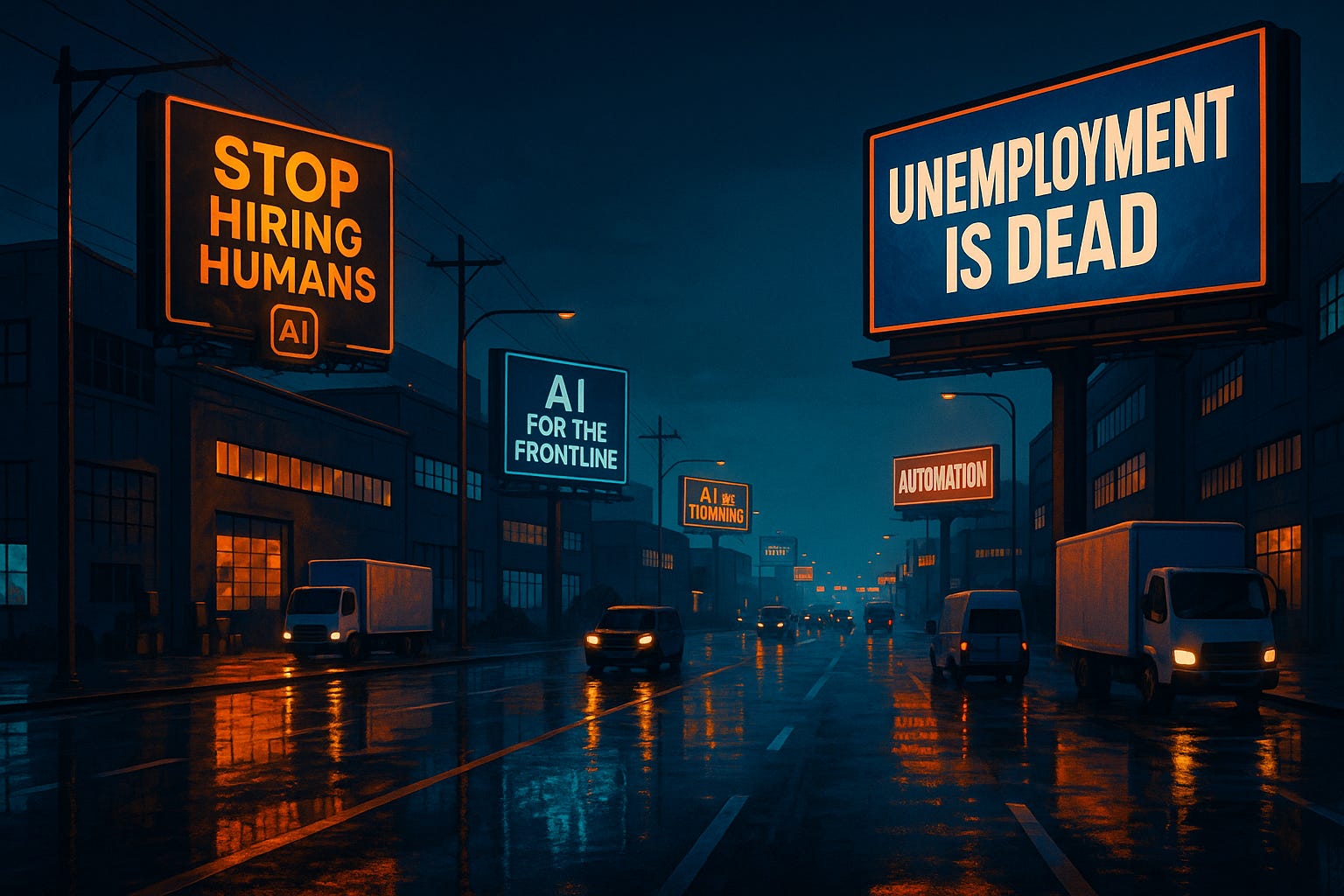
Drive on the busy stretch of Highway 101 between Mountain View and South San Francisco and you get a visual mood board of Silicon Valley: billboards promising to make work faster, smarter and more automated.
These ads offer a snapshot of tech’s AI priorities: copilots for engineers, chatbots for recruiters, agentic platforms for knowledge workers. The slogans shout “Stop hiring humans” and “Software ate the world — now AI eats software.”
These billboards target the same audience that’s always driven this corridor — investors, founders and engineers — not the people using the tech on factory floors or loading docks.
Years ago, though, the billboards told a different story. They were about the cloud. Companies like Box, Salesforce and Workday plastered the sides of the road with slogans that tried to make enterprise software sound almost cool.
One of Box’s most memorable signs read, “Enterprise software sucks,” and then added, “Enterprise software doesn’t have to.” It was 2012, and the message was part rebellion, part promise that cloud computing would democratize software and make it as simple as opening a browser.
That revolution happened. Software became easier, cheaper and far more ubiquitous. But the targeted audience was people who work from behind desks.
“Drive down 101 and you’ll see the proof. Most of us are building software for each other,” said Arjun Vora, co-founder of Teambridge, which helps companies manage hourly workforces using AI to automate scheduling and communication.
In pointing out that divide, Vora said that the tech world has spent decades optimizing knowledge work while leaving the rest of the workforce — the warehouse crews, janitors, delivery drivers and hospital staff — to paper schedules, text chains and outdated tools.
And the messages on the side of Highway 101 support that notion. The billboards aren’t designed for motorists commuting to hourly jobs. They’re built for peers and tech insiders. They’re social and professional signaling tools, reminders to each other that progress is being made online.
That divide shows up in the numbers, too. Roughly 2.7 billion people — about 80% of the global workforce — don’t work behind desks. But they receive only 1% of the $300 billion spent each year on enterprise software. In the U.S. alone, about 80 million hourly and frontline workers power industries like healthcare, manufacturing and Retail, and more than half report feeling burnt out.
Still, optimism is rising. It’s projected that three out of four new mobile initiatives by the end of this year will target frontline workers, part of a global market for deskless-worker training expected to double to $40 billion by 2027, according to a report in AInvest.
And now Artificial Intelligence is starting to reach the broader workforce.
A few miles north of the Highway 101 corridor, Jarah Euston, CEO of WorkWhile, has her own message up in downtown San Francisco. Her company’s billboard doesn’t promise efficiency or disruption. The sign simply reads: “Unemployment Is Dead.”
It’s not aimed at the tech elite, but at the people who make the city move, the frontline workers who Euston says are overlooked in every tech wave. That is, until now.
For them, AI isn’t a headline or a hype cycle. It’s a tool that might finally make their jobs fairer, safer and less chaotic.
WorkWhile operates in what Euston calls the “real economy,” the part of the labor market that keeps warehouses running, kitchens staffed and deliveries on time.
Founded in 2018, the company connects available hourly workers with open shifts that match their skills and location. The platform uses AI to automate screening, scheduling and training, with a growing focus on voice-based tools that let workers confirm experience and receive training prompts through natural conversation.
Euston said the goal isn’t to replace managers but to make the work experience less chaotic and more fair.
“AI can make hourly work better for everyone if it’s used right,” she said. “It can make the system more transparent.”
WorkWhile’s expansion follows a $23 million Series B to support its push to bring more data and AI to what Euston calls “America’s most underserved labor force.” With that community numbering roughly 80 million hourly workers, she sees potential in offering Technology that helps more people find a job and stay employed.
That focus on fairness and access is now drawing investors who see opportunity in the workers that tech has mostly ignored, the people in manufacturing, logistics, healthcare and hospitality who are now emerging as AI’s next major frontier.
Founders like Euston and Vora are showing that AI’s next expansion isn’t about writing code or summarizing meetings. It’s about transforming how everyday work gets done.
Ryan Falvey, co-founder of Restive Ventures, views this shift through a financial lens.
The firm has been the leading public voice promoting and defining “AiFi” — short for AI-powered Finance — as an industry framework to describe how intelligent systems are beginning to reshape banking and beyond.
On his blog, Falvey argued that AiFi is to fintech what fintech was to traditional banking: a phase of democratization, powered by infrastructure that lowers the barrier to entry. When we spoke, he said the same pattern is now playing out across industries.
“Companies are made of people, and AI will touch all of them,” Falvey said. The divide, he added, isn’t between white- and blue-collar work but between those who can afford paid tools and those using free versions on their phones.
He mentioned examples like a waiter using ChatGPT to explain menu items or write a social post. These are small, practical use cases that show how AI literacy is spreading outside the office.
The pattern is familiar: consumer adoption first, enterprise adoption later.
“We saw payments Innovation start with peer-to-peer apps and only later reshape banks,” Falvey said. “The same thing is happening here — except AI moves faster.”
That logic explains why investors are watching companies such as WorkWhile and Teambridge closely. They’re reimagining how labor and intelligence connect, which Falvey calls “AI for participation.”
Monique Woodard of Cake Ventures said companies, such as Abridge, Cloud Trucks and Toast are showing the potential of tools built for the physical economy. The IPO of ServiceTitan late last year, she added, marked a tipping point, showing that software for trades and blue-collar jobs can scale just as fast as SaaS built for the office.
“Every enterprise category is trying to figure out where AI fits into their stack,” Woodard said. “Categories that have traditionally had fewer tools and less innovation targeted at them — like healthcare systems — have limped along with Legacy software and they’re not expecting that legacy software to evolve. They’re proactively testing and adopting AI-native products.”
The pattern is spreading quickly across sectors, from fintech and healthcare to logistics and hospitality.
Vora at Teambridge describes the shift as “AI’s blue-collar moment.” He argues that while the last decade was about digitizing workflows, this one is about intelligence reaching every worker.
“AI isn’t about replacing people,” he said. “It’s about giving them the same kind of tools and insights that knowledge workers have had for years.”
He points to industries like construction and hospitality, where AI can handle shift swaps, predict absences and auto-adjust staffing based on demand or weather.
“We’re taking what used to be reactive and making it proactive.”
At the same time, AI is finding its way into the operations that keep the economy moving. FluxAI, a division of InFlux Technologies, is deploying agents across logistics, healthcare and manufacturing.
In a national retail example, their system cut delayed shipments by 30% and reduced manual coordination by 40%, according to the company. In healthcare, AI agents plugged into Epic and Cerner EHRs to automate prior authorizations and scheduling, giving nurses two hours per shift back for patient care, the company reported.
FluxAI’s VP of Sales and GTM, Donovan Lazar, said their systems act as a force multiplier.
“The AI doesn’t replace frontline workers, it redesigns their jobs for the better,” he said. “Efficiency improves and morale rises when AI is treated as a partner, not a monitor.”
Another example comes from AIO, a restaurant-focused AI platform used by chefs and servers to manage orders, prep times and customer communication.
The app can predict prep levels based on traffic patterns and menu data. AIO shows how generative AI is filtering into everyday hospitality jobs, the kinds that never had digital tools designed for them.
Other startups are targeting the same frontier. Frame, which is backed by Cake Ventures, uses AI to help fertility clinicians manage caseloads. Another example is Carebrain, which connects to EHR systems to free nurses from repetitive operational work.
These examples highlight a deeper point: AI is no longer confined to dashboards. It’s moving into the daily rhythm of work, routing deliveries, scheduling nurses, maintaining machines.
Even industrial giants are leaning into the transformation. Samsara, known for its logistics and fleet monitoring systems, is one of them.
Kiren Sekar, chief product officer at Samsara, said that the biggest AI opportunity lies not with desk workers but with the people who keep physical operations running, such as drivers, dispatchers and maintenance crews.
“When we put AI in their hands, it acts as a co-pilot to solve high-stakes, real-world problems,” he said.
At Samsara, that means using AI to analyze real-time video and detect risks like distracted or drowsy driving, delivering in-cab alerts that have reduced preventable incidents by more than 90 percent. AI is also changing how dispatchers work, shifting the job from “reactive whack-a-mole” to proactive planning, Sekar said.
Other deployments automate maintenance tasks and compliance workflows. Partners such as Sterling Crane Canada have saved more than $500,000 annually by automating invoices and inspection reports, while voice-to-text tools now make vehicle inspections faster and safer even in noisy environments.
Sekar said that these systems act as AI copilots for the real economy.
“We’re all just scratching the surface of what’s possible,” he said.
Back to Highway 101, the billboards haven’t changed much. They still stand as a proxy for Silicon Valley’s tech pulse. They flash with promises of what AI can do with copilots and automation for the white-collar workers.
But the promise of what a technology — in this case, AI — can do for others is starting to matter beyond the freeway.
The WorkWhile campaign might sound like marketing, but Euston insists it’s a statement of intent, a challenge to rethink what work looks like when AI stops serving only the privileged.
It’s a counterpoint to the neon confidence of Silicon Valley, a reminder that the next big platform might not be built for founders and investors driving past, but for everyone else waiting for technology to finally show up for them.
Editorial image generated using AI assistance. Image concept by the author.