


n
The big firms recruit top university students to join for an average of two years before they go on u2018to industry,u201d or graduate school. Firms recruit at masters and PhD programs in business, law and STEM . Firms recruit mid-career specialists or senior executives with large networks for client acquisition roles. Recruiters also look for consultants who might change firms for more Money or a clearer promotion path.
n
Most consultants stay in the field for between two to five years. Many firms have an u201cup or outu201d or u201cgrow or gou201d policy to ensure that they keep the most productive people.u00a0 Consulting firms have worked on life balance, but consulting is still a hard job with long hours and lots of Travel.
n
Firms quote annual staff turnover of 9 -15%u00a0 Most observers think that is conservative. Also, consulting is extremely sensitive to business cycles. Firms laid off people during Covid, over-hired immediately after, and had more layoffs when the business didnu2019t maintain the post -pandemic rebound rate.
n
Given all this, one might think that consulting firms would be good at on-boarding new consultants. Some are; others are not very good at bringing new people on board.
n
n
On-boarding is new hiresu2019 introduction to the work and culture of the firm so they can be productive as soon as possible. This Education begins during recruitment, but then the new hire and the firm are putting on the best face to close the deal.
n
Consulting work is complex and fast paced. Consulting firms hire smart, nice, people. They want quick learners who get along with clients and teams and are easily managed.u00a0 Firms never tell you this but they want over-achievers, those of us who are a little insecure, whou2019ll work harder. These are u201cready-fire-aimu201d folks, who often cover what they donu2019t know with feigned confidence. This is why consultants are described as u201cfrequently wrong, but never in doubt.u201d
n
n
Most large consulting firms, have a new hire briefing pack, with a welcome letter from the Managing Partner, maybe a history of the firm, Human Resource data to be filled out and confirmed, payroll direct deposit data, an employee manual. Smaller firms may provide this information less formally.
n
From there the on-boarding methods vary considerably, but there is usually some kind of new hire orientation, some training about the methodologies of the firm, both generally and specific to assigned project work. As time progresses there may be team events, conferences, lessons learned sessions. Some firms have formal mentoring programs; some use a less formal peer mentoring in a u201cbuddy system.u201d
n
n
At Gemini Consulting, everyone, regardless of level, went through a two-week residential program call Gemini Skills Workshop (GSW). This program included formal training in all Geminiu2019s methodologies, and specific consulting skills. Gemini was a strong team based culture, so there were many team building exercises and a simulated client project that you worked in teams for the two weeks to deliver. The project presentation was evaluated by officers of the firm and occasionally a client.
n
It was not unusual for the days to run from 7:00 a.m.-11:00 p.m. We were told that people were u201cwashed outu201d during GSW, mostly for treating colleagues poorly under pressure. In truth that happened infrequently, but in my session and those I coached as a principal, some people were u201cspoken to.u201d
n
Strong career-long Relationships were formed at GSW. There was further training at Gemini University over your whole career. GSW was created so that consultants could show up on a project anywhere in the world and instantly form teams as a part of one unified culture. For the most part that worked, and when ex-Gemini people get together they talk wistfully about Geminiu2019s u201cmagic culture.u201d
n
At the Forum corporation, there was a one week orientation, but Forum sold training and everyone had to take every course and learn to deliver at least one program. Everyone trained, regardless of role.
n
Katzenbach Partners, a McKinsey spin-off, was start-up when I joined. There was no formal training. I was experienced but not in the McKinsey Way. Later, I helped establish some formal training.
n
n
When I started at Harbridge House Europe (HHE), I was a second year London Business School student. All the training was about learning the commercial vehicle industry. It consisted of the firm librarian using materials from past u201ccases,u201d and industry executives and consultants lecturing and grilling us on content.
n
That kind of intense project education existed to varying degrees in the firms where I worked and all those where I have friends. Gemini had project introduction decks, put together by the second level. You learn best what you teach others. In places where this project orientation was poorly done, projects did not go well, no matter how experienced the team was. Starting on the same page matters.
n
n
Gemini had a formal mentoring program, but mentees were assigned and results were spotty. Katzenbach Partners had a less formal u201cbuddy systemu201d of peer mentors, which seemed to work well especially at junior levels. The founding partners had their favorite protu00e9gu00e9s, but when I was there, the pyramid was too thin for a more formal system. In the smaller firms where I worked, I was fortunate to have some great mentors, like Dick Connell at HHE, and Dr. George Litwin at HRI, but not everyone was so fortunate
n
n
n
n
n
n
Consultants often work on processes like on-boarding for their clients, but fail to apply the same principles to their own firms. In a downturn their training and mentoring programs are cut, even when theyu2019d advise clients not to do that. Some even joke about it using a clichu00e9 from medieval times, u201cthe cobbleru2019s children have no shoes.u201d
n
On-boarding isnu2019t a joke or unnecessary fluff, it is the life-blood of the specialized service of consulting firms.
n
n
Traveling t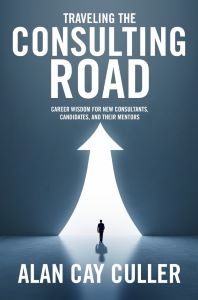 he Consulting Road: Career Wisdom for New Consultants, Candidates, and Their Mentors is a complete consulting career guide. This book describes what it’s like to become a consultant including how to get hired and promoted, how to start a consulting firm, whether to become an independent consultant, and how to find and serve clients.
n
The book includes clear descriptions of the frameworks, tools, and methodologies in the consulting toolkit to master at various points in a consulting career.
n
Available here
“,”tablet”:”
n
The big firms recruit top university students to join for an average of two years before they go on u2018to industry,u201d or graduate school. Firms recruit at masters and PhD programs in business, law and STEM . Firms recruit mid-career specialists or senior executives with large networks for client acquisition roles. Recruiters also look for consultants who might change firms for more money or a clearer promotion path.
n
Most consultants stay in the field for between two to five years. Many firms have an u201cup or outu201d or u201cgrow or gou201d policy to ensure that they keep the most productive people. Consulting firms have worked on life balance, but consulting is still a hard job with long hours and lots of travel.
n
Firms quote annual staff turnover of 9 -15% Most observers think that is conservative. Also, consulting is extremely sensitive to business cycles. Firms laid off people during Covid, over-hired immediately after, and had more layoffs when the business didnu2019t maintain the post -pandemic rebound rate.
n
Given all this, one might think that consulting firms would be good at on-boarding new consultants. Some are; others are not very good at bringing new people on board.
n
n
On-boarding is new hiresu2019 introduction to the work and culture of the firm so they can be productive as soon as possible. This education begins during recruitment, but then the new hire and the firm are putting on the best face to close the deal.
n
Consulting work is complex and fast paced. Consulting firms hire smart, nice, people. They want quick learners who get along with clients and teams and are easily managed. Firms never tell you this but they want over-achievers, those of us who are a little insecure, whou2019ll work harder. These are u201cready-fire-aimu201d folks, who often cover what they donu2019t know with feigned confidence. This is why consultants are described as u201cfrequently wrong, but never in doubt.u201d
n
n
Most large consulting firms, have a new hire briefing pack, with a welcome letter from the Managing Partner, maybe a history of the firm, Human Resource data to be filled out and confirmed, payroll direct deposit data, an employee manual. Smaller firms may provide this information less formally.
n
From there the on-boarding methods vary considerably, but there is usually some kind of new hire orientation, some training about the methodologies of the firm, both generally and specific to assigned project work. As time progresses there may be team events, conferences, lessons learned sessions. Some firms have formal mentoring programs; some use a less formal peer mentoring in a u201cbuddy system.u201d
n
n
At Gemini Consulting, everyone, regardless of level, went through a two-week residential program call Gemini Skills Workshop (GSW). This program included formal training in all Geminiu2019s methodologies, and specific consulting skills. Gemini was a strong team based culture, so there were many team building exercises and a simulated client project that you worked in teams for the two weeks to deliver. The project presentation was evaluated by officers of the firm and occasionally a client.
n
It was not unusual for the days to run from 7:00 a.m.-11:00 p.m. We were told that people were u201cwashed outu201d during GSW, mostly for treating colleagues poorly under pressure. In truth that happened infrequently, but in my session and those I coached as a principal, some people were u201cspoken to.u201d
n
Strong career-long relationships were formed at GSW. There was further training at Gemini University over your whole career. GSW was created so that consultants could show up on a project anywhere in the world and instantly form teams as a part of one unified culture. For the most part that worked, and when ex-Gemini people get together they talk wistfully about Geminiu2019s u201cmagic culture.u201d
n
At the Forum corporation, there was a one week orientation, but Forum sold training and everyone had to take every course and learn to deliver at least one program. Everyone trained, regardless of role.
n
Katzenbach Partners, a McKinsey spin-off, was start-up when I joined. There was no formal training. I was experienced but not in the McKinsey Way. Later, I helped establish some formal training.
n
n
When I started at Harbridge House Europe (HHE), I was a second year London Business School student. All the training was about learning the commercial vehicle industry. It consisted of the firm librarian using materials from past u201ccases,u201d and industry executives and consultants lecturing and grilling us on content.
n
That kind of intense project education existed to varying degrees in the firms where I worked and all those where I have friends. Gemini had project introduction decks, put together by the second level. You learn best what you teach others. In places where this project orientation was poorly done, projects did not go well, no matter how experienced the team was. Starting on the same page matters.
n
n
Gemini had a formal mentoring program, but mentees were assigned and results were spotty. Katzenbach Partners had a less formal u201cbuddy systemu201d of peer mentors, which seemed to work well especially at junior levels. The founding partners had their favorite protu00e9gu00e9s, but when I was there, the pyramid was too thin for a more formal system. In the smaller firms where I worked, I was fortunate to have some great mentors, like Dick Connell at HHE, and Dr. George Litwin at HRI, but not everyone was so fortunate
n
n
n
n
n
n
Consultants often work on processes like on-boarding for their clients, but fail to apply the same principles to their own firms. In a downturn their training and mentoring programs are cut, even when theyu2019d advise clients not to do that. Some even joke about it using a clichu00e9 from medieval times, u201cthe cobbleru2019s children have no shoes.u201d
n
On-boarding isnu2019t a joke or unnecessary fluff, it is the life-blood of the specialized service of consulting firms.
n
n
Traveling the Consulting Road: Career Wisdom for New Consultants, Candidates, and Their Mentors is a complete consulting career guide. This book describes what it’s like to become a consultant including how to get hired and promoted, how to start a consulting firm, whether to become an independent consultant, and how to find and serve clients.
n
The book includes clear descriptions of the frameworks, tools, and methodologies in the consulting toolkit to master at various points in a consulting career.
n
Available here
“,”phone”:”
n
The big firms recruit top university students to join for an average of two years before they go on u2018to industry,u201d or graduate school. Firms recruit at masters and PhD programs in business, law and STEM . Firms recruit mid-career specialists or senior executives with large networks for client acquisition roles. Recruiters also look for consultants who might change firms for more money or a clearer promotion path.
n
Most consultants stay in the field for between two to five years. Many firms have an u201cup or outu201d or u201cgrow or gou201d policy to ensure that they keep the most productive people. Consulting firms have worked on life balance, but consulting is still a hard job with long hours and lots of travel.
n
Firms quote annual staff turnover of 9 -15% Most observers think that is conservative. Also, consulting is extremely sensitive to business cycles. Firms laid off people during Covid, over-hired immediately after, and had more layoffs when the business didnu2019t maintain the post -pandemic rebound rate.
n
Given all this, one might think that consulting firms would be good at on-boarding new consultants. Some are; others are not very good at bringing new people on board.
n
n
On-boarding is new hiresu2019 introduction to the work and culture of the firm so they can be productive as soon as possible. This education begins during recruitment, but then the new hire and the firm are putting on the best face to close the deal.
n
Consulting work is complex and fast paced. Consulting firms hire smart, nice, people. They want quick learners who get along with clients and teams and are easily managed. Firms never tell you this but they want over-achievers, those of us who are a little insecure, whou2019ll work harder. These are u201cready-fire-aimu201d folks, who often cover what they donu2019t know with feigned confidence. This is why consultants are described as u201cfrequently wrong, but never in doubt.u201d
n
n
Most large consulting firms, have a new hire briefing pack, with a welcome letter from the Managing Partner, maybe a history of the firm, Human Resource data to be filled out and confirmed, payroll direct deposit data, an employee manual. Smaller firms may provide this information less formally.
n
From there the on-boarding methods vary considerably, but there is usually some kind of new hire orientation, some training about the methodologies of the firm, both generally and specific to assigned project work. As time progresses there may be team events, conferences, lessons learned sessions. Some firms have formal mentoring programs; some use a less formal peer mentoring in a u201cbuddy system.u201d
n
n
At Gemini Consulting, everyone, regardless of level, went through a two-week residential program call Gemini Skills Workshop (GSW). This program included formal training in all Geminiu2019s methodologies, and specific consulting skills. Gemini was a strong team based culture, so there were many team building exercises and a simulated client project that you worked in teams for the two weeks to deliver. The project presentation was evaluated by officers of the firm and occasionally a client.
n
It was not unusual for the days to run from 7:00 a.m.-11:00 p.m. We were told that people were u201cwashed outu201d during GSW, mostly for treating colleagues poorly under pressure. In truth that happened infrequently, but in my session and those I coached as a principal, some people were u201cspoken to.u201d
n
Strong career-long relationships were formed at GSW. There was further training at Gemini University over your whole career. GSW was created so that consultants could show up on a project anywhere in the world and instantly form teams as a part of one unified culture. For the most part that worked, and when ex-Gemini people get together they talk wistfully about Geminiu2019s u201cmagic culture.u201d
n
At the Forum corporation, there was a one week orientation, but Forum sold training and everyone had to take every course and learn to deliver at least one program. Everyone trained, regardless of role.
n
Katzenbach Partners, a McKinsey spin-off, was start-up when I joined. There was no formal training. I was experienced but not in the McKinsey Way. Later, I helped establish some formal training.
n
n
When I started at Harbridge House Europe (HHE), I was a second year London Business School student. All the training was about learning the commercial vehicle industry. It consisted of the firm librarian using materials from past u201ccases,u201d and industry executives and consultants lecturing and grilling us on content.
n
That kind of intense project education existed to varying degrees in the firms where I worked and all those where I have friends. Gemini had project introduction decks, put together by the second level. You learn best what you teach others. In places where this project orientation was poorly done, projects did not go well, no matter how experienced the team was. Starting on the same page matters.
n
n
Gemini had a formal mentoring program, but mentees were assigned and results were spotty. Katzenbach Partners had a less formal u201cbuddy systemu201d of peer mentors, which seemed to work well especially at junior levels. The founding partners had their favorite protu00e9gu00e9s, but when I was there, the pyramid was too thin for a more formal system. In the smaller firms where I worked, I was fortunate to have some great mentors, like Dick Connell at HHE, and Dr. George Litwin at HRI, but not everyone was so fortunate
n
n
n
n
n
n
Consultants often work on processes like on-boarding for their clients, but fail to apply the same principles to their own firms. In a downturn their training and mentoring programs are cut, even when theyu2019d advise clients not to do that. Some even joke about it using a clichu00e9 from medieval times, u201cthe cobbleru2019s children have no shoes.u201d
n
On-boarding isnu2019t a joke or unnecessary fluff, it is the life-blood of the specialized service of consulting firms.
n
n
n
Traveling the Consulting Road: Career Wisdom for New Consultants, Candidates, and Their Mentors is a complete consulting career guide. This book describes what it’s like to become a consultant including how to get hired and promoted, how to start a consulting firm, whether to become an independent consultant, and how to find and serve clients.
n
The book includes clear descriptions of the frameworks, tools, and methodologies in the consulting toolkit to master at various points in a consulting career.
n
Available here
“}},”slug”:”et_pb_text”}” data-et-multi-view-load-tablet-hidden=”true” data-et-multi-view-load-phone-hidden=”true”>
The big firms recruit top university students to join for an average of two years before they go on ‘to industry,” or graduate school. Firms recruit at masters and PhD programs in business, law and STEM . Firms recruit mid-career specialists or senior executives with large networks for client acquisition roles. Recruiters also look for consultants who might change firms for more money or a clearer promotion path.
Most consultants stay in the field for between two to five years. Many firms have an “up or out” or “grow or go” policy to ensure that they keep the most productive people. Consulting firms have worked on life balance, but consulting is still a hard job with long hours and lots of travel.
Firms quote annual staff turnover of 9 -15% Most observers think that is conservative. Also, consulting is extremely sensitive to business cycles. Firms laid off people during Covid, over-hired immediately after, and had more layoffs when the business didn’t maintain the post -pandemic rebound rate.
Given all this, one might think that consulting firms would be good at on-boarding new consultants. Some are; others are not very good at bringing new people on board.
On-boarding is new hires’ introduction to the work and culture of the firm so they can be productive as soon as possible. This education begins during recruitment, but then the new hire and the firm are putting on the best face to close the deal.
Consulting work is complex and fast paced. Consulting firms hire smart, nice, people. They want quick learners who get along with clients and teams and are easily managed. Firms never tell you this but they want over-achievers, those of us who are a little insecure, who’ll work harder. These are “ready-fire-aim” folks, who often cover what they don’t know with feigned confidence. This is why consultants are described as “frequently wrong, but never in doubt.”
Most large consulting firms, have a new hire briefing pack, with a welcome letter from the Managing Partner, maybe a history of the firm, Human Resource data to be filled out and confirmed, payroll direct deposit data, an employee manual. Smaller firms may provide this information less formally.
From there the on-boarding methods vary considerably, but there is usually some kind of new hire orientation, some training about the methodologies of the firm, both generally and specific to assigned project work. As time progresses there may be team events, conferences, lessons learned sessions. Some firms have formal mentoring programs; some use a less formal peer mentoring in a “buddy system.”
At Gemini Consulting, everyone, regardless of level, went through a two-week residential program call Gemini Skills Workshop (GSW). This program included formal training in all Gemini’s methodologies, and specific consulting skills. Gemini was a strong team based culture, so there were many team building exercises and a simulated client project that you worked in teams for the two weeks to deliver. The project presentation was evaluated by officers of the firm and occasionally a client.
It was not unusual for the days to run from 7:00 a.m.-11:00 p.m. We were told that people were “washed out” during GSW, mostly for treating colleagues poorly under pressure. In truth that happened infrequently, but in my session and those I coached as a principal, some people were “spoken to.”
Strong career-long relationships were formed at GSW. There was further training at Gemini University over your whole career. GSW was created so that consultants could show up on a project anywhere in the world and instantly form teams as a part of one unified culture. For the most part that worked, and when ex-Gemini people get together they talk wistfully about Gemini’s “magic culture.”
At the Forum corporation, there was a one week orientation, but Forum sold training and everyone had to take every course and learn to deliver at least one program. Everyone trained, regardless of role.
Katzenbach Partners, a McKinsey spin-off, was start-up when I joined. There was no formal training. I was experienced but not in the McKinsey Way. Later, I helped establish some formal training.
When I started at Harbridge House Europe (HHE), I was a second year London Business School student. All the training was about learning the commercial vehicle industry. It consisted of the firm librarian using materials from past “cases,” and industry executives and consultants lecturing and grilling us on content.
That kind of intense project education existed to varying degrees in the firms where I worked and all those where I have friends. Gemini had project introduction decks, put together by the second level. You learn best what you teach others. In places where this project orientation was poorly done, projects did not go well, no matter how experienced the team was. Starting on the same page matters.
Gemini had a formal mentoring program, but mentees were assigned and results were spotty. Katzenbach Partners had a less formal “buddy system” of peer mentors, which seemed to work well especially at junior levels. The founding partners had their favorite protégés, but when I was there, the pyramid was too thin for a more formal system. In the smaller firms where I worked, I was fortunate to have some great mentors, like Dick Connell at HHE, and Dr. George Litwin at HRI, but not everyone was so fortunate
Consultants often work on processes like on-boarding for their clients, but fail to apply the same principles to their own firms. In a downturn their training and mentoring programs are cut, even when they’d advise clients not to do that. Some even joke about it using a cliché from medieval times, “the cobbler’s children have no shoes.”
On-boarding isn’t a joke or unnecessary fluff, it is the life-blood of the specialized service of consulting firms.
Traveling t he Consulting Road: Career Wisdom for New Consultants, Candidates, and Their Mentors is a complete consulting career guide. This book describes what it’s like to become a consultant including how to get hired and promoted, how to start a consulting firm, whether to become an independent consultant, and how to find and serve clients.
The book includes clear descriptions of the frameworks, tools, and methodologies in the consulting toolkit to master at various points in a consulting career.
Available here
The post On-Boarding New Consultants appeared first on Wisdom from Unusual Places.