
Photo credit, Karl Gibbons, Third-Eye Management
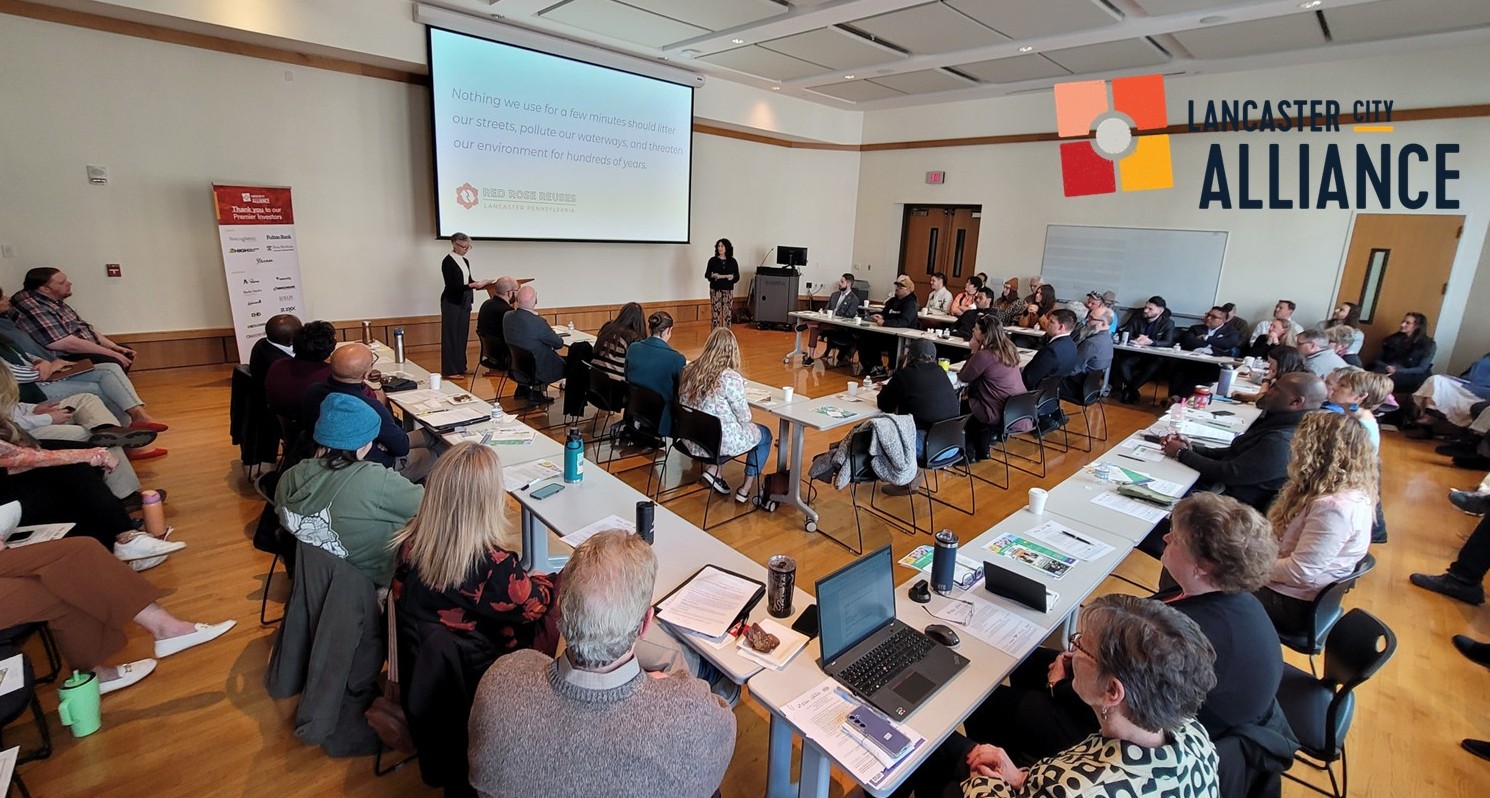
In April, Melissa Snavely and I, co-directors of Red Rose Reuses, had the pleasure of presenting a talk on reducing single-use plastics. Red Rose Reuses originated under the umbrella of College Park Climate Action Neighborhood (CAN), an affiliate of RegenAll. RegenAll is a local non-profit working towards carbon neutrality across business, agricultural, and neighborhood networks.
CAN borders F&M and Buchanan Park in Lancaster, PA, and just completed its first year of community climate action. One of our first initiatives was the Plastics Awareness Project – part personal audit, part educational, and part call for direct action. But mostly, it was a thorough look at the proliferation of plastics in our everyday lives, not just in our homes and the environment, but also at the growing evidence of microplastics in our bodies. It was through that program that a small but determined group decided to advocate for the reduction of single-use plastics in the City of Lancaster. Hence, Red Rose Reuses was born.
We have lived on planet Earth for a long time, but in the centuries since the Industrial Revolution, we began living out of balance, resulting in oversized problems that we never took the time to solve upfront. Nuclear and hazardous waste, human waste, and now plastic waste all contribute to our waste issues. Some have no viable, permanent solutions, like nuclear waste; some add chemicals to the water as part of the solution, like human waste, and some, like hazardous waste, can be contained in a facility, but eventually, those containment sites will need to be rethought since they are only stopgap measures.
And now we have plastic, which doesn’t break down or biodegrade except into smaller and smaller pieces. Sadly, the more plastic we make, the more we have to clean up, and since we don’t yet have a viable way to deal with plastic pollution, rather than amp up production, we should be looking for ways to reduce, reuse, and recycle.
Here are a few facts:
Let’s talk about the costs:
There are a great many benefits to be derived from reducing our reliance on plastics and the petroleum products that create them (and which I will save for the next post).
For now, I’d like to introduce you to Karl Gibbons, a Business Growth Architect, and one of the most intriguing and knowledgeable people I’ve ever had the pleasure to meet. Karl has some heady ideas about changing human behavior and offered to write the following piece. I hope you will read it and chime in with your own thoughts on this topic, which, from an environmental and health standpoint, is one of the most pressing issues of our time.

Behavioral Economics & the Packaging Problem: How to Nudge the World Toward Sustainability
Behavioral Economics is the study of how people actually make decisions — not how we think they should. It blends psychology with economics to understand the biases, triggers, and shortcuts that guide human behavior. And when it comes to saving the planet, those insights aren’t just useful — they’re essential.
If we want people to choose recyclable or biodegradable packaging, we have to accept a simple truth: facts alone don’t drive action. Logic informs, but emotion moves. The good news? We can use behavioral nudges — small, strategic shifts in the environment or incentives — to encourage more sustainable choices.
Take ketchup packets, for example.
Globally, we throw away an estimated 855 billion single-use condiment packets every year. These tiny sachets — mostly made of plastic and aluminum — are nearly impossible to recycle and almost always end up in landfills.
So, how do we change the behavior?
Simple: we attach a cost to the unsustainable choice and remove the friction from the better one.
Imagine a fast-food restaurant that charges 50 cents per ketchup or mustard sachet – a WasteRate, but offers manual pump dispensers at no cost and issues PlanetPoints. That’s not just an eco-friendly option — it’s a behavioral nudge rooted in loss aversion (people hate losing Money) and convenience. Suddenly, the path of least resistance aligns with the planet’s interests.
This is how we use Behavioral Economics to reshape habits—by creating either pain (a penalty or cost for wasteful choices) or pleasure (a reward or savings for sustainable ones).
Let’s apply this to supermarkets. What if clear plastic containers were taxed a WasteRate at checkout — but products in biodegradable or recyclable packaging came with a discount or loyalty PlanetPoints bonus? That small price signal would subtly shift consumer behavior over time, nudging people to favor packaging that doesn’t live forever in a landfill.
And it’s not just about consumers. Packaging manufacturers could be offered tiered incentives based on the recyclability and sustainability of their materials. EcoCredits (tax credits) for producing compostable containers. EcoTax penalties for generating hard-to-recycle waste. That’s how you drive change not only at the point of sale—but at the source.
The science is clear: people don’t always do what’s best for the environment — but they will respond to clear signals, smart incentives, and well-designed choices. Behavioral Economics gives us the blueprint to redesign those decisions.
Saving the planet won’t come from guilt trips or greenwashing. It’ll come from creating systems that make the right choice the easy choice.
About the Author
Karl M. Gibbons is a Business Growth Architect and the Founder of Third Eye Management & Associates (TEMA)—a strategic partner for purpose-driven entrepreneurs, brands, and organizations looking to grow smarter, scale faster, and build businesses that truly matter. With over 40 years of experience across multiple sectors, Karl blends Behavioral Economics with real-world strategy to help leaders create brands that are not only successful but uncopyable in their mission and marketplace.
 www.ThirdEyeManagement.com
 [email protected]
 LinkedIn: https://www.linkedin.com/in/karlgibbons
 (239) 961 0927
Regards
Karl
Karl M. Gibbons
Business Growth Architect
Cell +1 (239) 961 0927 Email [email protected]
Websites Third Eye Management & Associates
Facebook Facebook – Third Eye Management & Associates Facebook – Personal
LinkedIn LinkedIn YouTube YouTube
Pretty smart advice, eh? If you are an entrepreneur who sees value in a behavioral approach to business, I encourage you to contact Karl at any of the contacts above.
And stay tuned for Part 2 of Managing Our Love Affair with Plastics.
As always, thanks for reading.
pam lazos 5.16.25
Originally Published on https://greenlifebluewater.earth/feed/