
 What This SCOTUS Term Says About What America is Becoming
Over the past few days, I’ve written two “Supreme Court Potpourri” columns summarizing many of the Court’s most significant decisions. Looking back, however, I realized I missed one of the Term’s most important opinions—not because it lacked significance, but because I hadn’t yet seen the larger pattern.
That case involved Roundup weed killer and its link to Cancer. Many products over the years have been found to cause Cancer. And our justice system has, somewhat routinely, found ways to limit a victim’s access to justice and fair compensation without involving SCOTUS.
But this decision may prove to be one of the clearest examples of the constitutional philosophy that has increasingly come to define the current Roberts Court.
Let’s call this constitutional judicial philosophy The Constitution of “No.”
Every Supreme Court Term has had certain themes. This year, the theme isn’t simply executive power, immigration, transgender rights, or birthright citizenship.
It is something larger and far more dangerous to our democracy.
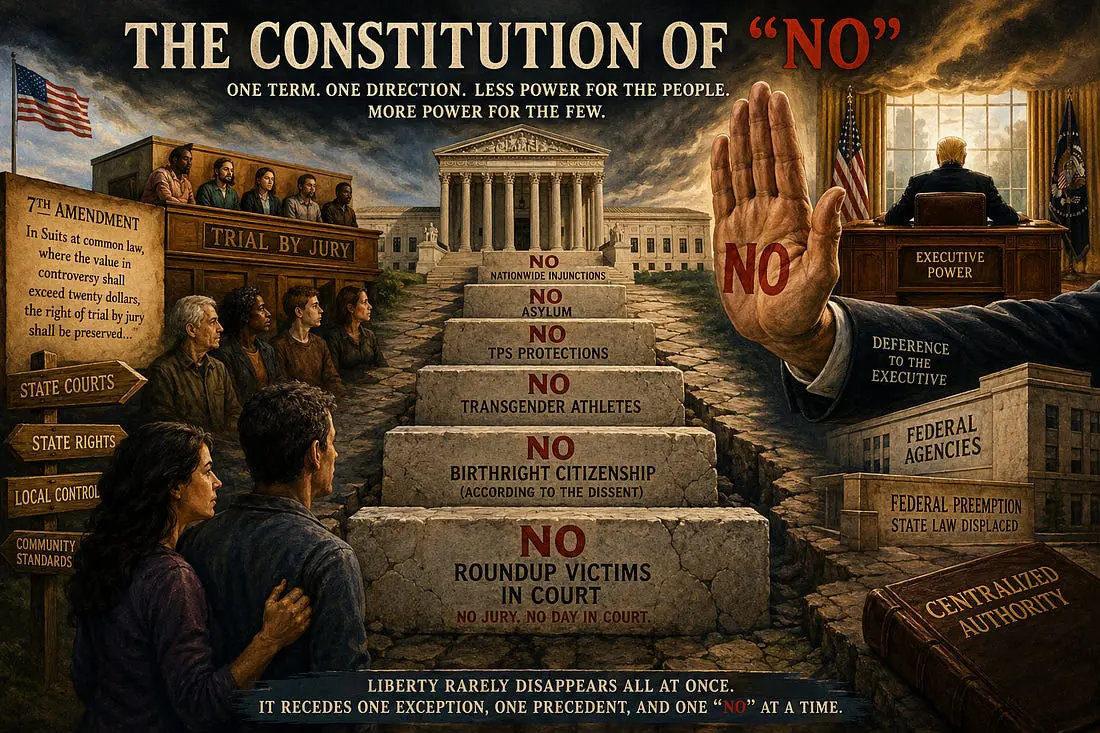
It is the steady transfer of power away from individuals, juries, state courts, and even the states themselves—and toward centralized governmental authority. Standing alone, each decision can be defended on its own terms. Taken together, they tell a very different story.
Consider a few of this Term’s decisions.
Immigrants seeking Temporary Protected Status?
“No.”
Asylum seeking?
“No.”
Transgender women seeking to compete in women’s athletics?
“No.”
Round up people living with Cancer seeking to present their cases to juries?
“No.”
Federal judges attempting to stop executive action nationwide?
“No.”
Meanwhile, the Executive Branch continues to receive broader discretion in immigration, greater deference from the courts, and an ever-expanding sphere of authority.
Each case has had its own legal reasoning. But constitutional history is written, not by one opinion at a time, but by cumulative effect.
This case presents one of the most difficult legal questions facing our country. I understand the concern. Some transgender women may retain physiological advantages. That is a legitimate subject for scientific inquiry and public debate.
But sports have never promised equal biology. They have always rewarded unequal biology. Elite athletes celebrate extraordinary natural gifts. Some are taller, or stronger, or possess remarkable speed, endurance, reflexes, coordination, and other physical characteristics the rest of us do not possess.
No one proposes excluding a basketball player because she is six-foot-eight, or bars a swimmer because she inherited an extraordinary wingspan, or disqualifies an athlete because she won the genetic lottery.
Every elite athlete benefits from biology. That’s how they become elite. And this raises a question I cannot escape:
If the law recognizes a transgender woman as a woman in virtually every other aspect of life, why should athletics become the one place where her prior biology forever determines her eligibility?
But SCOTUS sees it differently.
SCOTUS said “no.”
The birthright citizenship decision left me with a different concern.
The Fourteenth Amendment provides:
“All persons born or naturalized in the United States, and subject to the jurisdiction thereof, are citizens of the United States…”
Those words have governed this nation for more than 150 years.
Yet, three justices urged a narrower understanding, relying on concepts such as “domicile” and “allegiance.”
The Fourteenth Amendment does not use these terms. It doesn’t require “domicile” or “allegiance.” Those words are not there.
This should have been a unanimous decision, which illustrates a larger concern. One-third of our current Justices were willing to ignore plain language and add their own because of their own particular worldview.
They wanted their colleagues to say “no” to birthright citizenship even though it is enshrined in the Constitution. Principles that once seemed absolute suddenly became remarkably flexible.
And that should scare the hell out of every one of you.
The Roundup decision is the most overlooked opinion of the Term.
The Court did not decide whether Roundup causes Cancer or whether Bayer acted responsibly. Instead, it held that federal law preempts a significant category of state-law failure-to-warn claims because the EPA approved Roundup’s labeling.
Justice Ketanji Brown Jackson, joined by Justice Neil Gorsuch, warned that the decision unjustifiably closes the courthouse doors to injured plaintiffs.
That language immediately caught my attention. I have spent much of my legal career defending the Seventh Amendment. For years, I’ve argued that the right to trial by jury is not disappearing because courts openly reject juries. It is disappearing because our government has eliminated lawsuits before juries have an opportunity to hear them.
The 7th Amendment to the Constitution guarantees the right to a civil jury trial. But if there is no “valid” claim . . . there is no jury.
That is no small procedural change. It is a profound constitutional shift. In the Roundup case, the doors to the courthouse were slammed shut to thousands of victims.
SCOTUS said “no.”
For decades, conservatives have argued that important questions should be left to the states. We heard it repeatedly in debates over Education, environmental regulation, public Health, and, most famously, abortion. Yet in the Roundup case, federal law displaced state tort law. State judges, juries, and common law. gave way to a federal regulatory determination.
I cannot help but notice the tension. When does federalism matter? When does federal preemption suddenly become the preferred constitutional answer?
If we’re going to champion states’ rights as a constitutional principle, shouldn’t that principle apply consistently—even when state juries reach results some corporations find inconvenient? And does our government represent “we, the people” or ‘we, the lobbyists and the corporations?”
Finally, there is the Presidency. SCOTUS, this Term, apparently seeks an imperial president:
Presidential immunity.
Broad executive discretion in immigration.
Limits on nationwide injunctions.
Expanded deference to executive decision-making.
The Framers feared concentrated power. They had fought a revolution against a king and decided to divide authority among three branches of government. Checks and balances were not an accident. They were the Constitution’s central design.
Every time power shifts away from juries, away from the states, away from judicial review, and toward the Executive Branch, we should pause. And not just because a dangerous President occupies the Oval Office today, but because someone even worse may occupy it tomorrow.
What troubles me most is not the outcome of any single case. It is the constitutional instinct I see emerging.
As I reported yesterday, Justice Harry Blackmun’s constitutional vision was far different than Sam Alito’s. Blackmun’s was more expansive, while Alito’s is usually more restrictive (unless it runs contrary to his political ideology, as was the case in Trump v. Barbara).
Mine differs from both. Mine begins with a simple, yet very important question:
Does this interpretation make America a freer, fairer, more compassionate nation while remaining faithful to the Constitution’s text?
That question guides my views on the Seventh Amendment, immigration, civil rights, and equal justice under law. America’s greatness has never rested solely on military strength or economic power. It has rested on our willingness to expand liberty, broaden opportunity, and open courthouse doors rather than close them.
The genius of our Constitution is not that it trusted one institution. It trusted none of them. It dispersed power, empowered juries, respected the states, restrained the Executive, and protected individual rights.
Liberty rarely disappears all at once. It recedes one exception, one precedent, and one “no” at a time.
This is why this Supreme Court Term concerns me. Not because every decision was wrong. But because, taken together, they reveal a constitutional direction I do not recognize as the America that inspired my Family to come here—or the America I hope my grandchildren will inherit.
A citizen needs to hear “yes” once in a while.

Mark M. Bello is an attorney and award-winning author of the Zachary Blake Legal Thriller Series, ripped-from-the-headlines, realistic fiction that speaks truth to power and champions the rights of citizens in our justice system. These novels are dedicated to the social justice movement. They educate, spark discussion, and inspire readers to action. One of these was “Betrayal of Justice, a blistering novel about presidential misconduct and hypocrisy” For more information, please visit www.markmbello.com.
The post The Constitution of “No” appeared first on Lean to the Left.