When Catherine received her Early-Onset Alzheimer’s diagnosis, I thought goodbye would be a single moment. I imagined a clear, terrible day when everything changed. What I didn’t understand then was that this disease doesn’t work that way. It’s not a sudden rupture. It’s a slow fade, and the goodbyes come in waves, each one smaller but somehow no less devastating than the last.
There’s a particular kind of Grief that comes with watching someone you Love disappear while they’re standing right in front of you. It’s not like losing someone to death, where the world stops and people bring casseroles and acknowledge the rupture. It’s quieter and, in some ways, harder to bear. The person is still there. You still see them, touch them, share a bed with them. But pieces of who they are keep slipping away.
When the diagnosis came, Catherine and I were in our fifties. We had both spent our lives as endurance athletes, pushing ourselves past what we thought possible. So our instinct was to fight. We sold our home, retired, and decided to become nomads, running marathons and half-marathons around the world. In those early years, the disease moved slowly enough that we could still move fast. We traveled from Atlanta to Antarctica and everywhere in between. We ran in Madagascar, Bhutan, along the Great Wall of China. Catherine walked a half-marathon in the Australian Outback just weeks after breaking her ankle.
But those trips, as extraordinary as they were, were also goodbye. We were saying goodbye to the woman Catherine had been. The independent woman who could navigate a foreign city, who could plan logistics, who could remember where she put her passport. Every adventure was tinged with the knowledge that we were racing against time, that each moment was precious because we couldn’t count on having the same version of Catherine tomorrow.
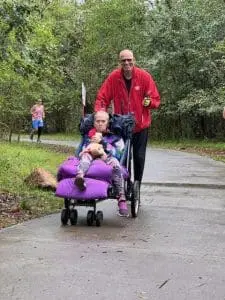
As the years went on, the disease progressed, and our life together changed. The fast pace of international races gave way to something slower. Catherine’s abilities shifted, and I had to shift with her. Some days she would wake up not remembering the city we were in. Other days she would forget my name, and I would have to introduce myself all over again. That happened hundreds of times.
Each of these moments was a goodbye. Goodbye to shared memories. Goodbye to inside jokes she could no longer access. Goodbye to the partnership we had built where we could simply understand each other without words. Now I was the keeper of our story, the one who had to hold it all.
There’s a temptation, as a caregiver, to become bitter about these losses. To resent the disease for what it’s taken. But what I learned, step by step, was that there’s another way to live with this kind of goodbye. It doesn’t erase the pain. But it can reshape it.
When you know someone is fading, the ordinary moments stop being ordinary. They become sacred. A morning coffee shared in silence. A walk where you hold hands the entire time. The way Catherine’s face lights up when she sees something beautiful, even if she doesn’t remember seeing it yesterday.
These aren’t the moments you imagined you’d treasure when you fell in love. You imagined remembering things together, building history, making plans for the future. Instead, you get this: the present moment, stripped of everything but itself.
I learned to say goodbye to my expectations of what our life should look like. I learned to stop fighting the pace the disease set and instead focus on making each moment meaningful. This wasn’t acceptance in the sense of giving up. It was acceptance as a form of love. It was choosing to show up fully for the person Catherine was becoming, not mourning the person she had been.
One of the strangest gifts of this journey is learning what actually matters. Through eight years of traveling as nomads and watching my partner slowly change, I discovered that the things we think we need to be happy are often illusions. You don’t need a house. You don’t need to remember yesterday. You don’t need to plan tomorrow.
What you need is this:
Caregiving for someone with Alzheimer’s asks everything of you. It asks you to love someone who may not know you. It asks you to find meaning in small moments. It asks you to die a thousand small deaths and keep going anyway.
People sometimes ask me when I stopped hoping for a cure. The honest answer is that I never did, not completely. In those early years, Catherine and I believed that a cure was just around the corner. We ran marathons partly out of joy, partly out of defiance, partly out of hope. As the years went on and the disease progressed, that hope shifted. It had to.
But the grief didn’t soften the love. If anything, they became more intertwined. Every goodbye I said to the Catherine I knew was also a hello to the person she was becoming. The woman who could still smile at a view. Who could still hold my hand. Who still, in some ineffable way, was the woman I loved.
There is no final goodbye in this kind of journey. There’s just the choice to keep showing up, to keep loving, to keep finding meaning in the moments that remain. That’s not the story I would have chosen for us. But it’s the story we’ve lived, and there has been grace in it.
If you’re navigating this journey yourself, whether as a caregiver, Family member, or someone facing a diagnosis, know that you’re not alone. The process of saying goodbye while someone is still here is one of the most difficult human experiences. But it’s also where we discover what we’re truly capable of. It’s where love shows itself in its most honest form. And there is meaning to be found in that, even if it looks nothing like what we imagined.
The post Saying Goodbye When Someone You Love Fades Away first appeared on Running With Cat.