


Most people assume that becoming a caregiver means your world gets smaller. You stop making plans. You cancel the trips. You settle into a routine built around doctors’ appointments and medication schedules, and you tell yourself that adventure is something that belongs to another chapter of your life.
But that assumption deserves a hard look. Because for some caregivers, the world actually got bigger.
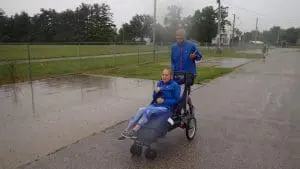
Anthony Copeland-Parker, the author behind Running With Cat, is one of them. When his partner Catherine was diagnosed with Early-Onset Alzheimer’s, Anthony did not retreat. He and Catherine sold their home, left their jobs, and spent years traveling the globe as nomads, running marathons and half-marathons on every continent they could reach. Their story, told across two memoirs, is a reminder that Caregiving and living fully are not opposites.
If you are a caregiver who still wants to see the world, or if you are trying to support someone who does, here is what that journey honestly looks like.
The first thing to understand is that traveling as a caregiver is not the same as planning a vacation. The goal is not to check off destinations. The goal is to build a life that has meaning for both of you, right now, with the time and ability you currently have.
For Anthony and Catherine, that meant running became a shared anchor. It gave their days structure, purpose, and joy. The specific destination mattered less than the act of showing up together and finishing the race hand in hand.
Before you book anything, ask yourself a few honest questions:
These are not reasons to stay home. They are the foundation for planning a trip that actually works.
Rigid itineraries are hard for anyone. For a caregiver traveling with someone whose condition can shift day to day, a rigid itinerary can turn a meaningful trip into a stressful one.
Anthony and Catherine adapted constantly. As Catherine’s Alzheimer’s progressed, the fast-paced international race circuit gave way to a slower rhythm. The routes changed. The pace changed. The kinds of activities they chose changed. But the commitment to making each day meaningful stayed the same.
Practically speaking, that kind of flexibility means:
The trip does not have to look like anyone else’s trip. It just has to work for the two of you.
One of the most refreshing things about the Running With Cat memoirs is the honesty. Anthony does not sanitize the experience. Traveling the world while managing an Alzheimer’s diagnosis is genuinely hard. There are moments of Grief, frustration, and exhaustion woven into the beauty of it.
Catherine walked a half-marathon through the Australian Outback just weeks after breaking her ankle. That is a remarkable thing. It is also a story with real stakes and real pain behind it. The point is not that everything worked out perfectly. The point is that they kept going.
As a caregiver considering travel, give yourself permission to hold both things at once: this is worth doing, and it will be hard. You do not have to pretend otherwise.
One of the loneliest parts of caregiving, whether at home or abroad, is the feeling that nobody around you truly understands what you are carrying. Travel can actually help with this, if you seek out the right connections.
Endurance events like marathons and half-marathons tend to draw people who understand commitment, grit, and showing up even when it is difficult. Running communities can offer a kind of fellowship that is hard to find elsewhere. For Anthony and Catherine, the running world became part of their support system across continents.
As you travel, look for:
You do not have to figure everything out alone, and you should not try to.
Caregiving is still too often framed as something women do. The emotional, logistical, and physical labor of supporting a partner through serious illness is rarely told from a male perspective with this kind of honesty and depth.
Running With Cat occupies a meaningful space in that gap. Anthony writes from the perspective of a man who is also an ex-pilot, an endurance athlete, and someone who has already faced significant adversity throughout his life. His voice is direct, grounded, and real. That perspective matters for male caregivers who may feel invisible in the broader conversation about this kind of Love and loss.
If you are a man supporting a partner through illness and you have been struggling to find a story that reflects your experience, this one might.
Traveling as a caregiver is not a solution to the grief that comes with watching someone you love face a serious illness. It does not stop the disease. It does not erase the hard days. What it can do is give both of you a life that feels like living, not just waiting.
Anthony Copeland-Parker’s two memoirs, ‘Running All Over the World’ and ‘One Footstep at a Time,’ trace a decade of that kind of living. From Madagascar to Bhutan to Antarctica, the journey is told with the kind of honesty that only comes from someone who was actually there. A portion of the proceeds from both books goes to organizations that support Alzheimer’s patients and their caregivers.
If this story speaks to you, pick up one of the books at Running With Cat. You might find something in those pages that changes how you think about what is still possible.
The post How to Travel the World as a Caregiver first appeared on Running With Cat.
