

Wednesday - June 3rd, 2026
Apple News
×

What can we help you find?

Open Menu

As seen in B2BVAULT: Anago’s 3-Tier Franchise Model

As seen in B2B VAULT 

AI SUMMARY

Commercial cleaning is often viewed as a low-tech “bucket and mop” industry, but Anago Cleaning Systems is proving that theory wrong. By utilizing a sophisticated 3-tier Franchise model, Anago separates sales and administrative friction from actual service delivery. This episode of the B2B Vault explores how CEO Adam Povlitz leverages AI-powered retraining and specialized territory management to create a recession-proof, recurring-revenue powerhouse that is perfectly positioned for the Economy of 2026.

as seen in B2BVAULT: Anago’s 3-Tier Franchise Model: Scaling Commercial Cleaning

Anago Cleaning Systems: The 3-Tier Franchise Model Powering Commercial Cleaning Growth

Featuring Adam Povlitz on B2B Vault: The Biz to Biz Podcast

In this episode of the B2B Vault, Allen Kopelman sits down with Adam Povlitz, CEO and President of Anago Cleaning Systems. While many associate franchising with fast food, Adam explains how a service-based system built on operational layers can provide a more accessible—and often more durable—path to entrepreneurship.


sponsored by

As Seen In B2Bvault: Anago’s 3-Tier Franchise Model &Raquo; B2B 300X89 1


What Makes Anago Different? The 3-Tier Franchise Structure 

Most franchises operate with two levels: franchisor → franchisee. 

Anago adds a powerful third layer. 

Tier 1: Corporate (Led by Adam Povlitz) 

Corporate supports: 

  • Expansion into new territories 
  • National account management 
  • Brand standards and training systems 

Adam, who joined the business in 2009 after a Finance background at IBM, took over leadership in 2015 and has since focused heavily on scaling systems and tech infrastructure. 


Tier 2: Master Franchise (Territory Owners) 

Master franchisees control large metro territories like: 

  • South Florida 
  • Atlanta 
  • Dallas 
  • Phoenix 
  • And dozens more across the U.S. and Canada 

Their focus is NOT cleaning. 

They handle: 

  • Sales teams 
  • SEO, PPC, digital marketing 
  • Customer acquisition 
  • Billing and collections 
  • Administrative support 
  • Quality oversight 

They function like the “business engine” of the territory. 


Tier 3: Unit Franchise (Cleaning Operators) 

Unit franchisees are the boots on the ground. 

They: 

  • Manage cleaning crews. 
  • Operate mostly after hours. 
  • Follow commercial-grade standards. 
  • Focus entirely on service delivery. 

They do not: 

  • Run marketing. 
  • Collect payments. 
  • Handle complex admin. 

That separation allows someone to start small — even as a side hustle — without needing to master sales or bookkeeping. 


Why Commercial Cleaning Is a Strong Long-Term Business 

Adam made a critical point: 

Technology may replace many jobs — but buildings will always need to be cleaned. 

Commercial cleaning serves: 

  • Offices 
  • Schools 
  • Hospitals 
  • Daycares 
  • Medical facilities 
  • Multi-tenant buildings 
  • Industrial spaces 

Even as AI grows, someone still has to physically show up and clean. 

It’s a recurring, contract-driven service business with durable demand. 


Investment Breakdown 

Anago offers two primary entry paths: 

Master Franchise 

  • Approximate investment: ~$300K–$400K (varies by market) 
  • Requires leadership and sales capability. 
  • Designed for Growth-oriented operators. 
  • Involves building a sales team and territory infrastructure. 

Unit Franchise 

  • Often ~$10K–$20K all-in range 
  • Can be operated part-time. 
  • Designed as an accessible entrepreneurship path 
  • No need to find customers — master franchise provides them. 

Adam even described it as the “ultimate side hustle” for someone who wants ownership without massive upfront risk. 


Technology: CleanCom & Customer Service Innovation 

Commercial cleaning has only two clients’ experiences: 

  1. Everything looks normal. 
  1. Something is wrong. 

No one throws a party because their office got cleaned. 

So Anago invested heavily in customer service tech. 

CleanCom Platform 

CleanCom allows clients to: 

  • Take a photo of an issue. 
  • Submit it instantly. 
  • Tag the location (bathroom, kitchen, etc.) 
  • Communicate privately (no phone number exchange) 
  • Use built-in translation. 
  • Receive a mandatory 2-hour response guarantee. 

This eliminates language barriers, confusion, and communication delays. 


Preventive Analytics + AI Retraining 

Anago didn’t stop reporting issues. 

If multiple clients report the same problem from the same franchisee (for example, restroom quality), the system flags a pattern. 

Next step? AI-powered retraining. 

Instead of manually scheduling retraining: 

  • The system assigns the correct training module. 
  • Franchisee completes video-based learning. 
  • Must pass a test. 
  • Gets re-certified automatically. 

That’s modern franchise quality control. 


Billing & Payments: Where Modernization Is Still Needed 

Interestingly, Adam noted many commercial cleaning accounts still pay via paper check. 

Monthly invoicing remains common. 

As Allen pointed out, this creates an opportunity for modernization: 

  • ACH payments. 
  • Payment links 
  • Automated invoicing 
  • Recurring billing 
  • Faster reconciliation 

For franchise systems managing dozens or hundreds of accounts, payment automation directly impacts cash flow and efficiency. 

Nationwide Payment System has systems that can handle these functions with NPSONE and our API and webhooks. 


Who Is the Ideal Candidate? 

Master Franchise Candidate 

  • Strong leadership background 
  • Comfortable with sales and networking 
  • Growth-driven 
  • Community-oriented 
  • Operationally disciplined 

Unit Franchise Candidate 

  • Entrepreneurial mindset 
  • Comfortable working after hours 
  • Operationally reliable 
  • Interested in starting small and scaling. 
  • Prefers service execution over sales. 


The Origin Story: From IBM to Entrepreneurship 

Adam Povlitz didn’t initially plan to join the Family business. 

While working at IBM during major layoffs in 2008–2009, he was assigned to review exit packages — based only on employee numbers, not names. 

That experience changed his perspective. 

He joined Anago in 2009 and stepped into the CEO role in 2015, focusing on scaling systems and technology. 


Final Takeaway 

Anago’s model works because it: 

  • Separates service delivery from revenue generation. 
  • Build infrastructure around franchisees. 
  • Uses analytics to prevent churn. 
  • Applies AI to retraining. 
  • Focus on recurring revenue. 
  • Keeps entry costs accessible. 

It’s franchising built for 2026 — not 1996. 

Listen to the Full Episode

As seen in B2B VAULT 

CLICK HERE TO FIND MORE ABOUT OUR PROGRAMS

FAQ: Frequently Asked Questions

1. Who is Adam Povlitz?
+
Adam Povlitz is the CEO and President of Anago Cleaning Systems, leading the company’s expansion and technology development.

2. What are Anago Cleaning Systems?
+
Anago is a commercial cleaning franchise operating under a three-tier model: corporate, master franchise, and unit franchise.

3. How does a three-tier franchise model work?
+
Corporate supports master franchisees, who manage territories and sales. Unit franchisees handle cleaning operations.

4. How much does it cost to start an Anago franchise?
+
Unit franchises may require around $10K–$20K. Master franchise territories require a significantly larger investment.

5. Can a cleaning franchise be run part-time?
+
Yes. Many unit franchisees operate after hours while keeping a day job.

6. What types of properties does Anago clean?
+
Offices, hospitals, schools, daycares, medical facilities, and other commercial buildings.

7. What is CleanCom?
+
CleanCom is Anago’s customer service platform for issue reporting, translation, and response tracking.

8. How does AI help Anago?
+
AI identifies recurring quality issues and assigns retraining modules automatically.

9. Is commercial cleaning recession-resistant?
+
Commercial cleaning is generally stable due to recurring contracts and essential facility maintenance needs.

10. Where can someone learn more about Anago?
+
Visit anagocleaning.com or connect with Adam Povlitz on LinkedIn.

function toggleFaq(element) {
const content = element.nextElementSibling;
const icon = element.querySelector(‘.icon’);

if (content.style.display === “block”) {
content.style.display = “none”;
element.style.background = “#f8faff”;
icon.innerText = “+”;
} else {
content.style.display = “block”;
element.style.background = “#eef2ff”;
icon.innerText = “−”;
}
}

The post As seen in B2BVAULT: Anago’s 3-Tier Franchise Model appeared first on payment solutions to grow your business.
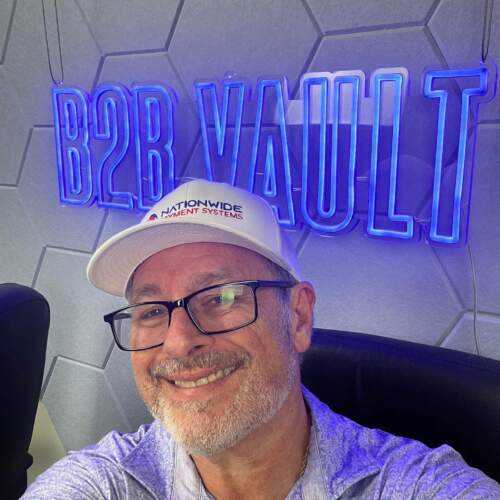
ALLEN KOPELMAN CEO, Nationwide Payment Systems | Host of the B2B Vault: The Biz to Biz Podcast

Allen Co-Founded Nationwide Payment Systems Inc. in 2001, with the plan to sell credit card processing services and equipment to merchants in the South Florida area and provide concierge style service for each client. Quickly the company grew to 1000 plus clients and we were had clients all over the United States.
The entrepreneurial bug started early in Allen’s life as comes from a family of business owners and learn about business from early age behind the cash registers at his father’s clothing stores in Miami. Later going to Culinary School in Atlanta and being a Chef, then Executive Chef for Metro Hotels in Dallas, Texas running food and beverage operations in Hotels. In 1992 a move back to Florida and opening a restaurant, catering company and consulting group.
After gaining a couple of years of experience selling merchant services, Allen Co-Founded Nationwide Payment Systems with David Burney. Together the company started and quickly grew, products were added, processing banks and the company became laser focused on technology that would help merchants. Along with that came a focus on hard to place businesses that many banks did not want to work with.

0 Comments
Oldest
Newest Most Voted