
 America’s Greatest Lie About Ourselves
Americans like to tell ourselves a comforting story about immigration.
We are a nation of immigrants, we say—open-hearted, generous, grateful for those who came seeking freedom. They built this country.
But history tells a harder truth:
America has repeatedly shut its doors on desperate people—and later congratulated itself for welcoming our descendants.
First, we fear.
Next, we exclude.
And, much later, we pretend we welcomed them after “they” became “us.”
In the 1920s, 30s, and 40s, the United States maintained some of the most restrictive immigration policies in its history. Driven by nativism, economic fear, isolationism, and open antisemitism, those policies prevented countless Jewish refugees from escaping the Nazis.
This was not ignorance. It was policy.
The 1924 Immigration Act imposed national origin quotas that gutted immigration from Eastern Europe, precisely where Jewish families were fleeing persecution. During the Great Depression, the “public charge” rule was aggressively enforced to deny visas to refugees deemed likely to need assistance.
At the Evian Conference of 1938, the world—America included—offered sympathy but no refuge.
In 1939, the MS St. Louis, carrying more than 860 Jewish refugees, was infamously turned away from U.S. shores. Forced back to Europe, many of its passengers later died in the Holocaust.
Even after Kristallnacht, 72% of Americans opposed increasing immigration quotas—even for Jewish children. And after the camps were liberated in 1945, only 5% supported increasing refugee admissions. While the United States admitted some 200,000 Jewish refugees between 1933 and 1945 (more than any other single nation), historians agree that hundreds of thousands more could have been saved had existing quotas been filled or if Congress had not blocked efforts like the Wagner-Rogers Bill to admit 20,000 children.
America knew.
America chose.
America declined to save lives.
A century earlier, Irish and Italian immigrants were met with many of the same false narratives we hear about Hispanics today. They’re:
“Criminals.”
”Disease carriers.”
”Job stealers.”
”Culturally incompatible.”
”A threat to ‘real’ Americans.”
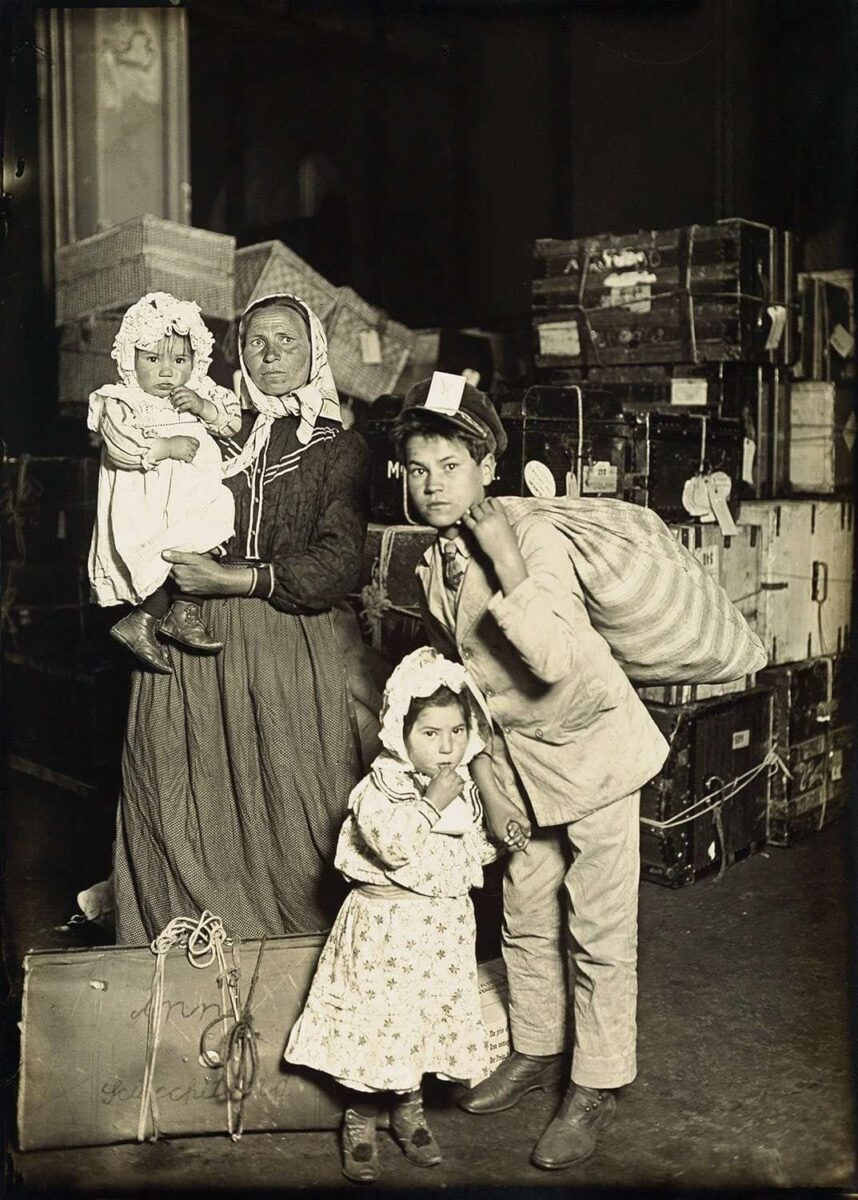
Irish Catholics were condemned as papist infiltrators, loyal to Rome instead of our Constitution. Italians were caricatured as violent, uneducated, Mafia-ridden, and unfit for citizenship. Housing and Employment discrimination followed. Lynchings occurred. Laws were written to keep both groups out.
Today, Irish and Italian surnames dominate American politics, law, business, medicine, Entertainment, and culture. Their food is celebrated. Their neighborhoods are historic. Their descendants are considered quintessentially American.
Our fears didn’t disappear. Our memories did.
Fast-forward to today’s southern border.
We hear century-old claims as history repeats itself:
Donald Trump, like Calvin Coolidge and Herbert Hoover before him, has elevated those fears into official administration policy—Family separation, refugee admissions slashed to historic lows, asylum redefined out of existence, children detained as deterrence, cruelty normalized as governance.
Similar script. Different century.
Most of us are only a generation or two removed from the very people they now fear.
Our families arrived poor, unwanted, desperate. They were told to go back where they came from. But, over time, they built businesses, unions, churches, synagogues, mosques, and schools. They studied and expanded art, science, medicine, and law. They helped build this country and cement its democracy.
America didn’t just tolerate these people.
America thrived because of its new citizens.
Jewish citizens became scientists, doctors, artists, and entrepreneurs.
Irish citizens became teachers, police officers, and politicians.
Italian citizens became builders, craftsmen, chefs, and innovators.
Labor, from all nationalities and religions, built this country. And this includes Black Americans, whose enslaved labor helped build America without consent or credit.
Latino farmworkers, caregivers, soldiers, small-business owners, and students continue to sustain us today.
The pattern is relentless.
And so is our collective amnesia.
Let’s stop pretending this is some abstract concept, shall we?
If you are an Italian American, your grandparents were once branded criminals and anarchists—lynched, excluded, mocked, and told they were poisoning our nation.
If you are an Irish American, your ancestors were depicted as violent, ignorant drunks—unfit for citizenship, faith suspect by default.
If you are a Jewish American, your people were fleeing extermination—and America said no, over and over again.
If you are a Muslim American, you know what it means to be viewed as a threat simply because you exist.
If you are a Black American, your ancestors didn’t immigrate at all—they were forced to come here, enslaved, segregated, terrorized, and then blamed for the consequences of that history.
And if you are a Latino American, your family crossed borders, only to be told they were invaders in lands their labor built.
So ask yourself this question (Be honest):
How much would you Love and support Donald Trump if these were your people at the border?
If he separated you from your children?
Placed your loved ones in out-of-state detention centers?
Or labeled your relatives “garbage” or “vermin” and accused them of “poisoning the blood” of America?
How would you feel if he called the country of your ancestors a “shithole country?”
Would you excuse family separation as “necessary”?
Would you refer to cruelty as “tough” policy?
Would you dismiss it as the politics of our time?
Or would you recognize it instantly for how anti-American it is?
History doesn’t ask whether we were once afraid.
It asks if we faced our fears and stood up for what is right.
Every generation is tested—not on whether it celebrates immigrants after they succeed, but whether it shows courage when they are still desperate, vulnerable, and inconvenient.
Every generation of Americans has failed that test and congratulated itself later.
And the cruelest irony of all?
Some of our country’s loudest supporters of Donald Trump’s immigration cruelty descend from immigrant communities that thrive here because America, once upon a time, allowed them in.
But their memory fails,
their history is forgotten,
and their basic humanity is discarded.
The question isn’t whether we are a nation of immigrants. The question is whether we are a nation capable of learning from our own history. If your ancestors arrived poor, unwanted, and desperate—and you now vote to keep others out—you do not honor your history, you erase it. The measure of a nation is not who it celebrates after they succeed—but who it saves when they are still unwanted.
The problem isn’t that we once shut our doors—the problem is that we, the descendants of those for whom America’s doors finally opened, are now demanding we close them again. Shame on us all.

Mark M. Bello is an attorney and award-winning author of the Zachary Blake Legal Thriller Series, ripped-from-the-headlines, realistic fiction that speaks truth to power and champions the rights of citizens in our justice system. These novels are dedicated to the social justice movement. They educate, spark discussion, and inspire readers to action. One of these novels, Betrayal High, was written in response to school shootings. For more information, please visit www.markmbello.com.