
In this episode of Meet the Expert with Elliot Kallen, Elliot sits down with Andy Zimmerman, CEO of Journey, a trailblazer in immersive experience design. Andy’s work redefines storytelling through physical spaces—think the Empire State Building, The Sphere in Las Vegas, and Disney’s MagicBand. As a creative CEO managing high-Growth rollups and imaginative teams, Andy shares how he balances profitability with world-class Innovation. A must-listen for visionary leaders, wealthy investors, and anyone fascinated by the intersection of business and creativity.
Andy Zimmerman is the CEO of Journey, a creative services agency specializing in immersive experience design across physical and digital landscapes. Formerly the CEO of Frog Design, Andy blends narrative structure with spatial storytelling, impacting global icons like the Empire State Building, Disney World, and Las Vegas’ The Sphere. He’s also a published novelist—his book Journey shares a name with his company, symbolizing his life’s work of transformative storytelling.
Zimmerman’s revamp of the Empire State Building proved that storytelling isn’t just for films—it drives business value. The transformation led to:
This is a powerful reminder that emotional design directly impacts financial performance, especially when targeting affluent consumers seeking unique experiences.
Journey, backed by private equity, has acquired five studios, all focused on pioneering creative disciplines. Andy’s approach emphasizes:
This model offers a new blueprint for creative roll-ups in the digital and experience Economy.
Q: Is immersive design just a trend?
No—Zimmerman’s work proves it’s the future of entertainment, branding, and tourism. The immersive layer enhances both emotion and engagement, which are vital for long-term brand loyalty.
Q: How can CEOs manage creative personalities?
According to Andy, the secret lies in emotional support and getting out of the way. It’s less about control and more about enabling brilliance.
Q: What seat should I book at The Sphere?
Andy says: there’s no bad seat. Sit in the middle for the best all-around experience, but every angle delivers awe-inspiring immersion.
Ready to transform your financial life or business strategy?
Call Elliot Kallen at 925-314-8503
Email: [email protected]
Visit: prosperityfinancialgroup.com
Be sure to explore past episodes of Meet the Expert—now in the top 2% of financial podcasts worldwide!
Elliot Kallen: Well, good morning, good afternoon, everyone. I’m Elliot Kallen, CEO of Prosperity Financial Group, and welcome to another very exciting episode of Meet the Expert with Elliot Kallen. Today we are interviewing Andy Zimmerman, one of the most creative CEOs you will ever listen to in your life. Don’t hit that delete button, don’t hang up, don’t turn that back channel. It’s going to be an exciting time with Andy. Andy, welcome to the show.
Andy Zimmerman: Thank you. Thanks, Elliot. Good to be here.
Elliot Kallen: Good to have you here. If you want to reach us, we’re at 925-314-8503 or elliot, E-L-L-I-O-T at prosperityfinancialgroup.com or prosperityfinancialgroup.com, top 2% of all financial podcasts in the world. Very exciting. We’re getting bigger and better every single day. Andy is the CEO of Journey. He’s done other things before that with Fog. And Andy unites creativity with CEO experience, and he does it not even being in the office, and he’s done it with COVID. So he’s been amazing. Andy, what exactly do you do?
Andy Zimmerman: Well, personally, it’s funny. I’m running a creative services agency, and a lot of what we do is very visual, whether that’s physical design of rooms and things or immersive or virtual, but very visual. I actually don’t have a visual bone in my body, but what I do have is I’m a storyteller. So I think where I add some value is coming up with what is the story we’re trying to tell with this experience, and I’m also a writer of fiction. But what I do day-to-day as part of Journey, of course, as a CEO, are things like we’re a private equity-backed company in the mid-cap roll-up area. We’re three and a half years old. We’ve bought five companies so far. Obviously, I oversee the acquisition of these companies, the integration. I get involved in some client relationship types of things and just work with about 90% of our people, or headcount, are creatives.
Elliot Kallen: So let’s talk about the creativity, Andy. Let me talk about the creativity, because I want people to say, why am I listening to this? Andy is responsible in some form or way with the sphere in Las Vegas. If you’ve ever been to the sphere and you haven’t been there, you want to go there, but it is a definition of a multidimensional experience, which I’d like for you to talk about. He’s completed the Empire State Building. He’s a producer on Broadway. I don’t want you to undersell your creativity, because it is amazing. For somebody like me, this is my third, fourth, and fifth companies that I’ve begun. I like to think of myself as a creative entrepreneur, but then I sit down with people like you and I realize I’m just a dull weed compared with your creativity. We’ll get to that roll-up thing, but talk about what you’ve done in Creative World, or what your team has done, maybe in better phrases, your team.
Andy Zimmerman: Yeah, thanks, Elliot. Style of one person, drawing. Yeah. I like to say team, because I really don’t want to take credit for the work. But I think a good example that I think shows both what we do and the power of multidimensional design is what we did recently with the Empire State Building observation deck. Many people have gone there decades ago and have never gone back. If you haven’t, I’d recommend you go. During COVID, working with the owner of the building, we looked at how can we make this experience more positive and multidimensional. What was happening is a lot of people come to the Empire State Building, obviously, and go up to the observation deck to see the skyline, but there were long waits in line. It wasn’t a particularly pleasant customer experience. Also, on days that were cloudy or rainy, then why go up and you wouldn’t have a view? What we did is completely rethink the experience. Now when you go to the Empire State Building, you don’t wait in line. You just go from one room to another. You go to a room where you’re sitting on girders, talking to the construction workers that built the Empire State Building in 1934 in one year, and hearing what they have to say sitting 40 floors above New York in the girders. You go through a movie set where you see the making of all the movies that use the Empire State Building as a background, things like Sleeping in Seattle and so forth, Sleepless in Seattle. You also go into a room where King Kong is outside batting away planes or attacking him and reaches in with a physical hand the size of King Kong into the room trying to grab him. All these things are happening, and you get to the top of the Empire State Building, and then you go out and you see the view. But the main thing we did, which was different, is we changed the story from a story about a view to a story about a building and the city that it lived in, and that’s where King Kong, all these movies, the construction, all of that takes place. What happened was the customer experience was so improved that prior to what we did, the Empire State Building on TripAdvisor wasn’t even rated among the top 25 tourist attractions in the world. In the last two years, it’s been rated number one in the world tourist attraction. So it’s the same view and the same building, it’s the same deck, but the multidimensional experience that we created has completely improved, changed the experience. That’s one metric. Another metric, which I can’t talk about more specifically, but actually revenue per visitor, per guest has gone up because there’s a lot more merchandising opportunities we created with some of the things I described. It’s very interesting to me that the number one Instagram photo for people visiting the Empire State Building is not the skyline anymore. It’s sitting in the hand of King Kong, what we call the Fay Wray moment. What’s really interesting about the King Kong experience, it doesn’t take place at the top of the Empire State Building, it takes place on the second floor of the Empire State Building. Using various dimensions of immersive and film and so forth, as a guest, you think you’re at the top of the Empire State Building staring at King Kong. So I think it’s just a really great example of all the different media that we bring to bear and a sort of before and after experience of an iconic building, an iconic experience, so improved and actually from a business point of view, better ROI, obviously, than previously.
Elliot Kallen: I use the word cool. It’s just cool stuff. We’re talking with Andy Zimmerman of the company called Journey, who’s also a world-class novelist with the same book of the same name, Journey, if you want to look at it at Amazon. This is the creative stuff. And this is really dedicated to your creativity right now. And if you’re a creative CEO, or you’re a creative person, or you’re a person who wants to be in a world of creativity and CEO, and I don’t mean drawing cartoons, but creating stuff out of nothing, Andy’s just amazing with that. I have been to the Empire State Building. I grew up in North Jersey. I went there when I was young. My dad complained that he had to carry me up too many stairs because the elevators didn’t work, and I was a little kid on his shoulders. And when I was in town with my wife many years ago, now I live on the West Coast, but many years ago, and I go back, I was going back quarterly to New York, and now it’s twice a year to New York, mostly for the food and Family. I took my wife to the Empire State Building. I’m not sure we were married at that point. And I hadn’t been there in years, and it didn’t change. And this is what I was struck by. This is an old building that has just fallen out of Love completely. I know it’s been sold, I think, since then. And they put a lot of Money into it. But what you’ve done, we went up there before you did your thing, and you couldn’t get to the edge because they were making sure you weren’t going to take your life, because suicide was popular for a while at the Empire State Building. But there was a—I don’t know if we—we couldn’t get to the edge. We were a while away from the edge. But there was a phrase that we had heard that if you throw a quarter from up there, whoever it hits will die, and it’s going to put a hole in the ground. It’s going to go down like six inches with a big hole because there’s so much—32 feet per second per second for the Empire State Building. You know, it’s, what, 80—I’d say the World Trade Center was 102. I think this is, what, 90? 10 stories less than the Empire State? About not—88 or something like that? 90 stories?
Andy Zimmerman: I think 88, maybe. It depends on how you measure the floors, yeah.
Elliot Kallen: Yeah, that was all we could think about, so we couldn’t get closer to it. It was just a visual observation like so many other places that are visual, and some of them, have those telescopic machines there. It was cool for my wife because she’d never been there, and it came out probably around the time of Sleepless in Seattle, so that was interesting, too, up there. But it was disappointing in a way because we couldn’t get the experience we wanted, so I’m so glad you changed that around as an ex-greater New York market person. I want to see great things in New York happen, so thanks for doing that, Andy.
Andy Zimmerman: Sure. No, the team did a great job.
Elliot Kallen: Yeah, I just want to talk about your creativity because it is amazing, and I don’t want to miss that. You’ve touched with the sphere in Vegas, and I think you told me, if I’m incorrect, about Disney World, excuse me, and Epcot. I don’t know where you’ve touched that. I owned a company in New Jersey, a packaging business, in the 1980s after I left accounting and I went into the packaging business, which I ultimately sold in 1987, and I would take my staff once a year down to Epcot, which was fairly new. It really had come out because for me, it was the most creative place on Earth, not Disney World, but Epcot. And then I went back there not too long ago, and it lost a little sense of creativity for me because it became a little bit more kid-friendly, which is fine. There, it was much more adult-friendly. So I want to know how you’ve touched on your feelings about the sphere because people who go to the sphere are in awe, and people who go to Epcot and now the Universal in Florida are in awe of what’s going on. So tell me about it and tell me how that people sit there and come up with things that I could never come up with.
Andy Zimmerman: Yeah. So with the sphere, once again, I want to be careful that a lot of people contributed to the creation of the sphere. First and foremost, Jim Dolan, who is CEO of MSG, and it was his vision. It was his idea for the sphere. We had worked with him over the years on different projects. So the work we did in the sphere was everything about the wayfinding and how you get around in this sphere before you go into the arena to have the experience. Now, that might not sound like a big deal, but when you go to the sphere, it is a big deal. We have an entranceway through the Venetian, and the whole thing purposely kind of narrows. And then when you get into the sphere, it opens up and you see all these sculptures and the lighting, and it’s multiple floors, and everything is curved. The whole theme is that it be spherical, that it be an otherworldly sphere that is almost floating above the world. And that’s the feeling you have when you walk into it, like you’re in a spaceship, a lot of blue, a lot of soft color. And then there are 20 food and beverage establishments in this sphere, each of them being different, you know, bars and restaurants and so forth. But one of the things that’s really kind of unique about it, there are many things, but one is that everything in the sphere is rounded. There are no corners, like a counter somewhere where you’re getting, it’s not, there’s no corners. It’s all spherical, conical, and so forth. Now, the actual experience in the arena, just I want to make clear, we did that Technology, both the audio and visual and the virtualization of the experience. That is something that was done by another set of people. And, we weren’t involved in the creation of that technology. But I like to think that while the experience in the arena is absolutely stunning and different, it’s really what virtual reality should be without the headsets. I like to think that we create an experience on the way there that begins to get you completely engaged, completely in this otherworldly state without the use of any psychedelics or anything else, and prepares you for and builds the excitement of what you’re about to experience in the arena. And obviously, the other thing is this great opportunity for, selling food and Bev and other kinds of merch and all that sort of thing.
Elliot Kallen: Have you seen a concert there, Andy? Have you been to anything there?
Andy Zimmerman: I was very privileged to be at the opening of the sphere, which was the U2 concert. And so I was there opening night. And honestly, I felt like I was part of history. I felt like, you know, I am seeing the future of entertainment tonight. Part of it, I think, obviously, was incredible technology. The sphere is unique. I mean, it never was used before. And then part of it, of course, is U2. It’s just such a spectacular band and Bono. And they’re so creative as musical artists. And so, yeah, I just felt like I’m seeing the future. It’s almost like landing on the moon. I’m seeing the future. And then I’ve been back.
Elliot Kallen: Does it matter where we sit? If I go see the Eagles? Because people have said to me, Elliot, don’t spend the money to sit low, because the experience doesn’t change. And you’re going to be rocked in your head backwards if you’re sitting low. But traditionally, if you sit high, you don’t see any faces except on this big billboard.
Andy Zimmerman: I don’t think I’ve sat a couple, because I’ve also seen there’s a movie that runs when they don’t have live acts called Postcards, which is a pretty incredible 60-minute movie. I don’t think there’s a bad seat in the house. If you kind of said, well, if you pick anywhere, I’d probably pick in the middle, kind of for the reason that you are in the middle. But the experience is so immersive that it’s not like there’s a bad place to sit. You’re just looking at it. You’re experiencing it from a different angle, but it surrounds you. I mean, it’s a sphere, and it surrounds you. And you kind of forget that you’re in an arena, and you kind of forget what seat you’re in. One of the amazing things about it is one minute you’re in this dark experience. It’s almost like more being in a film house or something. The next minute, you’re outside in the desert. The sun is shining. You can see everyone around you. There’s a wind blowing on your face, right? And this all happens in a matter of 60 seconds. It’s just incredible. Certainly highly recommend it, not just because we had the honor of being part of the team designing it, but it really is the future.
Elliot Kallen: We’re talking with Andy Zimmerman. If you want to reach me, it’s elliot, E-L-L-I-O-T, at prosperityfinancialgroup.com, or prosperityfinancialgroup.com is the name of the website. And we’re in the top 2% of financial podcasts, and you can see why when we’re interviewing these successful people who are just not mainstream. Sorry, Andy, I just called you not mainstream. But these are people that think out of the box, is what I mean by that. Epcot and Disney have been thinking out of the box. They have been out of the box forever, from day one. Walt Disney has had a reputation from the very beginning of being out of the box kind of guy. He wanted to be innovative. Mickey Mouse is innovative. And then came Donald Duck when they struggled with Mickey Mouse during World War II. Came Donald Duck. They have been so creative. And then the whole Florida experience versus LA has been creative and so forth. You worked down there. You did stuff down with them too, didn’t you?
Andy Zimmerman: Yeah. I mean, we work with them now on a couple of things. I can’t really talk about, but one thing I can because it’s out there. When I was formerly the CEO of a company, Frog Design, which is one of the largest, more digital design firms in the world, 50 years old. And we did a pretty famous project for Disney World where we introduced a band, an RFID band called the Magic Band that you could wear. And then you could use that to get into the park. You could use it to reserve space on rides. You could use it to get into your hotel. You could use it to buy things. It would track where you are and take pictures of you, not intrusive, but pictures of you on the ride and so forth. And at the end of your journey, you could get a portfolio of photos of you on rides and so forth. So it was a very, they spent about a billion, I think publicly disclosed about a billion dollars rehabbing the park in order to introduce this Magic Band technology and experience. And we at Frog worked with the Imagineers, which is their internal design division, to create the experience, both the digital, the band, the kiosks that you go up to and so forth. But the one thing I observe, and this was one of my inspirations for the idea of multidimensional is, you know, you think about the physical aspects of this experience. You think about the digital aspects, the websites, the apps. One of the things we had to figure out is how do we get, how do they get these bands, which are personalized? And the worry was if we, if they came to the park to get them, there’d be a big line of people waiting to get their personalized bands. So we came up with the idea, we, with the Imagineers and Disney, why don’t we ship them the bands before they get to the park? Now that was the genesis of the idea. It wasn’t really about the experience. It was just like a matter of convenience and not having lines. So we made up a nice box, which has a lot of, Disney characters, and then you open the box and each of the bands are there and they have your name, your first name on them. Okay. And what happens is a few months before you’re going to Disney World, this box arrives in the mail. What, then what would happen is the parents would say, Hey kids, come see, we got our magic bands from Disney. And you open up the box and you see your bands. So later years, a couple of years later, Disney did some consumer research. First of all, this was a huge success, the magic band experience in terms of people wanting to come back, higher spend per visitor, all kinds of KPIs, but they did some research. And what people told us was one of the most magical moments in the magic band experience was getting that box in the mail and opening up the box with the kids, because it’s about anticipation. So one of the dimensions you have to think about is chronological. The experience doesn’t necessarily start when you visit the park or when you leave the park, it begins before you get to the park anticipation. And it also exists after you leave the park memories. And I don’t know, there was a statistic a while ago, how many million magic bands are sitting on the desks beside the bed of kids around the world.
Elliot Kallen: That’s amazing.
Andy Zimmerman: That inspired me a bit when I started up Journey that, you know, creating a bunch of studios that focus on everything from the physical to the technology, to the storytelling, to the gaming, to live performances and getting all these different people together and just seeing what the alchemy of all these skills being the same studio does in terms of creativity and innovation. And that sort of was a thesis because I thought with the magic band, I said, Hey, we need to really think in a lot of dimensions here, chronology, emotional technology, digital. And I wanted to build a studio or a company that could address all of them in a next gen way.
Elliot Kallen: I can see why you’re, you and a handful of people are in a class by themselves, Andy. That’s fantastic. Thanks. So let me go to the business side of this, because we do have a lot of business owners that listen to, on your left hand, you are CEO and dealing with investment bankers and dealing with all the day-to-day of CEO. And obviously you guys are looking at other businesses to buy, because you said you bought five of them. And on the right side, you are managing the most emotional business people on earth, which is the creative people. And they have not just highs and lows, they have super highs and with super lows and super drama all day long. And that’s just how it is. How do you do that and how do you manage that and what is that like?
Andy Zimmerman: Well, I don’t know. I think maybe you must have been, did you interview my therapist before we had this podcast? You did a good job of capturing the challenge. No, I think the, frankly, I have to tell you, the business part of it, I don’t mean to, I mean, it’s a lot of work and it’s challenging, but the working with the investors and the banks, the acquisitions, the systems infrastructure, the financial projections, I am a CPA, practiced for a couple of years. Frankly, I just find that to be relatively easy. And we’re also lucky that we’re actually growing very rapidly and we’re very profitable. It’s the other part that is a challenge because these are, I mean, because they’re at the top tier of their creative disciplines. That’s who I wanna acquire, like not big studios, but the studios that are working on the next generation of things. These people are just so talented, but there’s a couple of different profiles. There are people that are quite dreamy creative. There are people that are quite driven creative. There are passive aggressives. It’s every kind of profile you can think of. And I find that’s the most challenging part of running a creative agency, both at Prague, where we’re about almost a thousand people and here at Journey, we’re up to about 250. It’s, it is alchemy. And the reason I use the word alchemy, cause it is, it’s more, it’s magic. It’s not even in, much as I love Peter Drucker, it’s not in a Peter Drucker book. Maybe I should write a book someday, although I can’t, maybe I’m not, you know, I haven’t saw, it’s an unsolvable puzzle, but I kind of get out of the way, right? I mean, I gotta make sure, for my investors and employees that we make money and all that good stuff. But in the creative process, I try to stay out of the way and I try to emotionally support the team. And I use, it is more emotional than intellectual, I find.
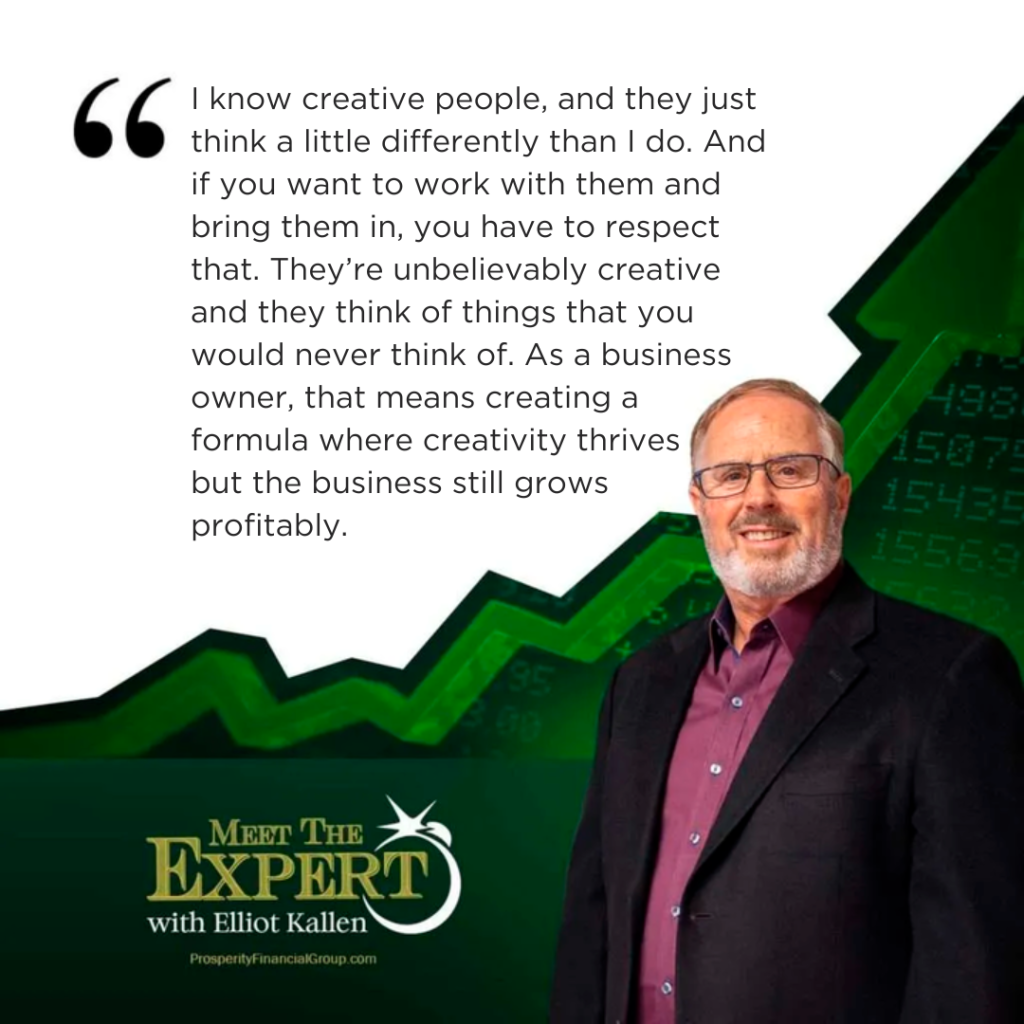
Elliot Kallen: Yeah, you’re doing a great job with that because I know that, I know creative people and they just think a little differently than I do. And you have to respect the fact, if you want to work with them and bring them in, you have to respect the fact that they do think a little different than you. And they may think very different than you, but they’re unbelievably creative and they think of things that you would never think of. If somebody wants to learn about that world, just go do a little bit of study on the greatest artists of history and how they worked and how a great painter would cut off his ear for a woman and who would do that and things like that. These are ultra creative people, Michelangelo, Leonardo da Vinci, the great ones, they just think out of the box and different. And what you’ve done so well, Andy, and a credit, hats off to you, is you have figured out the formula like Walt Disney did. You have figured out the formula that I can be super creative, super profitable and grow and manage these people and pull all these ships in the same direction. Is that a fair statement?
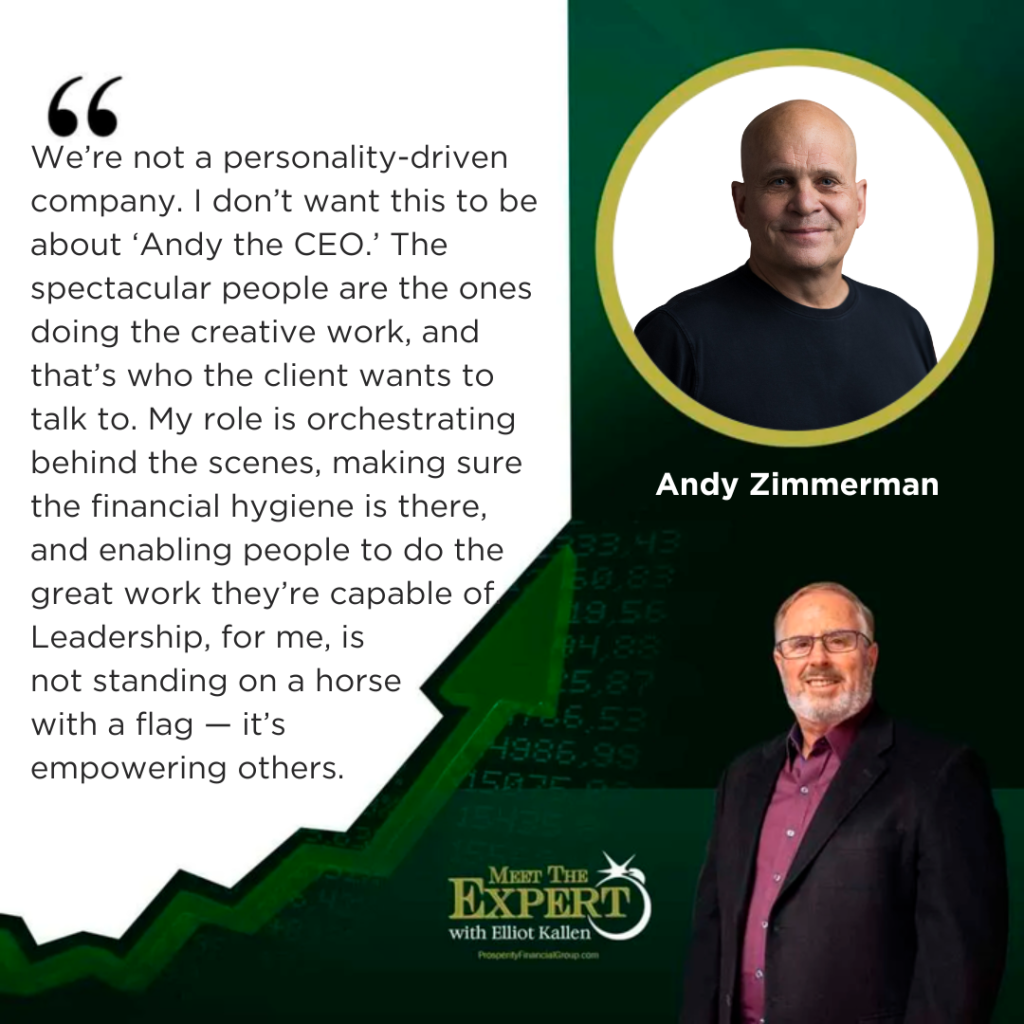
Andy Zimmerman: I would say myself and my team, which includes most of the founders of the companies, I just don’t wanna, we’re not a personality driven company. Andy’s CEO type of thing. To be honest with you, I kind of like the good to great sort of, I don’t know if you remember that book from decades ago.
Elliot Kallen: It’s on my top shelf up there.
Andy Zimmerman: Okay, so one of his observations was that the really great CEOs actually kind of step back a little bit. They don’t try to be like out there. And I certainly can’t be running Journey because the spectacular people are the ones that are creating this stuff. And that’s who the client wants to talk to. That’s who’s doing the work. And so I’m just sort of a little bit behind the scenes orchestrating things a bit and then helping where I can. And also just making sure that the hygiene, the financial hygiene is there in terms of making money and all that kind of good stuff. But in terms of leadership, it’s not a, you’re in the front of the, everyone’s gonna follow you and you’re on your horse and the flag. It’s much more of a enabling people to do the great work that they’re capable of.
Elliot Kallen: We’ll check the boxes for humble and humility along the way. How’s that?
Andy Zimmerman: Okay.
Elliot Kallen: So we’ve been talking with Andy Zimmerman, CEO of Journey, very creative. He deals with creativity, out of the box thinking, and he’s a CEO and he’s worked with venture capitalists, investment bankers, and bought five businesses and doing roll-ups. And if you’re a business owner, you wanna know more about that. But if you’re a creative person, unbelievably creative and far more creative than I’ll ever be in my life, Andy, how do people reach you?
Andy Zimmerman: So my best email is Andrew.Zimmerman, Z-I-M-M-E-R-M-A-N at journey.world. That’s the best.
Elliot Kallen: Andrew.Zimmerman at journey.world. At journey.world. I’m writing it down too.
Andy Zimmerman: Yeah, LinkedIn, I’m pretty good about responding to people who reach out to me through LinkedIn as another vehicle. So
Elliot Kallen: you know how to reach him. He is one of the most creative CEOs that you will ever meet in your life. And your office, primary office is Manhattan?
Andy Zimmerman: Well, I kind of shuttle between the East Bay and San Francisco area and Manhattan, yes.
Elliot Kallen: That’s great, that’s great. Well, you’ve been listening to Meet the Expert.
Andy Zimmerman: But Elliot, can I plug my book?
Elliot Kallen: Oh, please do, yes.
Andy Zimmerman: What did you say? No, so as Elliot mentioned, I’ve also written a novel which happens to also be called Journey. So the one thing I will proudly say is I may be the only CEO that I know of that both has created a company and written a novel with the same name. So that’s something.
Elliot Kallen: That is great, is it on Amazon?
Andy Zimmerman: Is on Amazon.
Elliot Kallen: Great, so to all those people listening, go to Amazon Books and order A Jury by Andy Zimmerman. And while you’re doing that, don’t forget to order Driven by Elliot Callan. And you’ve got two great books. I’m laughing because I saw my audio book the other day. It was on sale. The book is like $12.95. And they had a one day on sale on Amazon for 99 cents. And I started to laugh. I said, 99 cents, is that all I’m worth now? So Amazon is funny. And I’d laugh because you could sell a used book on Amazon. So here’s the new price. And then here’s the used price, used only once. And I don’t know what to think about that, but it is what it is with Amazon. Congratulations on your book there. And Andy, thanks for being with us. If you wanna reach us, it’s prosperityfinancialgroup.com. If you wanna watch this episode and so many more episodes, about 125, they’re on prosperityfinancialgroup.com under Meet the Expert with Elliot Callan. Andy, thanks so much for being here.
Andy Zimmerman: Thanks, Elliot. Great chat.
Elliot Kallen: Thanks, have a great day, everybody.
The post How Creativity Shapes Business Growth with Andy Zimmerman appeared first on Prosperity Financial Group | San Ramon, CA.