
In this insightful episode of Meet the Expert with Elliot Kallen, Elliot sits down with Steve Kantor, a 35-year Wall Street veteran and former Head of Securities at Credit Suisse, to explore the often-overlooked world of Opportunity Zones. Designed to spur economic development in underserved areas, Opportunity Zones also provide powerful tax deferral and tax-free Growth opportunities for savvy investors. If you have significant capital gains and are looking for a strategic, tax-advantaged solution, this episode is packed with high-value insights.
Steve Kantor brings over three decades of financial acumen to the table, having served as the Head of Securities at global banking powerhouse Credit Suisse. As a recognized tax advantage expert, Steve specializes in alternative investments, particularly Real Estate strategies within Opportunity Zones. Today, he’s focused on helping investors optimize capital gains through strategic, tax-efficient investments.
What Is an Opportunity Zone?
Opportunity Zones are federally designated areas aimed at economic revitalization. Investors who roll capital gains into qualified Opportunity Zone projects can defer taxes until at least 2027—and if held for 10 years, all new gains from the investment are entirely tax-free.
Why Consider an Opportunity Zone Investment?
Investment Vehicles: REITs vs. Partnerships
Steve explains that while REITs offer pooled diversification, they lack the tax-loss benefits of partnerships. Partnerships may be better suited for high-net-worth investors looking for tax pass-throughs and more tailored control.
Liquidity Matters
Though technically illiquid, these investments often return a large portion of principal within 2–3 years via refinancing, mitigating the 10-year hold concern for many investors.
Not Just for Real Estate
Unlike 1031 Exchanges, which are limited to real estate, Opportunity Zones apply to capital gains from virtually any asset—art, stocks, businesses, etc.
Diversification Is Key
Steve advises never to put all your gains into one project. Diversify across several Opportunity Zone investments to reduce risk and enhance outcomes.

Is this strategy right for me?
If you’ve realized significant capital gains and don’t need immediate liquidity, Opportunity Zones can be a compelling strategy. However, as Steve reminds listeners, never invest just for tax benefits—the underlying project must be sound.
Legislative Watch
Pending bipartisan legislation could further extend tax deferral deadlines, making these opportunities even more appealing. Stay tuned for updates.
Interested in exploring Opportunity Zone investments for your portfolio?
Email Elliot Kallen: [email protected]
Call: 925-314-8503
Visit: www.prosperityfinancialgroup.com
At Prosperity Financial Group, we help affluent investors like you navigate complex tax strategies with confidence and Clarity.
MTE Steve Kantor Ao v01
===
Elliot Kallen: Well, good morning, good afternoon, everyone. I’m Elliott Kallen, CEO of Prosperity Financial Group. And welcome to another episode, exciting episode of Meet the Expert with Elliott Kallen. Today we’re going to be talking with Steve Kantor, Opportunity Zones, Opportunity Zone Marketing. What is an Opportunity Zone? Steve, welcome to the show. Thanks for being here. Thanks for having me. Good. Let me tell you about Steve in a moment. But Opportunity Zones are something that I know a minimal about. I feel like I know an inch of a mile of this, Opportunity Zones and Opportunity Zone Marketing. And that makes me kind of half an expert compared to what everybody else knows about it. So it is another way to get to defer taxes. That’s very important to do. And it is another way to get involved with something that grows tax-free. That’s the concept here. So if you’ve got Money on either one of those worlds, you’re going to like what you hear today. You’re going to want to reach out to us. So if you need to reach out to us, it’s 925-314-8503, Elliott, E-L-L-I-O-T at prosperityfinancialgroup.com. The website is prosperityfinancialgroup.com. And we just recorded the other day our 145th episode of Meet the Expert with Elliott Kallen in the top 2% in the world of financial podcasts, which is just awesome. So Steve is 35 years on Wall Street. You can see his picture here. He just looks like a young boy that can’t imagine even being 35 years old. But he’s 35 years on Wall Street, former head of securities at Credit Suisse. If you’re not sure who they are, you should look them up. They are a major player coming out of Switzerland. And he is a tax advantage expert. So Steve, let’s start with what is an opportunity zone?
Steve Kantor: Well, first of all, thanks for having me. Really appreciate it. And that’s amazing that you’ve done so many episodes. So congratulations.
Elliot Kallen: Thank you.
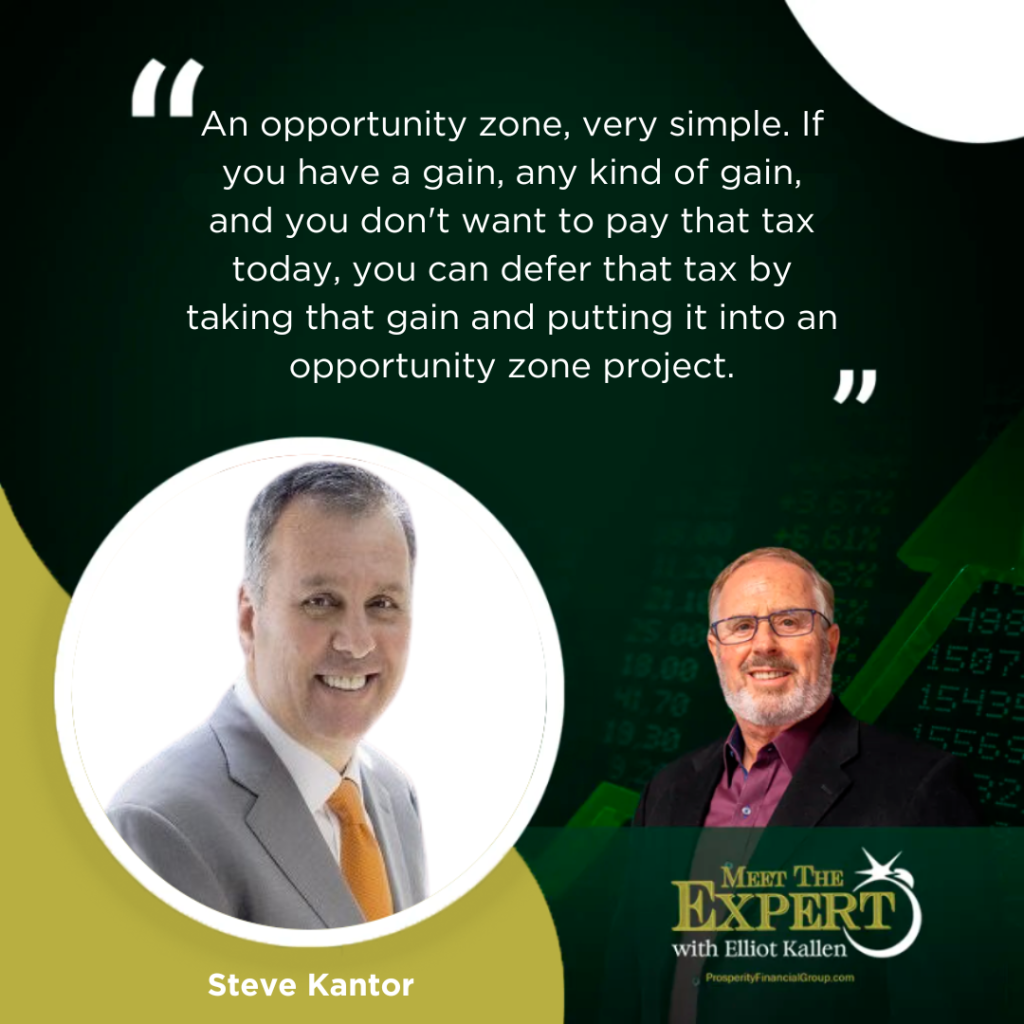
Steve Kantor: So an opportunity zone, very simple. And we’ll keep this very, very simple. So if you have a gain, any kind of gain, you sold a Rembrandt. If you were lucky enough to have a Rembrandt you just found and you sold it, you had a big gain, you’d normally pay tax on that gain. You’d pay capital gain tax. Well, if you don’t want to pay that tax today, you can defer that tax by taking that gain and putting it into an opportunity zone project. So that’s the simple part. Now, what is an opportunity zone project? You can get online. All these opportunity zones that these projects could be in was established, and you can look at where they are. They’re all over America. And they were based on a 10-year-old census of really places that needed development to help the Economy in those cities, towns, states. That’s what they were created for. So it was there to help spur on development for jobs and creation of jobs. And so when you look at them, if you took your gain that you just had, you put it into one of these projects, and you hold it for 10 years, you can defer the taxes that you would have normally paid on that initial sale of that project. That’s the simple way of doing it. Is it only for capital gains? It’s only for capital gains. So it’s got to be something. You could still invest in the project, but you wouldn’t get the benefits of deferred tax.
Elliot Kallen: Okay.
Steve Kantor: Or here’s the other great thing. If I really went through it, when it first started, there were three things that were important. Now there are two. If you took that gain and gave it to me, and we put it in the project, you would defer the tax. You would defer the tax till 2027 based on tax rates in 2026, and we’re going to come back to that a little later. The second part is if you kept it in that project for 10 years, that any gain in that project is tax-free. So that’s key. So assume that when you give somebody the money, they’re going to probably hold that for 10 years, so any gain would be tax-free.
Elliot Kallen: So I think of Opportunity Zones, Steve, since I’m here in Northern California, and I know you’re in beautiful Orlando, and I don’t even think Orlando needs an Opportunity Zone. But I think of downtown Oakland or the tenderloin of San Francisco or the Bronx of New York or downtown Baltimore being the areas where there are going to be Opportunity Zones, and I personally would never want to invest there. So am I wrong?
Steve Kantor: No, you’re not. You’re not. But here’s the crazy part. About 20% to 25% of those zones, you’d be going, how could that be an Opportunity Zone? Let’s go through some. Charlotte, North Carolina, Williamsburg, New York, I can keep going. There’s so many places, Cincinnati, Ohio. You can keep going. There’s places all over that are Opportunity Zones, and the reason they are is I said earlier they were based on 10-year-old census. If you took some of these properties and went to 10 years, you’d go, yeah, that would have been an Opportunity Zone. 10 years ago isn’t today. It is an Opportunity Zone, but it isn’t today when you look at it. So I would say that when you look at these deals, you should try to find those 20% to 25% where you go, man, there’s no way this could be an Opportunity Zone.
Elliot Kallen: So they’re not Investing in a pool. They’re investing directly in the property.
Steve Kantor: Well, not necessarily. It could be a pool. It could be a lot of people have set these up as REITs and there’s a pool of assets, and other people have set them up as a partnership where there’s one asset that you can invest in. There’s many different ways to play this game if you want to play it. I personally like partnerships, and the reason is that at the end of the day, if you own it as a partnership, you might get a K1, and if you do one asset, you only get one K1, but the great part about that is some of the richest people in this country are real estate guys. In fact, we have a president that was a real estate guy, and most of those guys don’t pay taxes, legally don’t pay taxes, because being a real estate developer is a lot of losses, a lot of losses. And so if you’re looking for some of those losses that want to pass you to you, you do it as a partnership. If you do it as a REIT, like in some of these big pools, you don’t get those tax benefits. So if you don’t care and you don’t need those tax benefits and not look for any kind of passive losses at all, you can do it as a REIT, but if you are, maybe you want to consider doing it as a partnership.
Elliot Kallen: Is there a difference in liquidity? That means when people want to get their money back, because things happen between investing like you’re doing in a particular building with a K1, a partnership, versus a pool.
Steve Kantor: Well, even if there’s a pool, most of them are non-traded. So at the end of the day, there isn’t a lot more liquidity. I would tell anybody that gets in one of these deals, assume that you don’t have liquidity for 10 years. And by the way, that’s 10 years from whenever the fund closes. So just be aware of that. So it is an illiquid investment. However, I say that, but there’s a lot of different ways of looking at this. I always say, I can’t imagine somebody selling a business or selling something very big and saying, today, I think I want to be a real estate developer. That’s what I want to be, a real estate developer. And I really want to tie my money up for 10 years. And if you find those people, please give them my phone number. I’d Love to talk to them. But most people don’t. So when we look at these kind of deals, we say to people, what people really want is they really want to sell the asset, defer or not pay the tax, whatever the tax they’re trying to get to deal with. And then they really want their money back as quickly as possible. So you might not get, you might not pay that tax for 10 years, but if you do these right, you’ll get most of your money back well before the 10 years are up through refinancings. That at the end of the day, when you get your money back in 10 years, or you get another turn of your money, or you get 50% more, whatever the profit is, that’s tax free. But you should have gotten most of your money back well before that.
Elliot Kallen: So I’ve got a client right here who’s got a million dollars in capital gains from being one of the original Fortune 1000 employees, and they don’t know what to do with it. And they say, okay, I don’t mind putting my money in there, but I need something more semi-liquid. You think this could work for them?
Steve Kantor: Yeah, I wouldn’t call it, I’d use my term differently. I wouldn’t call it liquid, but I wouldn’t say I’ve tied up my money for 10 years. Okay, semi-available. Semi-available, not available, but semi, then I’m going to get money back. I’m not sitting there waiting for 10, I didn’t give you a million dollars today, and I won’t see a dollar back for 10 years.
Elliot Kallen: Okay. You know, in California, we live in a world of 1031s. There are people who will be 1031s forever, and I don’t know how that keeps, the real estate industry must be an incredible lobbying group, because I don’t know how that gets washed over every time they redo the taxes, that’s kept in place. But it is. And so, you’ve got all these people that are buying 1031s, and I keep saying, look, you’re buying something for your kids, not for you, because it’s just going to get passed through and stepped up the market. What’s the difference?
Steve Kantor: So, there’s a couple, and you’re right, whosoever’s running that lobby, I need to make my best friend because they’re doing a great job, and every time they do a tax bill, they say it’s going to go away, and it never goes away, never goes away, right? So, 1031s work for people that own real estate and sell real estate. But what if you don’t? What if you sold a business? What if you sold a piece of art? What if you sold a fur coat? You had another kind of gain? 1031s don’t work for those people. The second part is, some people would like to actually use the money while they’re living, right? So, in a 1031, you can’t use that money. If you do an Opportunity Zone, you could take back your initial basis, your basis, and only invest the gain, so you actually have money to go spend. And, oh, by the way, a lot of the Opportunity Zone deals will give you part of that to pay that tax in 27, if that’s when the tax is due, is in the form of some kind of payment, so that you’ll have paid your tax, and now all that money’s available to you. So, you know, if you were my parent, and you sold a real estate thing, I’d want you to put it into a DST, so I had it all. But if you weren’t my parent, I’d be like, hey, and if I was the parent, I’d say, you know something? I’m going to leave my kids a certain amount of money, but I think I want to go enjoy myself with the rest. You might want to look at an Opportunity Zone. But
Elliot Kallen: I want to repeat what you just said, Steve, and we’re talking with Steve Kantor, who’s been 35 years a global head at Credit Suisse, so we’re talking about Opportunity Zones. He’ll give you his information a little bit later. And you’re on Meet the Expert with Elliot Callan, that’s www.prosperityfinancialgroup.com, or Elliot at prosperityfinancialgroup.com. So again, you brought something up that’s very interesting. Somebody owes taxes from coming up on April 15th next year for a gigantic capital gain. Maybe it’s a stock option program, maybe it’s just that they had massive gains. They can still do this Opportunity Zone and get the taxes paid?
Steve Kantor: Well, hopefully, if you do a deal, always say to you, when are you planning on making a payment to us? And so the way we like to do deals is we like to always say, when the taxes will be due, we’re hopefully going to do a refinancing that we can give you a distribution. And that distribution will hopefully pay your tax, so 20% to 30% comes back in the first two or three years. You know what happens? You forget that tax, right? So you put in an Opportunity Zone, two years go by, and you’ve spent the money. You took your trips to Europe and Asia, and you’ve had a great time. And then you’re like, oh, I forgot I got to pay that tax on that gain two years or three years later. And now, so if you’re smart, we try to do it so we have distributions kind of scheduled out to make sure that you can pay that. It doesn’t always work that well. We rely on that, but that’s the way people try to make those things happen.
Elliot Kallen: Okay, so I get it. What are the misconceptions here?
Steve Kantor: Well, I want to put one thing out before we get there. This is really key, right? So if they ever pass a tax bill, I mean, I’ll take your opinion on that, but if a tax bill ever gets passed in this country, if the Republicans and Democrats can agree on anything, the Opportunity Zone legislation that is to extend the legislation, because right now, like, there’s a benefit, right? There’s two benefits I said. The one benefit was you don’t pay your tax until 27. Is that really a big benefit? Is that a real reason to go do one of these deals? Probably not. The big benefit’s 10 years and no tax. But it has done a good job of spurring the economy in these places. So there’s a bipartisan, believe it or not, bipartisan agreement that they should extend the Opportunity Zone rules and extension, which would mean that if you had a gain instead of paying it on tax year 27, it could move to tax year 28 payable in 29, or tax year 29 payable in 30. Now that’s the big deal, right? If you can defer your tax for four or five years, that’s much better than 12 months. So at the end of the day, keep your eye on that bipartisan, Republicans and Democrats actually agree. It’s supposed to be part of the tax bill. If the tax bill gets passed, we’re hoping that that gets extended. And if that gets extended, you will see a lot of people, especially the people that even thought about DSDs, start to think, well, maybe given that, given my age, whatever, I might just do this as an OZ. And
Elliot Kallen: DSD stands for what?
Steve Kantor: Delaware Statutory Trust.
Elliot Kallen: Why is that important?
Steve Kantor: I don’t have a clue why they call it that, but it’s, if you, for real estate people, if you had a piece of real estate and you sold it, you can take it and put it into another piece of real estate called the 1031 Exchange. This just gave you units instead of one property for one property. And you had the ability not to pay the tax on the gain by doing that. Only if you had a like exchange real estate to real estate.
Elliot Kallen: Okay. So on this one, eventually those taxes are going to have to get paid. You don’t, you’re not abating the taxes. You still owe them.
Steve Kantor: No.
Elliot Kallen: You’re just kind of deferring them.
Steve Kantor: Yeah. However, the asset you put it in, if that has a gain, there is no tax. And I always say to people, you know, rate those two things. You went through it. Rate how important those two, so if you have to defer a tax, if you defer a tax a year to probably not worth a lot on a scale of one to 10, 10 being the best, if you had to defer five years, probably a four or five or six, but you still pay the taxes you set. However, tell me, I’m going to ask you the question. If you had that, if you put it in, in 10 years from now, you didn’t have to pay a tax. Is that a zero or 10 or what in between? What would you call that?
Elliot Kallen: Well, I mean, I would like to defer taxes. I don’t care who, I’m like everybody else. Nobody likes
Steve Kantor: writing that check. But not a tax on the gain. The gain I just gave you, you bought this piece of property, in 10 years, is that value of not paying a tax on that gain zero or 10? Well, if I’m alive, it’s a 10. But what if there’s no gain? That’s a zero. So the key thing is here, that’s a 10 if there’s a gain and a zero if it’s not. I will tell everybody what I say on tax deals. Make sure, if there’s one thing you remember today, make sure that when you do a deal, you don’t do it for tax purposes alone. That deal has to work. Is that why you’re doing
Elliot Kallen: a partnership, Steve, versus a day one? I do.
Steve Kantor: I do. I like to do one. It’s very simple. I like to pick my spots. I like to figure out the best markets. Remember, what do you people say about real estate, location, location, location? It’s still a local game, right? You got to make sure you have a good team that’s going to do this development, good team that knows how to manage it, a good team that’s a Fiduciary, all the same things. And then if that’s a great deal and you get all those tax benefits, it’s just a cherry on top of the sundae.
Elliot Kallen: We’re talking with Steve Kantor and we’re talking about Opportunity Zone Marketing. He’s been 35 years on Wall Street. So give me the downside. If somebody says, hey, Elliot, give me the two or three downsides of why I should or should not do this.
Steve Kantor: I’ll give you the downsides. To me, there’s two major ones. One of the deals has got to work. We just talked about that.
Elliot Kallen: Okay.
Steve Kantor: And the other one we did talk about, it’s illiquid. Do not go into this thinking about liquidity. Right? It’s illiquid.
Elliot Kallen: And you don’t believe in your heart that the U.S. Treasury is going to take these things off the market and make them taxable right now.
Steve Kantor: I do not. But who knows what the U.S. Treasury ever does? I do not. And usually, even when there are tax changes, they don’t go backwards, right? They go forwards. So I think if you bought one, the odds are against it. If the government start doing that with every tax legislation, you’d have a lot of problems. It just changes things going forward, usually. So it says the tax benefit you have will not be available anymore.
Elliot Kallen: So one more question there, and then we’ll give you some information about you, Steve, if that’s okay. Today, I have a million dollars of capital gains. I’m a business owner. I’m selling my business. Or I got five million. It doesn’t really matter. I got a big tax bill due right now. So would you put it in the opportunity zone, and would you put it in one building? Because that seems super dangerous at that moment to me. But if I don’t need the money for a while, that sounds good. But if I do, fortunes have a loss pretty fast.
Steve Kantor: Yeah. Look, you could ask that question with a thousand things, and I’d answer the same way. Diversification is the key to everything. I don’t believe you should ever put your money on one thing. I don’t care how rich you are. The reality is some of the greatest deals I’ve ever done are the ones I expected the least at, and some of the worst deals I’ve ever done are the ones I expected the most out of. Always diversify. If you had a million dollars in gains, and that’s a big portion, first of all, if it’s a big portion of your net worth, don’t tie it up to 10 years. It’s the first thing I tell you. But if it’s money you can live without, and you want to do it, and you want to defer tax, and you want to hopefully get a gain the other way, I’d diversify it in multiple properties. I wouldn’t do one.
Elliot Kallen: Okay. Well, you can see how this fits into people’s portfolio. So, Steve, this has been great, Opportunity Zone. Most people know nothing about it. We spent about 20 minutes talking about it. Is there anything I’ve missed about it?
Steve Kantor: No. By the way, I think you did a great job. It’s an interesting topic, and I would tell everybody, once again, watch that legislation. I’m sitting there every day. I wake up every morning. I’m like, please, please, please, somebody give me some good legislation, or give me any legislation at this point. So, we’ll see. We’ll see. Okay.
Elliot Kallen: So, if people want to reach you to learn more about it, and the idea is to go through me at Elliott at prosperityfinancialgroup.com or 925-314-8503. But if somebody just wants to have a conversation about why this is important, how do they reach you guys?
Steve Kantor: Well, we have s2kco.com as our website. Go there. We take no money directly. We always work through broker-dealers. We want people to talk to their financial consultants. We like that. We want you and your financial consultant to be very happy if you want to do business with us, and we’d love to talk to you. Love to talk to you. As you can tell, I could probably talk about this stuff all day, and I can easily talk about real estate all day. I can assure you of that. I’ve done this for a very long time.
Elliot Kallen: So, in geeky terms, you mentioned broker-dealer. So, we are a registered investment advisory firm. Can we go direct to you without going through a broker-dealer?
Steve Kantor: You can, as an RIA. Sorry, I should have said financial advisor. So we always work through financial advisors, whether they be a broker or they be an RIA. We’re fine, but we don’t take any money direct. We only take it through financial advisors.
Elliot Kallen: And I bring that up because we are fiduciaries on everybody’s account, so I make sure that you’re doing the right thing, you’re making sure I’m doing the right thing, and our outside compliance company is making sure that we all do the right thing. And a broker-dealer world, the Merrill Lynch world, the Morgan Stanley world, is a different world than our world, or Edward Jones. Not to plug them, but they are different worlds, and we love what we do, and there’s a reason we’ve been doing this for 33 years. So that’s great. So, Steve, you’ve been great. I appreciate you being a part of this show. It’s been Meet the Expert with Elliot Kallen . This will be beyond episode 145, so…
It takes us a few weeks to get this out here, but if you’re an investor with capital gains, that’s the takeaway here. And you want to defer in some form that capital gain payment, and you don’t mind it being semi-illiquid or totally illiquid for 10 years. Might be two years, but it might be 10 or might be five. And hopefully if legislation doesn’t change, I’ve been around long enough to see legislation change with all types of things, and it has. But assuming that they’re not going to change yet, this was put into place in 2017 under Trump, it’s hard to believe that the Trump 2.0 would take it away. But, you know, the worst things have happened.
Steve Kantor: He’s a real estate guy though, don’t forget that. He’s a real estate guy. So if at any time you’re going to get real estate legislation in your favor, it’s right now. He is
Elliot Kallen: bending a little bit because of this, political claim of we need to tax the rich a little bit more. But we’ll see what happens at the end of the day on that. But give us a call. Give me a call, 925-314-8503. And let’s talk about this, because it’s a great conversation. And I will get Steve or the representative of Steve on the Zoom with you so you understand it completely. So Steve, thanks for being part of this.
Steve Kantor: And can I just, one more thing. I think it’s phenomenal that a financial advisor gets that and does Education. And so the education is a key and I love what you’re doing and just keep it up.
Elliot Kallen: Thank you so much. We’ve gotten great kudos on that. We love doing this. You could see that, I’m a bit of a yapper and with people skills. And so it’s a lot of fun. And if I could do this for a living and not have to do the rest of my job, I would do it. I have, we have two companies here. Each one is over 500 million. That’s a billion dollars in assets right here in San Ramon, California, Northern California, outside San Francisco. We have clients all around the country because most of our clients started at East Coast and here. And now they moved all over to Idaho and to Seattle and to Austin, Texas. And now you’re trying to get away from everybody, trying to get away from taxes. So that tax issue is a major league issue and a major question. Not everybody has capital gains that they could defer or the ability to be semi-liquid, but boy, there are a lot of tax issues there.
Steve Kantor: Yes, there are.
Elliot Kallen: So thanks for being part of this, everybody. Remember, it’s prosperityfinancialgroup.com. Come visit us, come check out my calendar. It’s online. We’d love to have a conversation with you and have a great day, everyone.
All right, wrap this up. Again, thanks for being part of this discussion. Have a great day, everyone.
The post How Opportunity Zones Can Transform Your Capital Gains Strategy with Steve Kantor appeared first on Prosperity Financial Group | San Ramon, CA.