
 Corporate, Religious, Ethnic, Female, and Working Class Voters
In Parts I—III of our series, we talked about the crimes. We talked about the cover-ups. We talked about the cowardly Congress, the inactive Departments of Justice, and a compliant, profit hungry media that looked the other way, normalized the abnormal, and let a con man operate in plain sight.
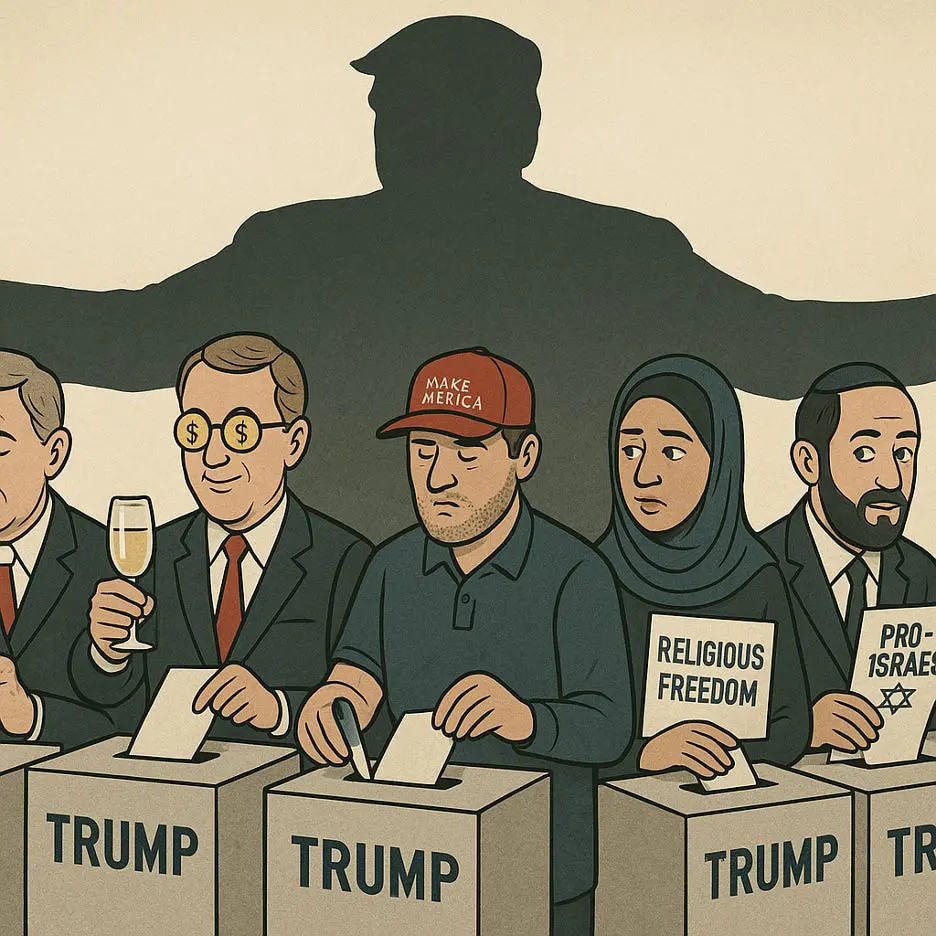
But Donald J. Trump didn’t rise to power because of the RNC, a weak Democratic response, Fox News, or Russian trolls. No. the principal enablers are far more intimate. They are the people we live among. Work with. Worship beside. Share Family dinners and Sunday sermons with. The truth is uncomfortable: Trump wouldn’t have come within a thousand miles of the White House without the active support—or the willful blindness—of these key voting blocs:
The corporate class who only saw deregulation and tax cuts
The religious class who forgave his every sin
The working class who saw a tough-talking savior
And yes, even women and minorities, whose votes made all the difference in swing states
They are as responsible for his rise as anyone in Washington. Let’s take a look:
Trump’s pre-presidency legal history shows a man who weaponized civil law to settle lawsuits while admitted noting, to use NDAs to pay off and silence critics, and to preserve his brand while blaming others. This is what most civil justice lawyers refer to as the corporate playbook—delay, deny confuse, refuse.
Trump’s version might be referred to as the corporate playbook on steroids. As former federal prosecutor Preet Bharara put it in a 2021 PBS interview:
“Trump’s entire life has been about playing just inside the legal line or writing a check to make the problem go away.”
Many people compare Trump to Nixon, but Silvio Berlusconi—Italy’s billionaire-turned-prime-minister—is a more accurate comparison. Berlusconi is a Media mogul who used office to shield himself, had dozens of criminal trials and multiple convictions overturned or expire, and thrived by creating a cult of personality and manufactured persecution. Ruth Ben-Ghiat, author of Strongmen, had this to say about Trump:
[He] “is part of a long lineage of authoritarians who use victimhood as a weapon and the law as a shield.”
Blaming the 1% for the Trump phenomenon is almost too easy. Greed over country has become the corporate creed in the era of Trump. Of course they support Trump. They get what they want: an extension of the 2017 tax cuts, deregulation, weakened labor protections, gutted environmental laws, and a president who views corporate crime as savvy entrepreneurship.
Wall Street didn’t flinch when children were locked in cages. CEOs didn’t blink when Trump praised white supremacists in Charlottesville. They just watched the stock market soar and called it patriotism.
They continued to license, sponsor, contribute, and fund his activities long after his scandals, double-dealing, predatory behavior, and autocratic tendencies were made public. When history asks how fascism crept in through the back door, the answer will be etched in corporate balance sheets.
Once upon a time, religious conservatives and others demanded moral character in a president. They railed against Bill Clinton for his sins. They wore “WWJD” bracelets and decried moral relativism.
Then Donald Trump came along.
Here was a man who bragged about sexual assault, paid hush Money to porn stars, divorced after cheating on every wife he ever had, and quite literally could not name a single Bible verse. He is the walking embodiment of everything they claim to oppose.
And yet, they embrace him.
Why?
For evangelicals, he gave them judges, a Supreme Court majority. He nodded at Christian nationalism, promised to outlaw abortion, and posed awkwardly with a Bible upside down after tear-gassing peaceful protesters.
White evangelical Protestants remain one of Trump’s most loyal voting blocs—even after impeachment, conviction, and ongoing felony indictments. According to Pew Research, nearly 8 in 10 white evangelical voters backed him in 2024, seeing him as a defender of Christian values on issues like abortion and religious freedom.
He was seen as uniquely effective in delivering policy wins:
Many evangelical leaders endorse Trump not despite his moral failings—but because they believe he’s instrumental to achieving their policy goals, even if that means overlooking grave personal misconduct. This view comes from the idea of “vessel theology”—that God sometimes uses flawed people for greater outcome.
This alignment emerged clearly in 2024, when evangelical pastors continued to support Trump as “standing up for Christian values,” despite statements and policy decisions widely viewed as immoral or anti-Christian by critics.
More Jewish voters voted for Trump than they did in 2020. Why?
According to most sources, the relocation of the American Embassy to Jerusalem, support for Israel, anti-Semitism, and the aftermath of October 7 were primary reasons. While Kamala Harris received a higher percentage of the Jewish vote, Trump cut into her margin as he did with other ethnic and religious groups. Trump-supporting Jews were concerned about DEI (which many Jews feel is ‘anti-Jewish’), campus protests about the Israeli response to Oct 7 and support for Israel in general.
To my fellow Jews who fell for the Trump charade: Trump trafficked in dual-loyalty tropes, emboldened neo-Nazis (‘very fine people’), and blamed ‘both sides’ after Charlottesville. Tikkun Olam—repairing the world—means more than securing political wins for Israel. It means standing against bigotry in all forms, especially when it masquerades as friendship.
Muslim voters also increased their support for Trump. While his infamous “Muslim Ban” and hostility toward the religion troubled most, Middle East peace was an overriding reason why more Muslims chose Trump. Muslims weren’t happy with the Biden Administration’s response to the aftermath of October 7 and the deaths of thousands in Gaza. And when Kamala Harris announced that U.S. support for Israel was “unwavering,” it failed to help her with Jews and alienated Muslims.
The Democrats’ stance on social and economic issues were also a factor. Gender identity, family values, and economic priorities swayed certain blocs of Muslim voters. Military aid for Israel seemed to be a higher priority for Democrats than domestic funding. Trump’s America first, anti-war posture was especially appealing. A strange combination of concerns about Gaza, Biden’s foreign and domestic policy issues combined to increase Trump’s percentage of the Muslim vote, especially in key swing states like Michigan, Pennsylvania, Minnesota, and Wisconsin.
To my Muslim friends: While your intent was to protest, the result was aligning with a man who once said: ‘Islam hates us’ and cheered for mass surveillance of Muslim communities. And how are Trump tariffs and economic policies working for you? Has anything changed in Gaza? Think about those things when you go into the voting booth in 2026.
The bottom line for religious voters? Moral conviction took a back seat to perceived American power under Trump at it relates to issues that religious groups value. So much so, that these groups were willing to ignore Trump’s obvious shortcomings in how he viewed the tenants of these religions. Shame on all of them.
According to polls, Latinos, a key part of the Democratic voter base for decades, bumped their percentage of 2024 Republican votes by almost 15% compared to the 2020 election. Latinos cited economic, social, peace, and family values issues as reasons to vote for Trump. They ignored Trump’s anti-Latino stance on immigration and criticized Democrats’ embrace of “socialistic” policies.
More Blacks voted for Trump because of the Economy and perceived Democratic malaise about minority issues. Blacks experienced lower unemployment under Trump and were willing to ignore his racist tendencies for a better economy.
About 13% of LGBTQ voters supported Trump, despite a presidency that rolled back transgender rights, banned military service for trans Americans, and embraced anti-gay religious liberty arguments. Some LGBTQ conservatives cite economic freedom or opposition to leftist ‘wokeness.’ But freedom without safety, recognition, or dignity is not freedom at all. Trading survival for swagger is not a strategy—it’s surrender.
One of Trump’s most consistent support groups is non-college-educated white women. Concerns about the economy and a perceived decline in social and economic standing played a significant role. Despite reproductive rights issues and Trump’s multiple sexual assault and harassment cases, many women believe the economy was better under Trump.
Research suggests that women who viewed Motherhood and traditional family values went for Trump. Worries about “open borders” and crime also contributed to increased support for Republicans.
Women are not a monolithic voting bloc. Black, Latina, and Asian American women, particularly those of higher Education, have consistently shown strong support for Democratic candidates. While some might assume issues like Trump’s past comments or stance on reproductive rights would automatically deter female voters, this wasn’t necessarily the case for all women. Female Trump-voters were born out of a complex interplay of factors, including demographic backgrounds, economic concerns, and alignments with specific social and political ideologies.
For these various blocs of voters, the fact that none of these reasons are valid is beside the point. Perception is reality, and if Democrats want to win elections in the future, they must do a better job or prioritizing kitchen table issues and explaining themselves on social and ethnic issues. While ashamed to publicly admit it, “America first” resonates across socio-economic classes of Americans when it comes to the economy and immigration.
Women and minorities were deciding votes in the 2024 election. While it’s easy to understand why white evangelicals or corporate donors backed Trump, it is far more difficult to understand why nearly 30% of Latino voters, 8% of Black voters, or more than 40% of white women helped elect him. Misogyny, racism, and xenophobia weren’t deal-breakers. Some believed the economy mattered more. Others bought the “strong leader” image. Many were duped by disinformation. And too many convinced themselves it wouldn’t get that bad.
But it did get that bad.
When women watched Trump brag about grabbing them “by the pussy” and still cast their ballots for him, something broke in our civic soul. When voters descended from immigrants cheered as asylum seekers were turned away or sent to South America without due process, something curdled in our national identity.
The bottom line? When ideological, political, or financial rewards are promised, standards tend to fall—accountability dies, and hypocrisy lives. 7 months into Trump’s second term I would ask these religious and ethnic voters:
How’s this version of Trump working out for you? This isn’t just about Trump. It’s about us.
Donald Trump—a man born into obscene wealth, who stiffs his workers, outsources his products, and golfs while unions strike—somehow has convinced millions of working-class Americans that he is their voice—he is on their side.
While he put his name on golden buildings, he told workers he was “one of them.”
He mocked the disabled, insulted veterans, and shipped jobs overseas—and still workers cheered. Why?
Because he spoke their language of grievance? Scapegoated immigrants? Mocked elites? Was it because he fed the fantasy that their decline wasn’t caused by globalization or automation or decades of bipartisan neglect? No, it was simpler than that. It was ‘their’ fault—the Democrats were to blame for their current circumstances.
It was the oldest trick in the book: punch down—never up. And it worked.
But Trump’s policies have done nothing to help them. His tariff and economic policies have made things worse. Apparently, a flag to wave and a constituency to blame is enough in this age of tribal politics. You will one day realize that the joke is on you.
Trump’s enablers aren’t shadowy conspirators. They’re your neighbor. Your brother-in-law. Your pastor, rabbi, or Imam. The corner doctor, lawyer, barber, butcher, grocer, or pharmacist. A wealthy donor, a factory worker, or a suburban mom.
We must stop pretending this was some freak anomaly.
It was a choice. Made by millions. Twice.
They empowered a man who attacked democracy, stoked insurrection, betrayed allies, coddled dictators, openly tried to overturn an election, and lined his pockets at taxpayer expense.
If we let them, they will do it again. What will we, the people do about it?
In Part V, the final segment of our series, we’ll conduct an experiment: What if Barack Obama had done even one-tenth of the things Trump has done. Spoiler alert: They would’ve impeached him with fire and fury.
The double standard isn’t subtle. It’s the whole game. Stay tuned

Mark M. Bello is an attorney and author of 9 Zachary Blake Legal Thrillers and other legal themed novels and children’s books. For more information, please visit https://www.markmbello.com