In this compelling episode of Meet the Expert with Elliot Kallen, Elliot sits down with Tom Burgess—serial entrepreneur, board member, and “gun-for-hire” executive—to unpack brand loyalty strategies and the complexities of exiting a business. From global packaging challenges to loyalty marketing Innovation, this episode is packed with actionable insights for business owners and high-net-worth individuals looking to scale, optimize, or transition their enterprises.
Tom Burgess is an accomplished entrepreneur with a 30-year track record in telecommunications, marketing Technology (MarTech), and financial technology (Fintech). He currently serves as President at SNP Interactive, advising consumer packaged goods companies on marketing and customer retention strategies. Tom is also a trusted board member and M&A advisor, making him an invaluable resource for business owners navigating Growth or succession.
1. Packaging Industry in Transition
Tom explains how the packaging industry, especially soft packaging from China, is bracing for major tariff changes. These supply chain pressures are prompting companies to diversify manufacturing away from China and reassess cost structures. The result? A period of limbo and uncertainty—highlighting the need for strategic foresight.
2. The Power of Loyalty Programs
Tom breaks down effective loyalty strategies into two categories: episodic (e.g., sweepstakes and promotions) and evergreen (e.g., points-based systems). His advice? Keep it simple. Programs should be engaging and easy to understand to retain customers and attract new ones.
3. Brand Engagement Beyond Points
Modern loyalty is evolving. Perks like early boarding, free upgrades, and elite recognition often deliver more perceived value than traditional point redemption. Tom shares real-world examples of how airlines, hotels, and financial institutions create emotional loyalty through tailored experiences.
4. Planning the Business Exit
Whether selling to private equity, going public, or passing a business to Family, Tom emphasizes foundational preparation. Business owners should know their long-term goals from the start and understand that exit timing might not always be in their control—especially with outside investors involved.
Tom and Elliot dive into the emotional aspect of exiting a business—comparing it to letting go of a “baby.” Elliot references his book Driven, highlighting the three phases of entrepreneurship and the critical moment when founders must decide their future. Tom reinforces the importance of early planning and being ready for multiple outcomes.
Want to explore ways to increase brand loyalty or plan your business exit? Reach out to:
Tom Burgess
Email: [email protected]
Text: 401-855-4319
For financial guidance and to watch more expert interviews, contact:
Elliot Kallen
Email: [email protected]
Website: ProsperityFinancialGroup.com
Phone: 925-314-8503
Elliot Kallen: Well, good morning, good afternoon, everyone. I’m Elliott Kallen, CEO of Prosperity Financial Group. Welcome to another exciting episode of Meet the Expert with Elliott Kallen. We are talking today to entrepreneurs. You’re going to Love this because this is a gentleman, very entrepreneurial, who’s in the M&A world. He has started four very successful businesses. He lives in multiple continents, multiple countries. He’s a gun for hire in different ways. He sits on corporate boards. This is very exciting. Tom Burgess, you’re going to love this. Welcome, Tom. Hey, Elliott. It’s nice to be here. Thanks for having me. It’s great to have you here. I’m Tom Burgess. I’m at Elliott, E-L-L-I-O-T, at prosperityfinancialgroup.com, or the website is prosperityfinancialgroup.com, where you can see this and more than 125 episodes. Very exciting. Top 2% of all financial podcasts in the world, everybody. So you want to listen. It’s going to take up just enough time on your treadmill or on your bike or in your car for you to go a handful of miles, and you’re going to love this. So let’s get going here, Tom. Let’s talk about, as you started companies, you worked with M&A Work. You know what it is to do this. And today, you’re a gun for hire president, you’re in a packaging, you’re giving advice in a packaging business. What are you doing that’s exciting in the packaging industry?
Tom Burgess: Yeah. So SNP Interactive is a great company that works with CPG companies, so consumer packaged good companies. It’s great that you and I, as consumers, would buy off the shelf at a retailer. And SNP in particular helps these companies acquire, retain, and engage the consumers. So marketing programs such as loyalty platform work, sweepstakes, any type of couponing, things like that. So we’re out on the front line, that zero moment of truth, if you will, when the consumer is about to make a decision on buying a product. So that’s what I’m working with right now. I’ve spent quickly, I’ve had my background, as you mentioned, four different companies and 30 years. So I’ve had the opportunity to work in telecommunications, marketing technology, or Martech, and financial technology, Fintech. So I’ve had the opportunity to work with a lot of different types of companies over these years.
Elliot Kallen: So it’s kind of interesting. I’m going to follow up on that in a moment, but I want to not forget what’s going on. Your companies that you work with do a lot of packaging, soft packaging, with products made from China and the Far East. And there is 100 plus percent tariff on China. I think they’re going to settle something out in the next 90 days, but they may be the last country we deal with. I don’t have a crystal ball. Nobody from the Treasury Department calls me up and asks for my advice anymore. But I do know that we’ve been having problems with China for 20 years now, but it’s the cheapest place or one of the cheaper places to do consumer packaging. So you’ve got a problem on both ends. We need China for consumer packaging. We’re not going to do that here. But companies get ripped off and all that other stuff, that political. How does that affect your conversations in boardrooms when you’re talking to packaging companies and loyalty programs?
Tom Burgess: Everybody’s preparing for what might happen. I would say realistically, there’s a tad of emotion, a tad of hysteria, and no true rubber hit the road results at this time. But it’s coming and everybody knows it. So there’s a lot of preparation, a lot of people talking about what happens if this goes on or what happens if that goes on. And then you see something like, you know, it’s even affecting shipping. So there was the federal government had the, I’m not going to come up with the right term, but the rule where any product shipped in under $800 in value would not be scrutinized for the tariffs. And they just lifted that. So now those products, even those shipments will be scrutinized for tariffs. So yeah, it’s going to impact everything. It’s coming and it will have a big impact and it’ll be felt by either the companies or the consumers.
Elliot Kallen: I have a very good friend, Tom, who does packaging here in the West Coast. And it’s just, his niche has grown into cannabis, packaging for the cannabis industry. Makes a lot of cash from it because they can’t get a bank account and you know the deal already with that.
Tom Burgess: Yeah. Payments are hard in the cannabis industry. There’s all kinds of rules around it. Sure.
Elliot Kallen: Yeah. Well, I remember one time when he woke up, he was very depressed and he said, I’m going to have to lay off some employees now because my cost of goods is going up so fast. I can’t pass it on as quickly as it’s going up. Are you finding that too?
Tom Burgess: Not so far. So the companies that we work with are making plans. And again, I go back to that. They’re making plans. They’re being cautious. There’s definitely some discussions around the fact that shipping has started to change. They see orders, right? They see future orders that are lower. They are making smaller orders. They’re in that prep mode. I can’t emphasize enough how I think we’re in limbo. I think that’s the best way to describe where the industry is. Anybody that’s feeling the impact is feeling the impact of preparation steps. But it’s getting very close to reality. You’re right, those massive, you know, any types of tariffs or taxes, whatever you want to call them, are impacting everyone. And there’ll be changes. And so the manufacturers are either going to try to step up their manufacturing plans, process, programs that they run, any packaging they do, they’re going to start to possibly shift it to different countries away from China. So we’re in a period of change for sure, no matter which side of the aisle you land on, right? Whether you like the rules or you don’t like the rules, or you think the rules have meaning behind them, or you don’t think the rules have meaning, or the changes have meaning behind them. I don’t care which side you’re on. It’s impacting the Retail industry and the end consumer.
Elliot Kallen: Well, that’s why I say my job is to figure out for our clients how to make Money, no matter who the president is or who’s in Congress and what they do. How can we make money? I agree with you there, because we build portfolios and nobody wants to hear that, but we’re not making money because. And they want to know, what are you doing?
Tom Burgess: Yeah. One of the worst places in the world is limbo, right? Let’s just face it, limbo is challenging. And when you’re in limbo, you don’t know which decision to make. Give me a result, right? Give me a pain or give me a carrot, one of the two. I need to understand what to do. We’re in the worst part of the process right now, where nobody really knows what decision to make. So people, smart people, are making predictions and saying, okay, if it goes down this path, and they always, if you’re smart, again, you’re making prediction for worst case scenarios. So the impact is happening based on those people, those smart people in the decision chair planning for the worst case scenario.
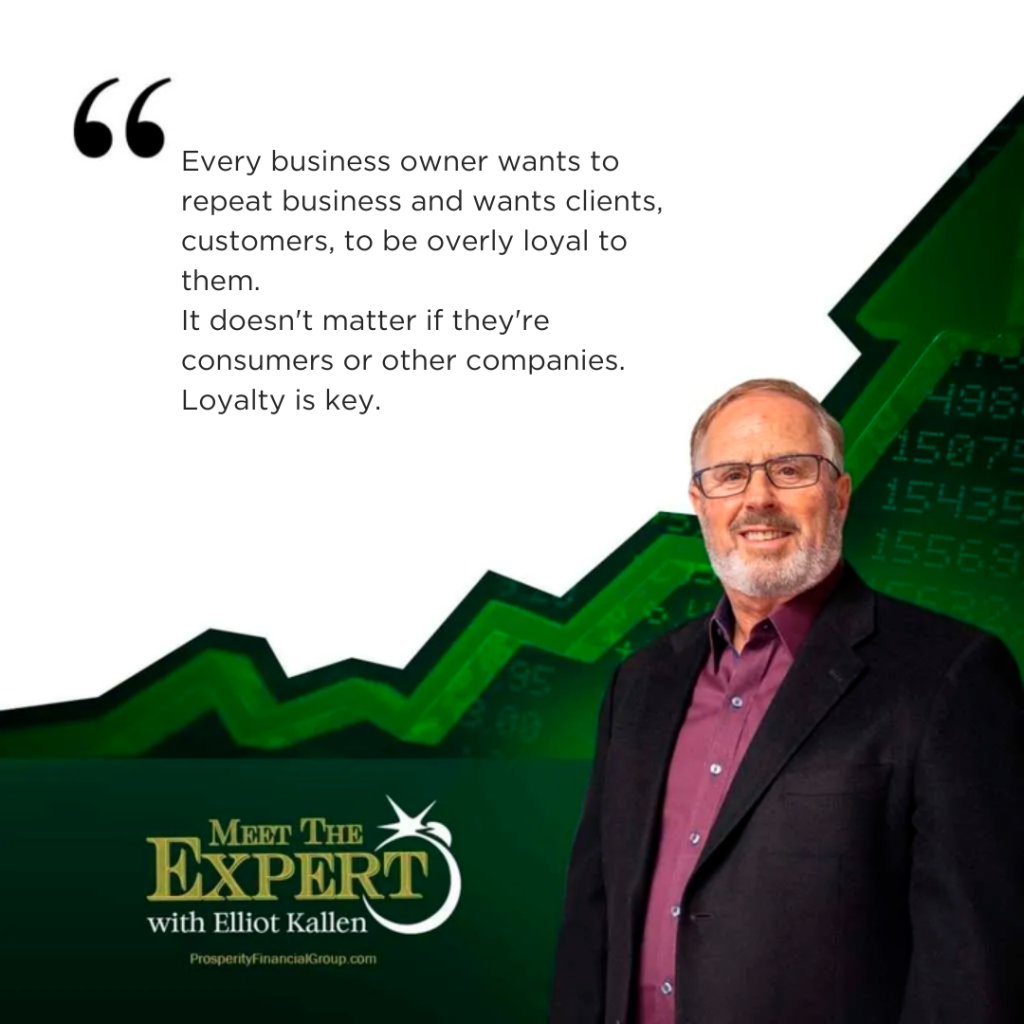
Elliot Kallen: Great. So we’re talking with Tom Burgess here on Meet the Expert. If you need to reach me, it’s Elliott, E-L-L-I-O-T at prosperityfinancialgroup.com. And he started for businesses, and now he’s a gun for hire. He’s president of a company here, Consumer Packaging. There is a CEO there, but he’s the president. I want to talk to you about, Tom, and this is really, I think, what you may bring to the table that’s the most valuable for people listening to this, and that everybody, every business owner, 60% of the people who listen to this are business owners. Every business owner wants to repeat business and wants client customers, clients, customers, to be overly loyal to them. And if they’re customers or consumers, great. If they’re customers or other companies, great. It doesn’t matter. You want brand loyalty, you want company loyalty, you want repeat business, because it’s too hard and too expensive to just find new customers all the time. You want to keep the ones you have. So I think you’re an expert in loyalty and loyalty programs. Am I correct on that?
Tom Burgess: I’ve done a lot in loyalty, yes, and a lot of different categories. So I’d take that, yes.
Elliot Kallen: So let’s talk about that, because that’s what people want to hear more than, I think, that you’ve been a successful entrepreneur with 44 companies. Loyalty, has most of your loyalty affected in consumer packaging?
Tom Burgess: No, I’ve done loyalty across telecommunications and financial technology as well, so banks, bank loyalty as well.
Elliot Kallen: Okay, so the people that aren’t in the bank business can learn from you. So let’s talk about, we have consumers that are listening to this. We have corporations that are listening to this where they’re selling to corporations. Let’s talk about the meaning of loyalty and what devices they can use to build brand loyalty in their world. They might not all fit, but you know more about brand loyalty than anybody else listening.
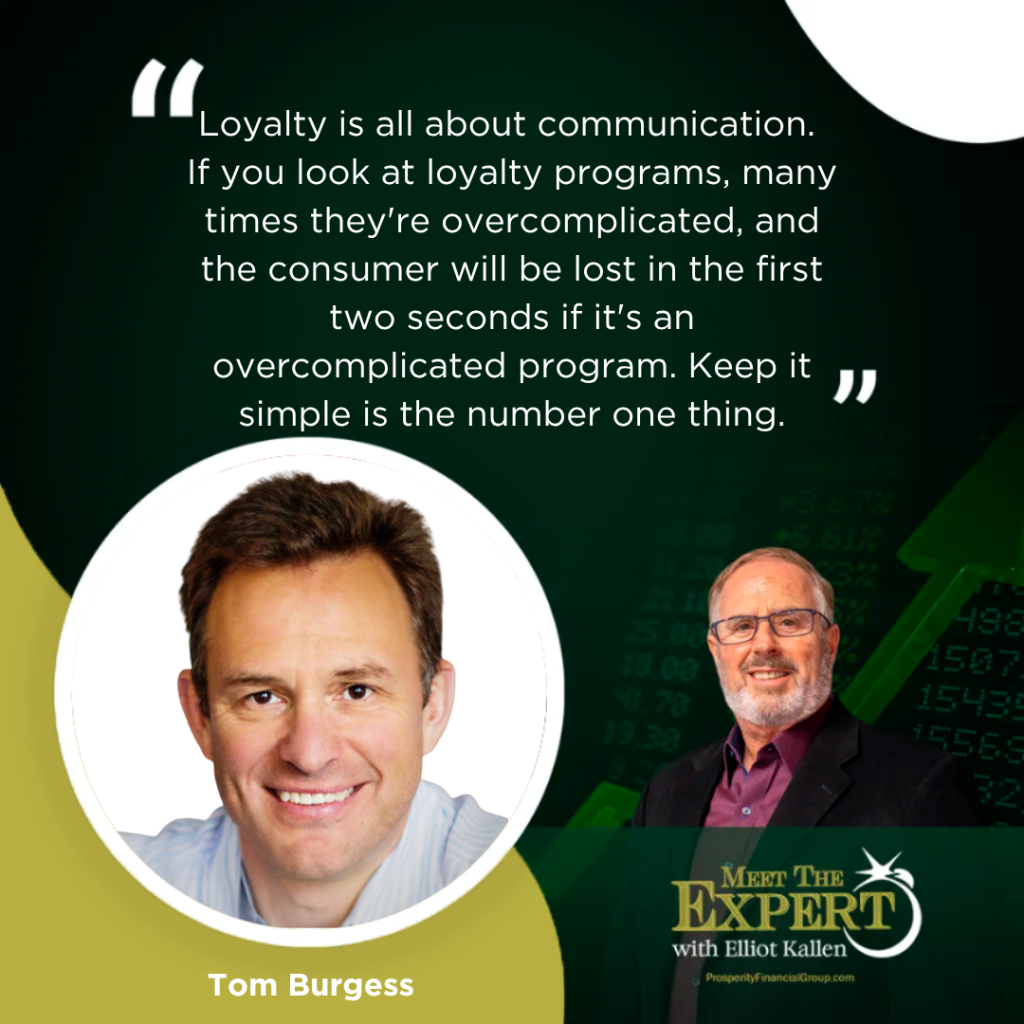
Tom Burgess: Well, loyalty is all about communication. If you look at loyalty programs, many times they’re overcomplicated, and the consumer will be lost in the first two seconds if it’s an overcomplicated program. I’ve seen so many unique ideas and exciting ideas that simply were too many steps or too hard. Keep it simple is the number one thing, and I know we all hear that in life. Keep it simple, stupid, the KISS program. But it could not be more relevant as it is in loyalty. So when engaging a consumer, and loyalty, by the way, isn’t just about retaining. You’re exactly right. It’s so much easier to sell an existing customer something than it is to acquire a new one. However, loyalty is also about acquiring new consumers and new customers or clients. You want to show the program is a value proposition when they engage with the brand and they get more value when they engage more. So you can get into all kinds of unique, fun things that a brand can do. It’s just keep it simple. You want to allow engagement to be something that is enjoyable so the consumer is going to enjoy the outcome. The loyalty programs, and there’s two different types of loyalty programs, by the way. There’s loyalty that are episodic, and then there’s loyalty that is a long-run or evergreen loyalty program. And in either case, you want to make sure that the consumer is well-educated and don’t overcomplicate. So I’ll start with that. Am I getting there?
Elliot Kallen: You are. And what are some things that you’ve found that have worked?
Tom Burgess: I think some of the funnest loyalty programs are buy-get programs, meaning that it’s just simply if you buy something from me or you engage with my brand, we’re going to give you something back for it. Now that’s where it shifts around, right? Now you get some decisions. You can buy and be entered into a sweepstakes. Those are very successful programs where, as a matter of fact, working on one with an energy drink company right now, I guess I shouldn’t say because who knows, it’ll be over before we get this podcast up, but this energy drink company is putting out a lot of high-value entries into sweepstakes. When a vehicle, when a motorcycle, when a truck, these kinds of things, those are fun. That means it makes you want to buy something, right? I’m going to win possibly something very cool like that. And you have other programs that are much more about either cash back or points, meaning that as I buy, just every single time, I know in the back of my head, when I buy this product, I’m going to earn points or I’m going to get cash back every single time I engage with the brand. And what that does is that drives loyalty and repeat. The first program buy, get, or sweepstakes-type programs buys enthusiasm, brand equity. You’re buying, you’re gaining equity in that person’s mind for your brand. You know, hey, that’s the brand that’s going to let me win something. I’m going to run down to the store. That literally will get that type of sweepstakes program will get somebody out of their chair, out of their car, and get them in a store to buy something. The other type of evergreen program that I mentioned is where you’re earning points. And you think hotels and airlines mostly is what a lot of people think, but there’s some fantastic consumer packaged good companies, cereal companies, beverage companies, again, where they have points programs. The challenge, if you will, for a second, that those programs, those evergreen programs have is to keep it fresh. You can’t just let it sit there. You got to keep it fresh and keep the consumer engaged. Show them, communicate. It goes back to the foundation of all of these things. Communicate with the user.
Elliot Kallen: It’s funny. I want to tell you my experience because I think I’m a typical consumer. So years ago, I made two decisions here. One was that I would just fly on United Southwest, you can’t help it. I’m on the West Coast here. But I would mostly book everything big on United. And then in hotels, I would use Hilton properties instead of Marriott properties when available. Not always available.
Tom Burgess: Not always available.
Elliot Kallen: And so I built my Hilton points up and I have just about 5 million Hilton points and I go all around the world. And not every Hilton is created equal. We’ve learned that. They need to work on their branding a little bit and approving some of the hotels. And so does Marriott because I’ve stayed in some Marriotts that just are 1981. And so is Hilton. But that Hilton 4.9 million points or 5 million points growing every day makes me want to go back there. Now, United is slightly different. United, I’ve got 700,000 points that I fly United all the time. If I want to fly first class right now, I’m going to Greece in a few weeks. It’s 200,000 points. It’s one third of my points to fly first class. That’s silly. So they’re making it so expensive. What it is, it used to be 75,000 to go to Europe using points and now it’s 200,000. So now 600,000, 700,000 points is like nothing. That’s not a good program.
Tom Burgess: Yeah. So is it though? Let’s pick on that. Let’s pull that thread for a second because there’s a shift that you’ll see in these programs. And that is that we all equate. And I’d say we all. Legacy flyers and travelers like you and I, we think of how many points can I exchange for what, right? That is I’m the same way. Can I get a vacation? Can I get a flight? Can I get an upgrade? Can I get into first class? Can I, you know, whatever I can do or use that alternative currency, those points for right? What’s my value? But there’s a shift that’s happened over the last five to seven years. And that’s giving those consumers, us, the travelers, we’re speaking, focusing on traveling. And by the way, financial institutions, banks are doing a similar thing here is this, but they’re giving us other value propositions. Maybe I get in, I get on the plane first. I like that personally. I do like getting on the plane first, so I don’t have to check my bag at the gate. I can put my bag up. I can sit in my seat. I like that value prop of being a high level loyalty program. When I check into a hotel and I, and they see my credit cards associated with my name, they bring it up. Oh, thank you, Mr. Burgess, for being a loyal member since 1980 something. And they give me an upgrade. Hey, we have an upgrade for you. Those things aren’t points exchange. That didn’t cost me anything, either one of those, except for the fact that I’ve been loyal, right? I’ve flown on it. So I see today that my value is less about the points. And in fact, a little dirty secret, at the end of every year, I take my American Express points and I check them and I cash them in for cash. And I give the money to my mother or to my family members, right? I say, here is some extra money. And that’s how I like to use those American Express points. And man, I get a lot of them. So it’s a different value and you got to shift the thinking of what’s important to me. I tend to get down right to it, stay at the hotel that I’m loyal to, because I know they’re going to give me an upgrade. And I’m bummed when, like you said, they’re not where I’m going. I can’t get into that hotel.
Elliot Kallen: Well, I’m with you on that, and I get the same thing as a Diamond member on Hilton, the automatic upgrades. It’s interesting. I own a couple of timeshares with Hilton also. Oh, wow. Okay. Yeah, I always laugh. I have a great financial planner and advisor that I own two timeshares, and we manage a billion dollars and I own two timeshares. So it’s very funny. Every time I go somewhere using Hilton Grand Vacations, which is the timeshare group, they want to book me for a 90-minute update. Every time, right?
Tom Burgess: It’s almost annoying,
Elliot Kallen: But my wife said to me, they said it’s so much easier to sell a current owner, and that’s why they’re doing it. Well, my wife has gotten to the point of saying, please don’t ever bring me to one of these again because all they’re doing is trying to sell us. And sometimes they’re not the most honest in how they’re presenting it. So it works two ways on that. That’s reselling the consumer to the point of saying, I don’t want it anymore.
Tom Burgess: Yeah. I mean, those programs are… There’s a whole secondary business that’s involved about getting people out of their timeshares, right? So it’s an interesting challenge. Hey, the brands have got to do what they’ve got to do. It’s up to us. At least they give us a choice.
Elliot Kallen: So let’s wrap it up with one more good question here, because we’re talking to Tom Burgess, who’s an entrepreneur, multiple entrepreneur, started four companies, worked in the M&A world, or worked with the M&A world, and is an expert in consumer packaging and loyalty. So we’ll get you his phone number in a moment and information. But you also work with people who are interested in exiting. And it is very interesting. I wrote a book called Driven. It’s over my left shoulder. And that book Driven talks about the three phases of entrepreneurship. Phase number one is startup. Phase number two is really, I’ve got a good ongoing business going. It’s time to expand or really capitalize on this. And phase three now is I’m in my 60s, what do I do? Do I sell it? Do I bring my children in, which is almost always a bad idea, but not always, but almost always a bad idea? Do I cash out? Am I going to work the next three years? Am I going to leave at the end of next month? There are a lot of things. What’s your philosophy to a CEO? What’s your advice to a president, to an owner about exit strategies and when? Because it is an emotional turmoil that puts that CEO in emotional turmoil because that business is his baby.
Tom Burgess: Yeah. So I read your book, by the way, Driven and good on you. Great book. And it was, it had some, I liked the story format of it that you did and it helps people relate back to their own life. And any business is started by out of a need, a desire, you know, what is that need or desire? And I go there to answer your question of what happens at the end. And if you’re starting a business and you’re going to ultimately reach some milestone, some goal, typically there’s three different goals. You’re either going to take it public, you’re going to sell it to somebody, or you’re going to run it as a Lifestyle business. It’s going to be an ATM, if you will. It’s going to give you cashflow. And those are the ones that you typically see that could be passed along to your family. But if you get to a certain point, whether it’s age or it’s a market changes, maybe the market accelerated, your business is wildly successful. Maybe the market’s gone down. You’ve got to make those choices. So that’s when exit comes up. And I go back for a second to the foundation level. If you, it’s like building a house, right? So I often say, if the foundation isn’t square, then by the time you get to that point, where you’re thinking about exit, the roof ain’t going to fit. Okay. So you need to make sure that when you’re starting a business, that you square up that foundation, that you put the right blocks in place, literally speaking, so that when you do get to an exit, you actually can do it. So that’s one thing that the signs that something’s ready for exit is really personal. It’s really individual to the founding member. And by the way, if you found companies that have outside investors, it may not be your choice. It may be the investor’s choice. I’ve done businesses with venture capital financing where I’ve had a venture capital firm come to me, tap me on the shoulder and say, look, it’s been five years. It’s long run. We invested with a mature fund and we need you to exit. So I was like, okay. So I didn’t have that choice, right? It wasn’t my choice anyway, but I had to go find the exit, had to find a way to get them their return, get them out. And so there could be any type of activity around that and each time you’ve got to make sure that you’re ready to go, ready to make that transition. Now we could break into all the different ways that things could transition. How do you sell it? Who do you sell it to? What are the steps in selling? How do you prepare? And again, that’s really individual, but it also depends on if you’re the sole owner, is this a business that can be acquired by a bigger business? Is this a business that could be acquired by your employees? Is it private equity business? Maybe you’re talking to Wall Street and they want to take you public because everybody wants to run on your stock and make that move. I’ve had the good experience of being both part of private companies that have been acquired by larger companies and by being part of public companies where everybody’s mostly focused on the value of a price per share. And so it depends on where you are. Is that helpful?
Elliot Kallen: It is. And that’s great advice. So we’ve been talking with Tom Burgess, Tom, we’re going to end there. Let me tell you the best way, if you’re an entrepreneur and you’re listening to this, you’re a business owner and you want to know how to develop loyalty programs for your company, you want to know how to reach consumers, or you want to know how to develop an exit strategy, and Tom Burgess here has done it all. And he’s done it in his own business and with other people. And there’s no one way to skin a cat, whether you’re public or private, whether you want to be public or private, or whether you’re backed by outside investors. He’s got the experience to do that. Tom, how do people reach you?
Tom Burgess: Yeah, you can get me, it’s easy to reach me over email, Tom at Burgess.media. And Burgess is B-U-R-G-E-S-S.media. And I’m available there. And I’ll give you my phone too, you text me. I don’t listen to voicemail as Julia, but 401-855-4319.
Elliot Kallen: All right, well, this has been great. Listen, if you’re somebody who loves this, like I do, and you got a little wonky side of you because you run a business and you come to work every day, thinking about how to do better on Tuesday than you did Monday, and better on Wednesday than you did Tuesday, then Tom’s your guy. And if you want to see all these episodes, they’re at prosperityfinancialgroup.com. You’ve been listening to Meet the Expert with Elliot Kallen. I’d love to have a conversation with you at 925-314-8503. Have a great day, everybody. We’ll see you again real soon. Thanks, Tom. Bye.
The post Building Brand Loyalty and Exit Strategy Success with Tom Burgess appeared first on Prosperity Financial Group | San Ramon, CA.