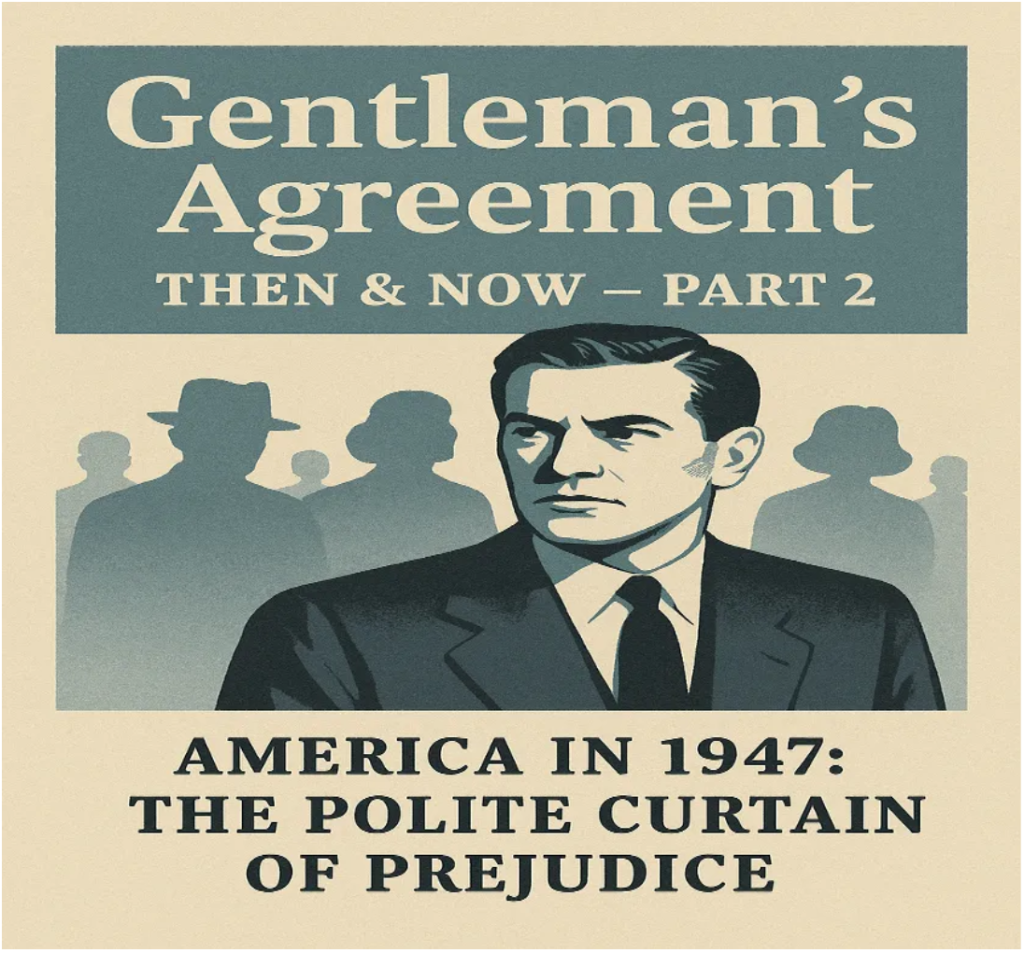
 by Mark M. Bello
In Part 1 of our 5-part series on a century of American anti-Semitism, we explored the origins of Gentleman’s Agreement and the courage it took for a Protestant director, producer, and actor to shine a spotlight on a form of American bigotry that few cared or dared to speak about.
In Part 2, let’s dig deeper into the postwar cultural climate of 1947—a triumphant America has defeated fascism abroad, but is quietly complicit in antisemitism at home. Let’s also take a look at how the film tackled this dangerously passive type of Jew-hatred.
On May 8, 1945, America, Great Britain, and the other Allied countries celebrated VE Day, victory in Europe. In the aftermath of the Allied victory in World War II, the world was exposed to the full horror of the Holocaust. Images from liberated concentration camps, circulated in magazines and newsreels, seared themselves into the American psyche. While America and Americans condemned the atrocities, a quiet, “respectable” form of anti-Semitism continued, even thrived in American cities, boardrooms, country clubs, and suburbs. Sadly, defeating Hitler and the Nazis did not defeat Jew-hatred in America.
As early as 1917, violent American neo-Nazi hate groups were killing Jews and non-white citizens, spreading hate, embracing racism, inciting fear, and committing other acts of violence to articulate their vision of a pure Aryan state. In an ideal Aryan world, non-whites and Jews would be annihilated, segregated, and made subject to the supreme authority of Aryans.
Eugenics, a theory that white people were mentally and physically superior to “darker” races, was extremely popular in the early 20th Century—it formed the basis for Mein Kampf and was the impetus for the Immigration Act of 1924, a U.S. law that permitted unlimited immigration to white Northern Europeans, quotas for darker Southern European whites, and practically zero entry for Africans.
In the 30s and early 40s, famous Americans like Henry Ford, Joseph Kennedy (the former president’s father), and Charles Lindbergh were advocates of eugenic propaganda. By 1939, Nazi-type bigotry was so normal in the United States, the Bund, a group of American Nazis, held a rally at Madison Square Garden in New York to commemorate George Washington’s Birthday. The rally drew over 20,000 fans of Nazism, celebrating “true Americanism.” A giant picture of Washington in uniform, flanked by American flags and a swastika served to emphasize American style fascism.
While this was happening, Lindbergh’s isolationist group, the America First Committee was active, rooted in admiration for the strength of the German air-force and anti-Semitic ideas. In a radio speech in September 1939, Lindbergh argued against fighting Nazis and advocated for the United States to “defend the white race against foreign invasion.”
As the Bund and other bigots were spewing hate, an equally dangerous brand of American anti-Semitism, rarely shouted at rallies or in the streets, was permeating American culture. These Jew-haters wore ties, smiled at passers-by, lived in nice neighborhoods, and used euphemisms. These anti-Semites barred Jews from Ivy League Schools via unspoken and unwritten quotas, refused them executive-level professions and positions, declined their applications to prestigious social and country clubs, and “restricted” Jews from certain hotels and Real Estate developments. The bigots claimed this was nothing personal—it was tradition—a Gentleman’s Agreement, get the idea? Indeed, that’s where the film got its title, and it penetrated like a knife through flesh.
“Gentleman’s Agreement”: A Title Loaded with Irony
To audiences in 1947, the title Gentleman’s Agreement was both instantly recognizable and deliberately ironic. It referred to the unspoken understanding among white Protestant elites that Jewish people were to be excluded from polite society—not by law, but by widespread consent. Like a wink across the golf course or a hotel registry with names mysteriously crossed out, Jews were quietly denied access.
In the film, Phillip Green, played by Gregory Peck, remarks with bitter anguish:
“That’s how it works. Nobody has to say anything, nobody does say anything. They just look a certain way… and you understand.”
The film dramatizes passive complicity, not active hatred, and that is its genius. Green doesn’t battle neo-Nazis—he’s at war with well-meaning citizens who are “personally opposed to discrimination” while never lifting a finger to stop it. Worse, he must clash with those who privately uphold an anti-Semitism rooted in ignorance, fear, comfort, or social climbing.
The film premiered in November 1947, just two years after V-E Day. America was euphoric in victory, beginning to flex global cultural and political muscle. But domestically, veterans were returning home, the Cold War was taking shape, and Americans were nervous. The civil rights movement was at least a decade away.
Darryl F. Zanuck was head of 20th Century Fox. He was also a filmmaker. After being denied membership to a Beverly Hills country club, he suspected anti-Semitism, even though he wasn’t Jewish. He was curious and began to investigate. He discovered that “restricted” policies were everywhere—even in Hollywood.
In response, Zanuck greenlit the adaptation of Laura Z. Hobson’s novel, Gentleman’s Agreement. The film had questionable box office potential, but Zanuck didn’t do it for the Money. He wanted to make a statement, and the backlash was swift and fierce.
But the film was made. It was no phenomenon at the box office, but it did win. Gentleman’s Agreement won the Academy Award for Best Picture in 1948. For a couple of hours in a movie theatre, Americans were forced to look in the mirror and view their own hypocrisy.
The film confronted anti-Semitism head-on and raised uncomfortable questions that continue to echo:
In today’s world—where anti-Semitism surges, “replacement theory” enters mainstream rhetoric, and political leaders either ignore or perpetuate hate in exchange for power—Gentleman’s Agreement is disturbingly relevant.
After all, wink-wink, nod-nod, the film didn’t end the “Agreement.” The “Agreement” continues to evolve.
“Judaism on Trial: Hollywood, McCarthyism, and the Limits of Tolerance”
In the next installment of the series, we’ll examine the tension between Jewish visibility and vulnerability in the postwar years, how the McCarthy era amplified fears, and how Jews were often seen as both insiders and outsiders—never fully accepted—often held uniquely suspect.

Mark M. Bello is an attorney and author of 9 Zachary Blake Legal Thrillers and other legal themed novels and children’s books. For more information, please visit https://www.markmbello.com