Fluctuating Mental Acuity and The Myth of “Normal for Age”
What Does “Normal For Age” Really Mean?
Am I OK?
#1: As Always, Talk to Your Doctor
#2: Take “The Test”
“The Test”, commonly, is either the Mini Mental Status Exam (MMSE) or the Montreal Cognitive Assessment (MoCA). Both are quick, in-office “screening tests” for evaluating cognitive functions (see APPENDIX). Commonly used in primary care to identify those needing more detailed and definitive testing, such screening is required at the Medicare Annual Wellness Visit.
The MMSE, developed in 19751, is the more extensively used tool in both clinical and research settings for evaluating mental status. (NOTE: Any inferences or conclusions that I offer apply equally to the MoCA.) The MMSE has 30 questions and takes 5 to 10 minutes. Scores range from 0 to 30. (Normal: 24–30; Mild cognitive impairment: 18–23; Severe impairment: 0–17) Results are influenced by education level, cultural background, and language. These screening tests are not considered sufficient for a conclusive diagnosis of dementia and should be followed by more comprehensive assessments if impairment is detected. Such formal neurocognitive testing is administering by a specialist and can take the better part of a day.
#3: Interpret Your Score (This can be tricky)
MMSE PASS/FAIL IS GRADED ON A CURVE, and
THE CURVE IS AGE AND EDUCATION:
From K-12 to beyond, cognitive tests have assessed your performance in comparison with your peers, rather than against a fixed pass/fail standard (like a requirement to achieve a fixed percentage of correct answers to pass, like the written driver’s test).
One’s score is most accurate and fair when compared with results from those of similar age and educational background. “Normal” is defined by the results of the group to which you belong. The “Normal Range” is the 68% of scores falling in the middle of the bell-shaped distribution of your group’s results (See figure above) “Normal” MMSE scores are typically 24 – 30 (out of 30). Our absolute scores tend to decline with increasing age, with higher levels of education yielding higher average scores. For instance, individuals with at least nine years of schooling had a median score of 29, those with five to eight years scored 26, and those with zero to four years scored 22. One’s comparison group is a subset of one of seven age groups and four education levels.2 It’s not simple: Older adults or those with less formal education may score slightly lower on the MMSE even if they’re unimpaired. A 30-year-old with a college degree might be expected to score a perfect 30/30. A 78-year-old with a 6th-grade education might still be considered “normal” with a score of 22–24.
#4: “Failing” score? Go back to #1
#5: Q: “Normal” score! Am I Good to Go?
A: No, Not Really!
How Does One Distinguish Between These Two Conditionswith the Same “Normal” Test Results?
When One (SCD) is Twice as Likely to Lead to Alzheimer’s Disease?
You can ask yourself the “SCD Question”:
In this age of artificial intelligence, 12th generation scanners and uber-diagnostic micromolecules, it turns out that the conclusive test separating normal aging from an increased chance of Alzheimer’s disease is the answer to a simple question:
HOW DO YOU FEEL ABOUT YOUR MEMORY AND COGNITION?
(Thus, the label: “Subjective” Cognitive Decline)
The post Fluctuating Mental Acuity and The Myth of “Normal for Age” appeared first on ouragingbrains.
Originally Published on https://agingoralzheimers.com/
Kenneth Frumkin, PhD, MD, FACEP studied physiological psychology (the interaction of the body’s basic biologic mechanisms with behavior) in college and graduate school. He earned his Masters and Ph.D. degrees from McGill University for his work on the relative contributions of nature and nurture to the ingrained survival mechanism of poison-avoidance in rats. After two years of research at the U.S. Army’s Biomedical Laboratories, Ken went on to medical school and a residency in emergency medicine. His 36-year medical career was split between community hospital emergency departments and teaching, research, and practice in military academic medical centers.
Board-certified in his specialty, Dr. Frumkin is the author of over three dozen peer-reviewed publications and textbook chapters in psychology and medicine. His article “How to Survive the Emergency Room” published in the AARP Bulletin, was a 2022 National Mature Media Merit Award winner. A complete list of publications and complete resume are at www.linkedin.com/in/KennethFrumkinPhDMD . A Fellow and Life Member of the American College of Emergency Physicians and their Geriatric Emergency Medicine Section, Dr. Frumkin is also an Emeritus member of the Society for Academic Emergency Medicine and their Academy of Geriatric Emergency Medicine. Having retired as a civilian employee of the Department of the Navy in 2017, Dr. Frumkin is currently a volunteer member of the academic faculty at the Emergency Medicine Residency, Naval Medical Center, Portsmouth, Virginia.
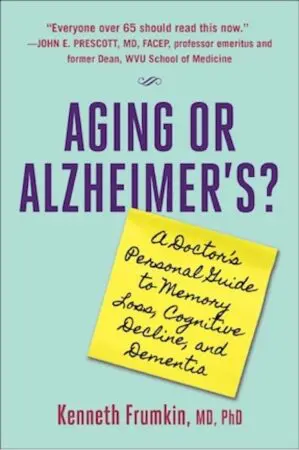
Dr. Frumkin writes from the perspective of a practiced author and researcher and, most importantly, as a fellow boomer with “skin in the game.” He, too, is seeking the answers to nearly every older-person’s questions about their fluctuating memories and the possibility of progressive cognitive decline. His book "Aging or Alzheimer’s? A Doctor’s Personal Guide to Memory Loss, Cognitive Decline, and Dementia" comes out November 5, 2024. (AgingOrAlzheimers.com)





 Low risk for progression to dementia
 Elevated risk for progression to Mild Cognitive Impairment and AD