


n
He said this with a sneer dripping off the word coach that you could smell across the room.
n
The problem was we were not really hired as consultants, at least not as he was defining a consultant. We were hired to teach a client coaches how to support continuous improvement (CI).
n
Client coaches attended advanced u00a0CI training u00a0and coached projects run by the business units. Each client coach was assigned a u201cconsultant coachu201d to help them with difficult problems.
n
This u201cconsultant,u201d an independent contractor, was ignoring his client coach and doing calculations, taking measurements, running experiments. In short he was ingratiating himself with the business unit leader and undermining the client coach and the project.
n
u201cWork is getting done and Tony (the business unit leader) loves itu201d the u201cconsultant said obstinately.
n
u201cYes, but nobody is learning anything,u201d I countered.
n
This was u00a0one of many painful conversations. He was better at all the things he was doing, but he couldnu2019t understand that his role was to teach not do. Ultimately, this consultant had to be removed from the project.
n
In fairness, many u201cexpertu201d independent consultants are hired as an u201cextra pair of handsu201d to do a difficult task. Competency transfer isnu2019t an expectation.
n
n
A coach is someone who helps and individual or a group develop competency (knowledge and skill), helps them learn in the context of a goal.
n
There are all kinds of coaches, singers vocal coaches, acting coaches, life coaches, spiritual guides, the tech help desk, executive coaches, change coaches, book publishing coaches, and so on.. They all teach (or help you learn) in the context of a goal.
n
Many people have an understanding of what a coach is from sports, Knute Rockne of Notre Dame football, John Wooden of UCLA basketball. Sports coaches often have the reputation of being motivational u201cass-kickers.u201d These coaches have the advantage of working with top players with a crystal clear goal, u201cwinning.u201d Sports coaches at top levels may not use much positive feedback; they can leave that to the cheering fans.
n
Business coaches use positive feedback more. Whether a manager or a consultant, these coaches take the u201cplayeru201d u201cas-isu201d with limitations and may clarify the goal as well as shape performance to achieve it. A business coach may also have to help move from competency to capability by adding review processes and other support structures to maintain competency.
n
My first management training had a half day of u201ccoaching and counsellingu201d. Coaching in the definition of this course was helping people perform better. Counselling was problem solving u00a0with difficult employees. I imagine that there are still managers who practice coaching as a part of their job, but many organizations hire external coaches.
n
n
Companies hire third party coaches for many reasons:
n
n
n
n
n
n
n
An entire business coaching industry has sprung up. There are individual coaches and coaching companies. There are many books, coaching models, and coach training and certifications programs.
n
Some consultants have decided to earn a living as full-time coaches. I never wanted to do that, but I came to believe that at a minimum consultants should learn coaching skills because coaching characterizes most senior level client Relationships. The vaunted u201cTrusted Advisoru201d consulting relationship at the CEO level is a coaching relationship, unfiltered feedback and goal-centered leadership development.
n
n
I have read enough testimonials about coaches u00a0(in sports, theatre, music, u00a0etc.) to recognize certain themes:
n
n
n
n
n
n
In my view good coaches have a strong similar set of core values. Coaches have knowledge and skill in what they are coaching. A Bill Belichick (New England Patriots coach) who had never seen a football wouldnu2019t be very effective. The coach may not be the best ever in the game, but what they have is the ability to transfer competency. The best coaches evaluate the player, determine what is needed and deliver motivation and a learning at the right time. They also understand the coaching process.
n
n
Most good coaches have underlying values and beliefs: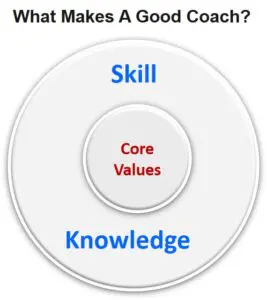
n
n
n
n
n
Good Coaches are
n
n
n
n
I can think of successful coaches who donu2019t have one of these values, but they have a strength in the other values that overcomes that deficiency.
n
You canu2019t train values. You canu2019t train the specialized content knowledge and skill You select for those attributes. You can train coaching skills around a coaching model..
n
n
There are many coaching models, all with clever acronym names, OSKAR, GROW, STEPPA, CLEAR, ACL, etc. The model I used was taught to me by Alan Moore, au00a0 Glaswegian Scot, and one of the gentlest souls I ever met. I worked with Alan on several continuous improvement initiatives in the oil and gas industry.
n
I like Alanu2019s model because it is simple and easy to understand.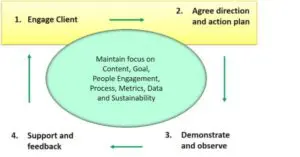
n
It is sequential, and a good conceptual framework on which to hang knowledge and skill.
n
n
n
n
n
n
n
n
n
n
The important element of engagement is the clientu2019s choice to engage and learn.
n
n
n
n
n
n
n
n
n
n
n
n
n
n
n
n
Coaching is a learning intervention. If people (Including me) always learned what they need to it would be a much better world. Coaching doesnu2019t always work.
n
I had major disagreements with one boss. We each felt a lack of respect. He hired a coach to teach me u201chow to talk to him respectfully.u201d I suggested the coach facilitate conflict resolution with us both. My boss declined. The coach resigned.
n
Ultimately I went to see my bossu2019s office and closed the door. We u201ccleared the airu2019 and things were better for a while, but I then I stepped on his toes again and he stomped on mine and I left the company.
n
Fully half the problem was my ignorance and arrogance, but not all of it. Coaching didnu2019t work.
n
n
The biggest breakdown is in engagement stage and the biggest part of engagement is the client must u00a0choose to be coached. Here are two categories about why coaching might not work.
n
n
Adults learn what they choose to learn, so if the board u201ctellsu201d a CEO that he needs to be more u201cempathetic,u201d when his entire career has been built on drive and not tolerating inaction, then this CEO may not be open to a u201csoftly-softly-make niceu201d coach. This is one point of Marshal Goldsmithu2019s book, What Got You Here Wonu2019t Get You There. Find a goal, a purpose for people to change and underinvesting in the u201cwhyu201d may lead to failure.
n
n
Perhaps the problem the client faces isnu2019t one the coach hasnu2019t faced before. Perhaps the coach didnu2019t do research on the industry, or accepted another personu2019s assessment of the problem. Maybe the problem is beyond the scope of the coaches capabilities, as when a client wanted to talk about his Marriage and I recommended that he consult with a trained psychotherapist.
n
So coaching doesnu2019t always work. The hard part is lack of outcome control; the client must act.
n
n
If a consultant learns coaching skills, I believe it increases project sustainability because the client has learned and is therefore more likely to act to maintain results. So most change programs can be enhanced by coaching.
n
It may increase consultant promotability. I mentioned earlier that senior relationships are coaching relationships. Partners at big consulting firms may have two or three such relationships.
n
It may improve the image of the industry. Consultants are often described as u201chaving an opinion on everything without the benefit of experience.u201d. Coaches typically listen more and that may help perceptions.
“,”tablet”:”
n
He said this with a sneer dripping off the word coach that you could smell across the room.
n
The problem was we were not really hired as consultants, at least not as he was defining a consultant. We were hired to teach a client coaches how to support continuous improvement (CI).
n
Client coaches attended advanced CI training and coached projects run by the business units. Each client coach was assigned a u201cconsultant coachu201d to help them with difficult problems.
n
This u201cconsultant,u201d an independent contractor, was ignoring his client coach and doing calculations, taking measurements, running experiments. In short he was ingratiating himself with the business unit leader and undermining the client coach and the project.
n
u201cWork is getting done and Tony (the business unit leader) loves itu201d the u201cconsultant said obstinately.
n
u201cYes, but nobody is learning anything,u201d I countered.
n
This was one of many painful conversations. He was better at all the things he was doing, but he couldnu2019t understand that his role was to teach not do. Ultimately, this consultant had to be removed from the project.
n
In fairness, many u201cexpertu201d independent consultants are hired as an u201cextra pair of handsu201d to do a difficult task. Competency transfer isnu2019t an expectation.
n
n
A coach is someone who helps and individual or a group develop competency (knowledge and skill), helps them learn in the context of a goal.
n
There are all kinds of coaches, singers vocal coaches, acting coaches, life coaches, spiritual guides, the tech help desk, executive coaches, change coaches, book publishing coaches, and so on.. They all teach (or help you learn) in the context of a goal.
n
Many people have an understanding of what a coach is from sports, Knute Rockne of Notre Dame football, John Wooden of UCLA basketball. Sports coaches often have the reputation of being motivational u201cass-kickers.u201d These coaches have the advantage of working with top players with a crystal clear goal, u201cwinning.u201d Sports coaches at top levels may not use much positive feedback; they can leave that to the cheering fans.
n
Business coaches use positive feedback more. Whether a manager or a consultant, these coaches take the u201cplayeru201d u201cas-isu201d with limitations and may clarify the goal as well as shape performance to achieve it. A business coach may also have to help move from competency to capability by adding review processes and other support structures to maintain competency.
n
My first management training had a half day of u201ccoaching and counsellingu201d. Coaching in the definition of this course was helping people perform better. Counselling was problem solving with difficult employees. I imagine that there are still managers who practice coaching as a part of their job, but many organizations hire external coaches.
n
n
Companies hire third party coaches for many reasons:
n
n
n
n
n
n
n
An entire business coaching industry has sprung up. There are individual coaches and coaching companies. There are many books, coaching models, and coach training and certifications programs.
n
Some consultants have decided to earn a living as full-time coaches. I never wanted to do that, but I came to believe that at a minimum consultants should learn coaching skills because coaching characterizes most senior level client relationships. The vaunted u201cTrusted Advisoru201d consulting relationship at the CEO level is a coaching relationship, unfiltered feedback and goal-centered leadership development.
n
n
I have read enough testimonials about coaches (in sports, theatre, music, etc.) to recognize certain themes:
n
n
n
n
n
n
In my view good coaches have a strong similar set of core values. Coaches have knowledge and skill in what they are coaching. A Bill Belichick (New England Patriots coach) who had never seen a football wouldnu2019t be very effective. The coach may not be the best ever in the game, but what they have is the ability to transfer competency. The best coaches evaluate the player, determine what is needed and deliver motivation and a learning at the right time. They also understand the coaching process.
n
n
Most good coaches have underlying values and beliefs:
n
n
n
n
n
Good Coaches are
n
n
n
n
I can think of successful coaches who donu2019t have one of these values, but they have a strength in the other values that overcomes that deficiency.
n
You canu2019t train values. You canu2019t train the specialized content knowledge and skill You select for those attributes. You can train coaching skills around a coaching model..
n
n
There are many coaching models, all with clever acronym names, OSKAR, GROW, STEPPA, CLEAR, ACL, etc. The model I used was taught to me by Alan Moore, a Glaswegian Scot, and one of the gentlest souls I ever met. I worked with Alan on several continuous improvement initiatives in the oil and gas industry.
n
I like Alanu2019s model because it is simple and easy to understand.
n
It is sequential, and a good conceptual framework on which to hang knowledge and skill.
n
n
n
n
n
n
n
n
n
n
The important element of engagement is the clientu2019s choice to engage and learn.
n
n
n
n
n
n
n
n
n
n
n
n
n
n
n
n
Coaching is a learning intervention. If people (Including me) always learned what they need to it would be a much better world. Coaching doesnu2019t always work.
n
I had major disagreements with one boss. We each felt a lack of respect. He hired a coach to teach me u201chow to talk to him respectfully.u201d I suggested the coach facilitate conflict resolution with us both. My boss declined. The coach resigned.
n
Ultimately I went to see my bossu2019s office and closed the door. We u201ccleared the airu2019 and things were better for a while, but I then I stepped on his toes again and he stomped on mine and I left the company.
n
Fully half the problem was my ignorance and arrogance, but not all of it. Coaching didnu2019t work.
n
n
The biggest breakdown is in engagement stage and the biggest part of engagement is the client must choose to be coached. Here are two categories about why coaching might not work.
n
n
Adults learn what they choose to learn, so if the board u201ctellsu201d a CEO that he needs to be more u201cempathetic,u201d when his entire career has been built on drive and not tolerating inaction, then this CEO may not be open to a u201csoftly-softly-make niceu201d coach. This is one point of Marshal Goldsmithu2019s book, What Got You Here Wonu2019t Get You There. Find a goal, a purpose for people to change and underinvesting in the u201cwhyu201d may lead to failure.
n
n
Perhaps the problem the client faces isnu2019t one the coach hasnu2019t faced before. Perhaps the coach didnu2019t do research on the industry, or accepted another personu2019s assessment of the problem. Maybe the problem is beyond the scope of the coaches capabilities, as when a client wanted to talk about his marriage and I recommended that he consult with a trained psychotherapist.
n
So coaching doesnu2019t always work. The hard part is lack of outcome control; the client must act.
n
n
If a consultant learns coaching skills, I believe it increases project sustainability because the client has learned and is therefore more likely to act to maintain results. So most change programs can be enhanced by coaching.
n
It may increase consultant promotability. I mentioned earlier that senior relationships are coaching relationships. Partners at big consulting firms may have two or three such relationships.
n
It may improve the image of the industry. Consultants are often described as u201chaving an opinion on everything without the benefit of experience.u201d. Coaches typically listen more and that may help perceptions.
n
n
“,”phone”:”
n
n
He said this with a sneer dripping off the word coach that you could smell across the room.
n
The problem was we were not really hired as consultants, at least not as he was defining a consultant. We were hired to teach a client coaches how to support continuous improvement (CI).
n
Client coaches attended advanced CI training and coached projects run by the business units. Each client coach was assigned a u201cconsultant coachu201d to help them with difficult problems.
n
This u201cconsultant,u201d an independent contractor, was ignoring his client coach and doing calculations, taking measurements, running experiments. In short he was ingratiating himself with the business unit leader and undermining the client coach and the project.
n
u201cWork is getting done and Tony (the business unit leader) loves itu201d the u201cconsultant said obstinately.
n
u201cYes, but nobody is learning anything,u201d I countered.
n
This was one of many painful conversations. He was better at all the things he was doing, but he couldnu2019t understand that his role was to teach not do. Ultimately, this consultant had to be removed from the project.
n
In fairness, many u201cexpertu201d independent consultants are hired as an u201cextra pair of handsu201d to do a difficult task. Competency transfer isnu2019t an expectation.
n
n
A coach is someone who helps and individual or a group develop competency (knowledge and skill), helps them learn in the context of a goal.
n
There are all kinds of coaches, singers vocal coaches, acting coaches, life coaches, spiritual guides, the tech help desk, executive coaches, change coaches, book publishing coaches, and so on.. They all teach (or help you learn) in the context of a goal.
n
Many people have an understanding of what a coach is from sports, Knute Rockne of Notre Dame football, John Wooden of UCLA basketball. Sports coaches often have the reputation of being motivational u201cass-kickers.u201d These coaches have the advantage of working with top players with a crystal clear goal, u201cwinning.u201d Sports coaches at top levels may not use much positive feedback; they can leave that to the cheering fans.
n
Business coaches use positive feedback more. Whether a manager or a consultant, these coaches take the u201cplayeru201d u201cas-isu201d with limitations and may clarify the goal as well as shape performance to achieve it. A business coach may also have to help move from competency to capability by adding review processes and other support structures to maintain competency.
n
My first management training had a half day of u201ccoaching and counsellingu201d. Coaching in the definition of this course was helping people perform better. Counselling was problem solving with difficult employees. I imagine that there are still managers who practice coaching as a part of their job, but many organizations hire external coaches.
n
n
Companies hire third party coaches for many reasons:
n
n
n
n
n
n
n
An entire business coaching industry has sprung up. There are individual coaches and coaching companies. There are many books, coaching models, and coach training and certifications programs.
n
Some consultants have decided to earn a living as full-time coaches. I never wanted to do that, but I came to believe that at a minimum consultants should learn coaching skills because coaching characterizes most senior level client relationships. The vaunted u201cTrusted Advisoru201d consulting relationship at the CEO level is a coaching relationship, unfiltered feedback and goal-centered leadership development.
n
n
I have read enough testimonials about coaches (in sports, theatre, music, etc.) to recognize certain themes:
n
n
n
n
n
n
In my view good coaches have a strong similar set of core values. Coaches have knowledge and skill in what they are coaching. A Bill Belichick (New England Patriots coach) who had never seen a football wouldnu2019t be very effective. The coach may not be the best ever in the game, but what they have is the ability to transfer competency. The best coaches evaluate the player, determine what is needed and deliver motivation and a learning at the right time. They also understand the coaching process.
n
n
Most good coaches have underlying values and beliefs:
n
n
n
n
n
Good Coaches are
n
n
n
n
I can think of successful coaches who donu2019t have one of these values, but they have a strength in the other values that overcomes that deficiency.
n
You canu2019t train values. You canu2019t train the specialized content knowledge and skill You select for those attributes. You can train coaching skills around a coaching model..
n
n
There are many coaching models, all with clever acronym names, OSKAR, GROW, STEPPA, CLEAR, ACL, etc. The model I used was taught to me by Alan Moore, a Glaswegian Scot, and one of the gentlest souls I ever met. I worked with Alan on several continuous improvement initiatives in the oil and gas industry.
n
I like Alanu2019s model because it is simple and easy to understand.
n
It is sequential, and a good conceptual framework on which to hang knowledge and skill.
n
n
n
n
n
n
n
n
n
n
The important element of engagement is the clientu2019s choice to engage and learn.
n
n
n
n
n
n
n
n
n
n
n
n
n
n
n
n
Coaching is a learning intervention. If people (Including me) always learned what they need to it would be a much better world. Coaching doesnu2019t always work.
n
I had major disagreements with one boss. We each felt a lack of respect. He hired a coach to teach me u201chow to talk to him respectfully.u201d I suggested the coach facilitate conflict resolution with us both. My boss declined. The coach resigned.
n
Ultimately I went to see my bossu2019s office and closed the door. We u201ccleared the airu2019 and things were better for a while, but I then I stepped on his toes again and he stomped on mine and I left the company.
n
Fully half the problem was my ignorance and arrogance, but not all of it. Coaching didnu2019t work.
n
n
The biggest breakdown is in engagement stage and the biggest part of engagement is the client must choose to be coached. Here are two categories about why coaching might not work.
n
n
Adults learn what they choose to learn, so if the board u201ctellsu201d a CEO that he needs to be more u201cempathetic,u201d when his entire career has been built on drive and not tolerating inaction, then this CEO may not be open to a u201csoftly-softly-make niceu201d coach. This is one point of Marshal Goldsmithu2019s book, What Got You Here Wonu2019t Get You There. Find a goal, a purpose for people to change and underinvesting in the u201cwhyu201d may lead to failure.
n
n
Perhaps the problem the client faces isnu2019t one the coach hasnu2019t faced before. Perhaps the coach didnu2019t do research on the industry, or accepted another personu2019s assessment of the problem. Maybe the problem is beyond the scope of the coaches capabilities, as when a client wanted to talk about his marriage and I recommended that he consult with a trained psychotherapist.
n
So coaching doesnu2019t always work. The hard part is lack of outcome control; the client must act.
n
n
If a consultant learns coaching skills, I believe it increases project sustainability because the client has learned and is therefore more likely to act to maintain results. So most change programs can be enhanced by coaching.
n
It may increase consultant promotability. I mentioned earlier that senior relationships are coaching relationships. Partners at big consulting firms may have two or three such relationships.
n
It may improve the image of the industry. Consultants are often described as u201chaving an opinion on everything without the benefit of experience.u201d. Coaches typically listen more and that may help perceptions.
n
n
n
n
n
n
n
n
“}},”slug”:”et_pb_text”}” data-et-multi-view-load-tablet-hidden=”true” data-et-multi-view-load-phone-hidden=”true”>
He said this with a sneer dripping off the word coach that you could smell across the room.
The problem was we were not really hired as consultants, at least not as he was defining a consultant. We were hired to teach a client coaches how to support continuous improvement (CI).
Client coaches attended advanced CI training and coached projects run by the business units. Each client coach was assigned a “consultant coach” to help them with difficult problems.
This “consultant,” an independent contractor, was ignoring his client coach and doing calculations, taking measurements, running experiments. In short he was ingratiating himself with the business unit leader and undermining the client coach and the project.
“Work is getting done and Tony (the business unit leader) loves it” the “consultant said obstinately.
“Yes, but nobody is learning anything,” I countered.
This was one of many painful conversations. He was better at all the things he was doing, but he couldn’t understand that his role was to teach not do. Ultimately, this consultant had to be removed from the project.
In fairness, many “expert” independent consultants are hired as an “extra pair of hands” to do a difficult task. Competency transfer isn’t an expectation.
A coach is someone who helps and individual or a group develop competency (knowledge and skill), helps them learn in the context of a goal.
There are all kinds of coaches, singers vocal coaches, acting coaches, life coaches, spiritual guides, the tech help desk, executive coaches, change coaches, book publishing coaches, and so on.. They all teach (or help you learn) in the context of a goal.
Many people have an understanding of what a coach is from sports, Knute Rockne of Notre Dame football, John Wooden of UCLA basketball. Sports coaches often have the reputation of being motivational “ass-kickers.” These coaches have the advantage of working with top players with a crystal clear goal, “winning.” Sports coaches at top levels may not use much positive feedback; they can leave that to the cheering fans.
Business coaches use positive feedback more. Whether a manager or a consultant, these coaches take the “player” “as-is” with limitations and may clarify the goal as well as shape performance to achieve it. A business coach may also have to help move from competency to capability by adding review processes and other support structures to maintain competency.
My first management training had a half day of “coaching and counselling”. Coaching in the definition of this course was helping people perform better. Counselling was problem solving with difficult employees. I imagine that there are still managers who practice coaching as a part of their job, but many organizations hire external coaches.
Companies hire third party coaches for many reasons:
An entire business coaching industry has sprung up. There are individual coaches and coaching companies. There are many books, coaching models, and coach training and certifications programs.
Some consultants have decided to earn a living as full-time coaches. I never wanted to do that, but I came to believe that at a minimum consultants should learn coaching skills because coaching characterizes most senior level client relationships. The vaunted “Trusted Advisor” consulting relationship at the CEO level is a coaching relationship, unfiltered feedback and goal-centered leadership development.
I have read enough testimonials about coaches (in sports, theatre, music, etc.) to recognize certain themes:
In my view good coaches have a strong similar set of core values. Coaches have knowledge and skill in what they are coaching. A Bill Belichick (New England Patriots coach) who had never seen a football wouldn’t be very effective. The coach may not be the best ever in the game, but what they have is the ability to transfer competency. The best coaches evaluate the player, determine what is needed and deliver motivation and a learning at the right time. They also understand the coaching process.
Most good coaches have underlying values and beliefs:
Good Coaches are
I can think of successful coaches who don’t have one of these values, but they have a strength in the other values that overcomes that deficiency.
You can’t train values. You can’t train the specialized content knowledge and skill You select for those attributes. You can train coaching skills around a coaching model..
There are many coaching models, all with clever acronym names, OSKAR, GROW, STEPPA, CLEAR, ACL, etc. The model I used was taught to me by Alan Moore, a Glaswegian Scot, and one of the gentlest souls I ever met. I worked with Alan on several continuous improvement initiatives in the oil and gas industry.
I like Alan’s model because it is simple and easy to understand.
It is sequential, and a good conceptual framework on which to hang knowledge and skill.
The important element of engagement is the client’s choice to engage and learn.
Coaching is a learning intervention. If people (Including me) always learned what they need to it would be a much better world. Coaching doesn’t always work.
I had major disagreements with one boss. We each felt a lack of respect. He hired a coach to teach me “how to talk to him respectfully.” I suggested the coach facilitate conflict resolution with us both. My boss declined. The coach resigned.
Ultimately I went to see my boss’s office and closed the door. We “cleared the air’ and things were better for a while, but I then I stepped on his toes again and he stomped on mine and I left the company.
Fully half the problem was my ignorance and arrogance, but not all of it. Coaching didn’t work.
The biggest breakdown is in engagement stage and the biggest part of engagement is the client must choose to be coached. Here are two categories about why coaching might not work.
Adults learn what they choose to learn, so if the board “tells” a CEO that he needs to be more “empathetic,” when his entire career has been built on drive and not tolerating inaction, then this CEO may not be open to a “softly-softly-make nice” coach. This is one point of Marshal Goldsmith’s book, What Got You Here Won’t Get You There. Find a goal, a purpose for people to change and underinvesting in the “why” may lead to failure.
Perhaps the problem the client faces isn’t one the coach hasn’t faced before. Perhaps the coach didn’t do research on the industry, or accepted another person’s assessment of the problem. Maybe the problem is beyond the scope of the coaches capabilities, as when a client wanted to talk about his marriage and I recommended that he consult with a trained psychotherapist.
So coaching doesn’t always work. The hard part is lack of outcome control; the client must act.
If a consultant learns coaching skills, I believe it increases project sustainability because the client has learned and is therefore more likely to act to maintain results. So most change programs can be enhanced by coaching.
It may increase consultant promotability. I mentioned earlier that senior relationships are coaching relationships. Partners at big consulting firms may have two or three such relationships.
It may improve the image of the industry. Consultants are often described as “having an opinion on everything without the benefit of experience.”. Coaches typically listen more and that may help perceptions.
The post Coaching Skills for Consultants appeared first on Wisdom from Unusual Places.
Originally Published on https://wisdomfromunusualplaces.com/blog/